What do you do when EVERYTHING is Going WRONG?
Games in This Video
5 games are featured in this video — they unlock as you watch.




Transcript
What do you do when things go wrong? It's a simple question and has one of the most complex answers in life. But life is not the only place we deal with this question. We deal with this question really everywhere and especially in board games. No matter what you do, how much you plan, everything you put exactly right, the one thing I can guarantee you in both life and board games is that eventually something will go wrong. For me today, that has been navigating one of my first big road trips and work trips combined with the baby. I should have a video up right now. I mean, as I'm filming this, I should have had time to sit and edit it. contract. The photography session that we have to do should have been shot yesterday. The baby shouldn't have gotten car sick. We shouldn't have left at 3:00 a.m. and drove all night. The place where we were going to stay should have still had an open bed. But it turns out it didn't. The only question we have is to determine what are we going to do about it. One of the great values, in my opinion, to playing board games is the ability to navigate and answer this exact question. What do you do when stuff hasn't quite worked out the way you intended? Board games give us a small abstraction, a little picture into the greater questions of life. how to
delay gratification, how to problem solve and think, how to innovate and be creative with the way that you stretch the various different skills your mind has. It can help us with simple skills, spelling and math. It can allow our dexterity to become a little bit more fine-tuned. I mean, my great-grandmother played Jeopardy, sort of a digital board game or a word puzzle, and Scrabble and uh those weird mathematical square problems for the entirety of her life. and her brain was sharp all the way up to 102. In fact, all the way up until she passed, maybe maybe 6 months beforehand due to a fall, my great-grandmother was able to beat any of us, young, old, her children, her grandchildren, her great-grandchildren, at most of the games she'd been playing for at least the last decade. And that's not just skill necessarily. It was also her ability to hold on to information, retain the function of her mind, and that's something that board games uniquely allow us to do. Why do you think the New York Times crossword puzzle has been one of the most popular sections for, I don't know, since it was created, which is way before I and my son ever existed. So, board games let us problem solve, right? They let us deal with the questions that we face and encounter in real life. So, how does that apply to this situation? And that's the area where I I don't actually quite
have an answer. Can I think of a game that allows me to think on my feet? Well, certainly. A game that perfectly replicates road trips across the country? Well, maybe. Theoretically. Can I think of a game that specifically has you on an adventure with your 13 or 14month-old son where he has car sickness. You leave way too late. You haven't got the work done that you needed to do. the contract that you were going to do is delayed and you're doing your best to manage it all at the same time. No, not exactly. But I can think of games that relate. And even if they don't relate perfectly, I can think of time think of times when I was stressed and pressured and dazed and confused that I had to decide either to move forward, think differently, strategize in a unique way or what? give up, quit, walk away from the game. And you can do that sometimes in board games. I mean, after all, board games are predictable. You can tell that you're getting to the end of the story in a couple hours, 30 minutes or so. But in life, well, life isn't predictable.
There's no end to the story in sight. And so, you have to adapt. You have to think creatively. You have to do your best to try and figure it all out. Board games teach us all of that. They teach us how to manage risks, deal with problems as they arrive, and handle some of the more complex but guaranteed situations in life. Now, I just got done filming on top of everything that's gone on this wonderful 11 minute monologue to go at the very end of this video. I'm re-recording it right now for you because my microphone was dead. So, or actually not on. I turned it off earlier to save battery and ended up ruining the last take. And the last take was excellent, but it's not the one you get.
It had the baby screaming in the back. One little foot popping out the side of the high chair there, or the uh booster seat, whatever it's called. I'm getting it completely wrong. Car seat. That makes sense. That's about the most obvious thing that it could have been. It's been a long day. It's been a long trip. The photo shoot is moving along well, and chaos still reigns in life. So, let's bring it back to board games. Board games for me give us an interesting and unique opportunity to learn how to manage the the greater areas of our life. The areas that seem to cascade into neverending failure to successes or wins. the areas where even if something unexpected hasn't happened, but the expected itself is challenging or chaotic, board games give us a chance to experiment.
And I know it's not a onetoone comparison. And there's not a board game out there that perfectly replicates the challenges that we have in life. But the practice of actively engaging in challenge, of directing your mind in a way so that you problem solve, you think of alternative routes, you embrace the little mild bit of stress and chaos that board games throw at us. I'm not going to necessarily be able to fight down a zombie plague and I certainly am not prepared for a new business venture in the Silk Road or very dynamic trading system of the Western European alcohol market. However, I might be a little bit better. I might be a little bit more adapted at dealing with little things as they come up. a roads closed that I was planning on taking all the way back home. An accident happened and now me and many other people have to reroute. Well, are there alternatives? Can I route down a pathway that doesn't necessarily lose me a lot of time, but also might save me a buck or two when it comes to tolls, or are there toll roads available that I could take? Could I wind my way across back roads and private uh you know uh private gravel driveways as ways sometimes has you do if you're driving with Google Maps. Have you checked the other options and seen what route they try to direct you on? Each one accommodating for and responding as traffic conditions change with the flow.
If my child throws up in the back seat, do I immediately become stressed, throw a fit, blame him, or blame myself or blame my wife who isn't even here, or do I address it and deal with it patiently, one step at a time, trying to figure out exactly what the next thing should be? and calculating in the back of my head, well, I only have this many resources left. So, if this happens again, I will have to make a run to the, you know, local Walmart or Target and pick up a few extra pairs of clothes. All of that ties into board games. Where I see it tie the most specifically, the most directly is in the cooperative board game genre and in the solo board game genre. And as I'm talking through these, I would love for you all who understand what I'm trying to say to maybe communicate it in a more accessible way or share with me the board games that stand out to you as games that have taught something. games that have given you an instruction, not a list of exactly how to overcome a task, but instead they gave you practice at managing risk, at balancing chaos, and they allowed you to be a little bit more steadfast when the time came. And we're only talking about gradual amounts, but for most of us, gradual amounts of progress are the most substantial option for progress that we have. You're either moving
forward or you're sliding slowly backwards without even realizing it. In the cooperative game market, I can think of a lot of games, but some of the first ones that come to mind are games like Pandemic or the Forbidden Game series. And I'm not a fan of either of those games. Maybe I need to practice being on teams a little bit more. But both of them paint interesting challenges and allow players to deal with them. And as my son grows older and hopefully our family expands, I can for sure see myself sitting down with a couple of the forbidden games to approach the puzzle solving nature of board games to look at how one might rely on a team or think dynamically when given a hard or challenging situation that they need to address. Forbidden games have each of you play your role, much like life, and then they allow each of you to tackle that role and rely on the other people to do so in order to mitigate the chaos that is sure to come and is going to continue descending until one of you either wins or loses.
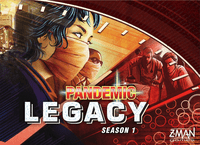
Pandemic is another escalating failure system. And Pandemic Legacy, not only that, but adds on top of it the idea that the choices you make throughout the course of the game have consequences that extend well beyond the scenario that you're playing. You abandon one region to save another. Suddenly, you're thinking about the ripple effects that that might have. And isn't that true in a lot of areas of our life? I decided to travel with a baby. There were a lot of ripple effects associated with that. I decided to head out early where the contract had the potential to be delayed instead of knowing for sure that it was going to happen. And sure enough, the contract did. The photography sessions happening a day after it was originally supposed to happen. Meaning the baby and I have had a long drive and a rough night and both of us are ready to hit the road home and our journey isn't even completely over.
I could see myself sitting down and playing through a game of pandemic legacy and not emphasizing these points directly, but instead inviting the opportunity for questions or for thought to exist while we play. Oh, you want to make that choice? Interesting. Well, what do you think might happen in a later scenario if we let Brazil get entirely infected? How might that affect the surrounding regions? And should we do our best to mitigate that? Games help with stress and frustration with a surprise loss that comes at the hands of a boss that just showed up to the table. Cooperative games like Kingdom Death Monster provide you not only a dynamic puzzle to try to solve, but also emphasize the team building, the nature of some sacrifices needing to be made so that we can progress, we can move forward. I just got a text from my father-in-law saying that my son needs his diaper changed and I'm on the way out to grab a lighter cuz we don't have what we need for the photo shoot and the battery on this camera is about to die.
Everything is going well. And at the same time, in many ways, everything is chaos and unmanageable and slightly falling apart. In cooperative games, it's pretty obvious to see where stress management might exist. And in solo games, you give yourself the opportunity to deal with challenges that you sometimes face when you're on your own because those happen as well, whether they're internal personal struggles or external ones like the road trip with my son without anyone else here to help. And I know he is another person, but he's not the most effective at changing his own diaper yet or wiping up puke when it's all over the car seat. There's solo games that I think of, games like Robinson Caruso or Friday. Those games provide you this small little test run to see where your instincts might be right. They give you the chance to to to risk mitigate to to choose to take uh that extra resource or choose to take that extra challenge to stretch a little farther to get a little more. And who knows if it's the right call or not? And you can play games enough that you're pretty darn certain what the mathematical probability is.
And in life, that's true as well. But most of the time, you don't have that opportunity. So sitting down with a new puzzle, one that you might be loosely familiar with, but taking on a new challenge gives you the chance to see how good your instincts are. When risks approach your door, do you make the right call more often than not? Board games give us a tiny little micro version of that. and risks will show up at your door. Challenges will approach. And again, it's not that if you make the perfect decision in every single instance in a board game, you'll do so in life. But I would bet the odds are in your favor. That the more experiences you have making tough decisions when tough decisions are needed. to sacrifice one player in order to save the team, to push a little bit farther to get the resources you need, to extend the journey, to press your luck and hopefully score a little bit more. I would venture to guess that in those situations, if you've learned to make the right call, you'll be slightly better at making the right call when the situations are a little bit more desperate and a little bit more dire.
How quickly do we make it to the hospital? How many red lights do we run? When do I call and let the family know that something drastic has happened or dramatic has changed? How far do we push? How much lack of sleep and overwork are we as a couple or a family or a person able to bear? How far do we go out of the way to visit for the holidays? How hard do we avoid uncomfortable conversations or political conversations at the table for the sake of protecting and maintaining the relationships that we have? Or do we lean right into those? Embrace them because it's the right thing to do. If our tire pops on the side of the road, what's the order of events we need to go through in order to make sure that those that need to know know and those that care also are aware. and the legal authorities and tow truck and service people that are going to help get us out of this tight spot are on the way. That happened to us recently when the engine blew and I had my son with me. We had a series of events we had to go through and I think overall we made the right decision. I don't know if that's from board games specifically, but they certainly can't hurt and I would say that they likely do improve. There's one important thing to keep in mind. We're talking about the real world and life.
And we're also talking about tabletop games and pretend play and the power of imagination at ruminating on and thinking through what you might do in each situation. We do know neurologically, scientifically, daydreaming has deep advantages for creativity and for appropriate reactions when reactions are needed. But this all requires you to exist in the real world, to step out of the comfort zone and move out into life. Board games are a fantastic way to do that, but they're not enough on their own. You could learn a board game inside and out and still know nothing about life. And you could live your life inside and out and still not know how to play a board game. But if you're able to do both, you're able to lean into and focus on and perfect your skills or at least try.
You'll be better for it in both regards. Thank you for watching. Thank you for being here. I have to be honest, I don't think the second monologue was quite as good, chaotic, exciting. I miss the kids screaming in the background. And I certainly was trying to replicate some of the thoughts that I had along the way, but they never quite qu click together the same the first time, the same as they do the first time. I'm also a little bit more sore and a little bit more tired and my mind is actually focused on the photos that we're getting. And I'm having a lot of fun and it's going really well. And overall, life is exceptionally good. So, what do we do when nothing is going right? When your kids thrown up in the back and you're a couple hours late on the road and it's raining and it's dark and the contract that you had gets delayed, so the finances that you need are rolling down the hill. The video that you need edited and posted still hasn't even been filmed. And the section that was filmed didn't have any audio.
You look around. You contemplate life with curiosity and gratitude. And you move forward using all the skills at your fingertips, even the ones you've learned from playing games. We'll see you later. Bye.