Let's Talk Board Games - Episode #44 - Soda Jerk, Vivo, A Place for All My Books, Rowdy Partners
Games in This Video
4 games are featured in this video — they unlock as you watch.



Transcript
Hi everyone. My name is Monique
and I'm Naveen from Before You Play
and welcome to another episode of Let's Talk Board Games. We are going to be talking about some games today.
Four games today.
Four games. But before we do, we hope you've been well. We hope it's been warming up in some areas that uh were really hit with a cold winter. We hear we heard about that a lot, right?
We didn't experience it here,
but I'm pretty sure we're going to experience some major heat. So,
a delicate balance.
It doesn't look like it, but it has been hot. Yeah,
it has been very hot here lately, but we have been playing some games. you know, whenever we can. And so today we're going to be talking about four games today. They're kind of random, right?
Small box things, some two trick takers amongst these, and uh more in the medium and lightweight games. Nothing too heavy today.
So, we're going to dive right into it today. Now, before we talk about the first game, we do need to mention that every game we're talking about today was sent to us as a review copy by the publisher.
That is true.
All right. Shall we begin with the smallest boxes?
Bring both on.
Okay.
Two for one.
Both on is the request. So, we have a couple of games from AllPlay. These are a part of their small box line.
They have is what it's called. I think there's several now in the series.
Tiny box.
Tiny box.
It literally says tiny box.
I miss uh I mised that. The tiny box line. So, today we're talking about Soda Jerk as well as Vivo. So, let's start with Vivo because this is a game that we've actually talked about before on our channel. Well, not in the sense that we played it cuz we hadn't, but we were looking for this game everywhere when we went to Japan.
2025 when we went to Japan. We were looking for this game. We went to a bunch of like the used board game shops, new board game shops. I would show it
to the people that work there asking if they had this in stock and they instantly knew that they did not have it in stock. So,
just I was pretty dejected after like six or seven objections like don't think we're going to get this game. I don't think we're, you know, and then all of a sudden it showed up in all plays line. So, we were very, very happy to find that out.
Naveen did not give up though. He tried every single
I tried every time. You know,
this is a game that was was released at um Tokyo Game Market. And the thing the way that that works is they'll they'll release games at that market and then sometimes you'll see them in the local board game stores for like a week after and after that it's pretty difficult to find a lot of the titles.
And it wasn't released in last year's Tokyo Game Market. It's in a previous one. So sometimes like it hits the market like and Tokyo Game Market is their convention. It's like one of their big ones over there. It hits the convention then it goes into their retail shops and then maybe sometimes that is it. You know that's that is the selection you get. So
we were really, you know, we're a little sad that we may not be able to play it ever, but All Play fortunately brought it to the Western markets. It is a game called Vivo. This is a trick-taking game. It's for three to four players, plays in 20 minutes, and it's by uh designed by Leo and art by Sai Beepu. Both of these games and a lot of the games in the Tiny Box line has uh art by Sepu. I love I love that art style.
Always always on point. Yeah,
very very talented. Really, really, really nice art. So, in Vivo, players have a hand of singing animal cards. It's it's a bit themeless, but all the cards have like a dog or a cat or something and they're all singing and it's a music themed technically music themed trick taking game and it is a mustf follow trick taking game but the catch here is that the game is played over the course of two rounds. You're trying to have the highest score by the end of two rounds but each round is played over the course of 12 tricks. Now, the game also comes with a separate deck of harmony cards, and that's sort of the kicker in the game because the harmony cards are going to say like solo or a duet or a trio, and they dictate how many suits are allowed to be present each trick.
Yes. So, as an example, if we have a duet for this current round, um, and somebody leads with like a card in the green suit and Naveen is going to go next, he can either follow the original suit by playing another green card, or he can play a different suit,
offsuit, basically suit relative to the first uh one played. Now, let's say Monnique played green. I decide, okay, I'm gonna play red. And if we have two more players behind us, the other two players must follow one of the two previously led suits in a duet,
right?
Uh in a solo, everybody must follow the same. And in a uh triplet, is it trio?
Trio. Yeah,
it's also a music term. Uh in a trio, then you can have three. So the fourth player must play one of those three. If ever you cannot legally play, then you're
you're playing off harmony.
Off harmony.
So you just play anything.
Yeah. So you just you're not scoring. You're basically not scoring that trick.
Now, the way that scoring works is at the end of each trick of the players who played on harmony, the player who played the highest valued card actually flips their card face down and adds it to their scoring pile. And it's going to be worth two points at the end of the round.
It's always going to be two points if you win the trick via the highest value card. Doesn't matter what the suit is, doesn't matter who led, as long as you played the highest value.
And to be clear, there's technically no winner of the trick. It's just which two players are going to be able to score their cards.
Who's eligible to score? Say it that way.
And the second player who scores points is whoever played the lowest valued card. And that player actually gets to score the amount of points of the value of their card.
Yeah. So if it's a three-player game, Mon'nique maybe it maybe this is a solo and everybody has to play the same suit. Mon'nique plays a 12 of one suit. I play the four of the same suit and the third player plays the seven of that suit. Well, the person who played the middle is does not have the highest or the lowest. So, they're not going to score. Mon'nique takes her 12 card, flips it face down. Now, she's going to score two points. And me, who snuck in there with the four, takes my four face up, and that means at the end of the round, I will score four points.
Yes. But that's essentially how the game works. And at the end of two rounds, whoever has the most points wins. In a three-player game, I believe you remove the quartets as well as one suit. So, you're only playing with three suits. Now, now that you played this game, Naveen, your most recent grill game of sorts, what are your thoughts on it? Uh, I like it actually. I like it a lot. Um, I'm a big fan of trick- taking games and I always look for the quirks in a different trick- taking game. Uh, what I also like about this particular one is those harmony cards. It changes up the way you're trying to strategically score points.
Um, and also you can always see what the next harmony is going to be on deck, meaning what's going to be um, the style of play for the very next like hand. Yes.
So, that's also an important thing. So, sometimes if like you're like, I'm kind of shorted here. I really want to take control. So, I can control the solo that's coming out because if somebody plays a yellow and I don't have a yellow,
then now I'm not eligible to score. So, um it it's clever in that in that way that you're trying to find a way to really you're trying to find a way to score with the highest valued
lowest card possible. That's eligible. That's really like where you're going to get a bulk of your points.
The sweet spot. Yeah.
Yeah. So, sometimes like you don't know like am I I don't want to be short suited. Sometimes I do want to be short suited, but you don't want to have these like middling cards.
But sometimes as people start to play their twos and threes and fours and you're hanging on to your five
now all of a sudden your five can really score you a lot of points if it could be the lowest thing. So the hand management and like trying to figure out and pick your your moments is pretty clever in the game.
Yeah, I really really liked it. Um it's definitely a game where I think it really benefits you to card count. like you want to do that I think in trick taking games anyway but
I think there's a variant when if you're playing off harmony uh you can play the card face down so there's a way where you can where so people don't get that kind of information like okay like he's he doesn't have the suit
so he's going to you have to get rid of a card still to keep it so that everyone's playing the even amount of cards but then you can't card count what is that thing that you're tucking away
but if you're not playing that variant then card counting is really beneficial in a game like this in particular But I really liked it because I found it to be very unique. You're not really thinking in in a way in the same way that you do in standard trick taking games. You know, you're always thinking about, oh, who has a trump the trump cards and like I want to I want to be short suited so that I can play my trump cards, stuff like that. But in this game, you kind of want to have one of each suit. Yeah.
Right. Like you want to like be balanced,
find a way to always be eligible to score. you're just trying to like wade water and it's just so
it just it has some really funny moments I think too where it's like oh I think I'm winning with a really high value and somebody comes and takes it takes it from you but the harmony deck makes the game really interesting I think I thought it was pretty unique. It also plays well at at both player counts. It plays three or four. I think the four player game is still more interesting but it still plays well at both both player counts.
Yeah. In the four player game there's a quartet. So that means everybody must play off suit. So if you play the red, nobody should nobody's allowed to play the red. Then I play the blue, nobody's allowed to play the red or the blue. And so when he gets to you and you're the fourth player, you're like,
I I can't I have to. And you're out of harmony and then you're just trying to find a way to get back in.
Now, I will say though that we played a three-player game of this with Michael and he made a comment regarding the the arc of the feel of the game. And he basically said that at the beginning of each round, it's sort of a slower it's a bit of a slower burn and really the meat of it is in like the second half of each round as the cards. whittling down cuz you start the I think with 12 cards cuz you're playing 12 tricks.
As you start to get into like trick six, seven, eight, then like then the game really starts to compress down.
Yeah. Because the beginning half of each round is a little bit more obvious in terms of what you can get away with. Like if I'm going to play the highest value card in this, I'll probably be one of the two people scoring, but like as it gets closer and closer to the end of the round, then it's a lot less obvious and those moments can happen a lot more often. So anyway, that is Vivo, one of two trick- games that we're going to be talking about today. Okay. The other game uh from AllPlay is a game called Soda Jerk. Yeah.
This is a game for two to four players, plays in 15 minutes, and it's designed by Chris Ye
of the Dice Hour.
Of the Dice Hour. So, in Soda Jerk, the theme of it, or I guess the theme revolves around different flavors of soda. So, there are five different fruit soda flavors like strawberry, orange.
There are five different bananas.
Yes. Yes.
And they're just laid out in a row. And basically the object of the game is you're trying to have the highest scoring hand by the end of the game. And each player's hand is comprised of different values of these five different flavors of soda. But I believe the values are only like one through three.
It's one Yeah. One, two, and three. Yeah.
Yes. Now, on your turn, you're either going to play one of these cards to one of the five different soda companies face down,
or you're going to flip a face down card face up. Because at the end of the round, when it's time to score, each card that is played below one of these flavors that matches the flavor is going to score positive points for that flavor. But each card that is a different flavor is negative points. So if you have a three banana in the banana stall, then it's worth then this banana stall is
the banana stand.
Yeah, banana stand is actively scoring three points. But if somebody tucked in a two blueberry inside that same stall face down, nobody knows about it. Even if it's face up, it's still going to score. Yeah. Uh it's going to be negative -2 towards that. So then the total score would be three minus two for one.
Yeah. Now, you don't know when the game is going to end, though, because the game, the round ends as soon as either a player has three cards in their hand at the start of their turn, or if all players consecutively just take a turn to flip a card face up, or if just all the cards are face up.
Yeah. So,
again, on your turn, you're going to take one card from your hand and place it face down in any one of the five stalls,
or you're going to flip a card that's already been face down so that you gain a little bit more information about why did Mon'nique put something in the banana area. I want to know, oh, she's aligned with banana because she put a three banana into three banana. Yes. You know, so it's so that that's why you would flip it over face up. But if all the players do flip flip flip flip, then the round ends. So that's something you got to be aware of.
So it's variable in terms of when the round is going to end, which means you don't know how much time you have. You also don't know how many cards you'll have left in your hand at the end of the round. And they basically act like shares. Like when you go into scoring your hand, it doesn't matter what the values of the cards are on your hand. All that matters is the fruits on the cards.
If I have like three kiwis in my hand, a blueberry, and a banana, then that means whatever the kiwis are scoring, I'm scoring three times that, which could be three times negative, it could be a three times a positive, depending on how the game played out. Same thing for one times banana, one times blueberry.
Mhm.
And that's basically the game. You can also play with the advanced variant where there's an opposite side to the flavors of Bside where they each have their own individual like effects,
abilities. Yeah.
I think you should always play with them. That is my personal opinion because it is like a very quirky game already. It's it's quite chaotic and it just adds more to the chaos like just lead into it at that point, right?
Yes.
So, uh what do you think of it?
Yeah, I actually I liked it. Uh between the two, I think I like Vivo better, but I still like a it's it's a comparison.
We only have 20 minutes. Choose one to play. I'm gonna probably pick Vivo, but I still did like my uh plays of Soda Jerk. There's like good table talk around the game. Like, yeah,
Mon'nique put two things in banana. Nobody's going to flip over and see what she's up to in the bananas. All right, I'll spend my turn flipping up one of those. Two blueberry in the bananas. Oh man, she must be really tanking that. And then you're seeing yourself, I have three bananas here. This is not good. And the problem is
the cards you have are what you're going to try to score. But if you want to influence that particular flavor,
then you have to play it to the flavor that you're trying to influence. But now you have less shares because now you put it into play. Yes.
So that's what's kind of like the like the kind of back and forth that you're trying to like figure out like how exactly am I going to put together the right scoring hand. But it's also chaotic in the sense that like I can only affect if you're playing a four-player game 1/4 of the decisions that are happening here. But hopefully other people are semi-aligned and are going to try to play into what I'm trying to score.
This is a very silly game. Soda Jerk is not to be taken seriously.
15 minutes. I think at least in my in my personal opinion it is a game that is group dependent.
So this one you really want to be I think um cognizant of who you're playing it with,
right? Because I feel like the group really makes the game like this is like uh it's almost like Lean's partyish, right?
Yeah. Like I said, the table talk that happened around it was very uh was fun hanging out with your friends and playing this game.
Yeah. Yeah. in that in that small amount of time that what is Naveen doing to the bananas and you flip it over and you put three kiwi there and you know that he's trying to trash the bananas. You know, it can get really silly.
Yeah.
For this one specifically, I would say the more the marrier because you definitely want to encourage that sort of atmosphere playing a game like two to four. I think you want to play in the three or four.
You want to play in the three or four. Hopefully four if you can get that because it just adds to what the game is trying to achieve. In general, I enjoyed it. It's a game that I would definitely never say no to. Yeah. But it's not necessarily a game that I I gravitate towards typically. It's a very silly game.
This is one of those ones where like you're in a group of five and so and so needs a refresh on a game that we're going to get into. This is a perfect little filler just to get into it, play it, have a good time, and then just move on.
But I will say that same night that we played Vivo three player with Michael, we also played three player Soda Jerk and he loved it. I think this was his favorite game of the night. So it really just depends on the atmosphere on the table. And that's actually it. That is Vivo and Soda Jerk.
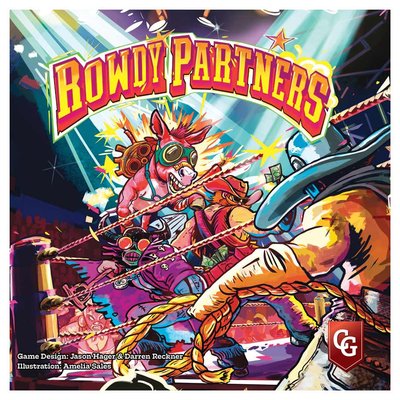
Yep. There you go. Okay, moving on to the next game. This is the other trick-T game that we're going to be talking about today. It is called Rowdy Partners uh from Capstone Games and it's designed by Jason Hager as well as Darren Reer. Now, this is a two to four player uh team-based uh trick- takingaking game where basically in a four-player game, it's 2v2. In a three-player game, it would be 2v1 and then in a two-player game, of course, it's 1 v one.
Yes. Uh, the theme of this game is you are rowdy partners because you are partners in tag team wrestling and your goal is to try to inflict as much damage and get your opponent's health down to zero. Yes.
Now, you're going to be going up against two opponents. So, really the ultimate goal is to get at least one of your opponents down to zero. If you do that, then your team wins.
Yes. Now, the way that the game works is each player is a silly wrestler. Like their wrestlers are asymmetric. They're uh their things like one of them's like a train, I think. Otherwise, a donkey.
Yeah. And as a team, you're going to join your player boards together.
Use them.
And there are four suits to the game. It's a must follow trick taken game. Now, there is a ring that comes with the game that also determines the order in which players are going to play a card during the trick. And which two players are actually in the ring?
Because only players who are in the ring can take damage.
They're the ones that are susceptible to damage.
Yes. Now, the way that each trick works is the first player is going to lead by playing a card from their hand. It's a mustf follow trick taking game. So all other players when it's their turn to play must play a card of the same suit if they have it. There are wild cards in the game. So you can also use those uh in order to play the suits that you need. And at the end of the trick, whoever played the lowest card technically wins the trick because they get to inflict damage on their opponent, whichever one is in the ring. And the amount of damage they deal is equal to the value of their winning card. So, if I play the lowest valued card, if I played a three in the lead suit and it was a lowest value, then I deal three damage to my opponent that's in the ring.
Yeah. So, only the opponents that are in the ring get damage dealt to them, but you can deal damage from outside the ring. Yes.
Now, that's not all because there's also another rule. If multiple players play the same value card, their cards get flipped down and now they are basically out of the trick.
Yeah. And that would happen if like you're if you're familiar with trick taking if you're short suited. Yes.
Let's say somebody led with a blue blue five and now it's your turn. You do not have the uh blue a blue card to play. So then you can play like a red five to cancel out that blue five.
Yes. So this could be strategic. Let's So let's just say for example, one person played a five, another one played a three,
somebody else played a four, and then another person played a three. Well, that second three cancels out the other three and now the lowest value is a four, right?
So, you can do things like that with this rule in place. In addition, there is a pop track that is formed by combining the two player boards together. And certain cards have uh benefits on them that you gain as soon as you play them. And a lot of the cards are going to allow you to go up this shared pop track. And along this track, there are certain thresholds that allow you to gain the token that represents your signature move or coins and other modifiers, just things that help you during the round that either allow you to deal more damage or change the value of your card. Some tokens let you tag in, which basically allows you to switch the places of the wrestlers in the ring.
It's important if you're getting beat down.
Yes, that can be really important. And by the way, if you win the trick by playing the lowest value card, you lead the next trick, which means you actually go into the ring. if you weren't already in it. But that's essentially how the main game works. Now, like Navina was mentioning, in a three-player game, you play 2v1 where the one person plays as a headliner. So, they have like a a a really big player board. It's a very special player board that has a big health track. They also play with um what's called a manager diamond or something. It's basically this diamond structure that's made out of cards. It kind of forms the other half of their hand.
Yeah. And it kind of looks like um if you're familiar with Seven Wonders Duel where you have like kind of that lattice like with some cards face up, some cards face down, and you don't flip over those face down ones until they've been unlocked.
Yes.
And so that just adds to the single player's hand. So they can either choose a card from their uh their personal hand that they're actually holding or from that lattice that's face up that everybody can see.
Yes. Which also means there's parts of their hand that they don't know, you know,
they don't know and then parts of their hand that's actually exposed.
Yes. And similarly, in a two-player game, you both play as headliners. So, you both have that manager diamond. You can both see sort of aspects of each other's hands. Now, I personally think the game plays the best at four. Um, I think the headliner aspect is interesting. We've played it at three also.
Yeah, we did.
I think it's interesting. And in general, I think the game is interesting. I really love trick games. We both do that.
And we're we both are like on a quest to play as many of them as we can because it just they're all different iterations of the same thing. truly. Um, but I what I appreciated about this one in particular is the theme. I think a lot of people will resonate with that aspect. They did a really good job implementing the wrestling aspect of it in a trick.
Yeah. Like the the way to tag in and you're trying to like beat down your one person. Like it's clever like in that way. If if you're in the ring, then you're the one susceptible to injury.
Yeah, that's my favorite part of the game. The fact that you tag in and out.
You can also unlock your signature moves and it's very just silly in that way. Now, I will say though that if you're like really uh into trick taking, it does suffer a little bit sometimes from the luck of the draw.
Yeah, we've had rounds where like it's like we're just losing
like no matter what. Like
if you have a really bad hand,
you're just riding that mid tier.
There's some things going up the pop track, unlocking your signature move, but it's really just sometimes you really can't control it cuz there's no um there's no trump suit, anything like that.
Yeah. there's no way to like reverse somebody like if if they just have a lot of the cards that the low value like they're just going to be able to just whittle away at you.
You can get rocked like that person if that if if if somebody has a really strong hand, they can really they can control you, I think. And there's kind of little to be done outside of of that. But fortunately, there are other aspects to the game that slow down their progress. Like on the health tracks, as soon as you get to the very bottom, there are stop signs. So, you can't just like I'm gonna just deal, you know, 20 damage in a round or something and then your health goes all the way down. No, you actually have to stop at these stop signs and you can't you have to progress through them very slowly basically cool down period.
Like you got the 20 like health and then once you get into this red section, it's like in order to take them down to the next level, you have to hit them by at least a two. So, you can't win a trick with a one because like one is not enough to to hit them with two. then it's like you have to win by a three, win by a four and like if you're able to do that then you truly knock out one of your opponents and then you would win the game.
So I'm assuming that that is there so to sort of offset the that aspect, right? Because it buys you a little bit more time to sort of regroup and maybe get a better hand and have the upper hand next time.
Yeah, because it's not like you score per round. It's like, oh, this round he won, this round we won. It's just it just keeps going and you just reshuffle and you just keep playing until somebody's health gets deteriorated down to the final blow. But despite that, I actually enjoy the game. Now, I do think I liked it much better at four. I like the 2v2 game better than than anybody having the manager.
I feel like I think that's how I feel with any trick taking game that uses that sort of like lattice formation.
I'd rather not knowing anybody's hands.
I think the best player count is probably four. Then I would I would say four then two then three
because like because in two it's like well you both we both have it.
Yeah. in three it's only well that person has it and sometimes it's like well their hand is they because sometimes
just the way the game plays they're they're plucking from here and now they have two cards here and but their whole lattice is there it's like they don't know half the the deck that's true
so then but it's like but they had to play here because the lattice wasn't working out for them so
because they have to you must swallow and if if it's in your hand right yeah the lattice can be a detriment to that that one
play that's why I think I like it four then two then three
mm Mhm. I'm 50/50 on this one. Like I kind of like it, but I also don't like the element of uh sometimes just getting a really bad hand and not being able to do anything about it. Um we have played games where it's like
it just feels like after six tricks of just getting ah I'm just getting hurt. Tag in please now you tag back in. Take more damage. Like that can sometimes happen in this game.
Yeah. I think we're more on the mechanics side of trick taking games. You know what I mean? I think anybody who's like really looking for a sweet theme will really really like this one.
Yeah, I do like the uh the shared board and like moving up that track as you play the higher value things because you get those tokens that can really help you.
Um so so that that is really cool. There's a lot of different characters in the game. Um and I believe they're all double-sided, so like you can play a bunch of different like variety of different combinations and each character has its own like um attribute wheel. So it's like this character is really strong but also has good like defense and like you can kind of balance things out a little bit more that way that partnership based off of their abilities. So all in all for me I would not say no to a game of this but it's not one that I am truly itching to play.
So you thought it was okay?
I think it's okay. Okay. I definitely liked it a lot more than did. It's still not my favorite trick taking game because I I
be hard to knock off your favorite trick taking game.
Yeah, I know. I like tricking games where you can like feel like you're doing something cool. You know what I mean? Yeah, I get it.
And it's not that that's not in here. I think this really leans into the partnership aspect a little bit more. And like I said, the silly theme. So, there are some parts of this game that are done extremely well, but the trick- taking aspect, I think, is a little bit tough to balance. And by the way, I don't think the wrestlers are doublesided. I think there might be a total of six of them.
Am I tripping? I think I'm Oh, maybe it's the headliners that I got to be used with. Yeah, there's there's multiple headliners that you can play as.
Yes, there are multiple headliners. That's why I thought they're like doublesided.
But anyh who, that is essentially it. That is rowdy partners.
All right, moving on to the final game of today's video. This is a cozy game
and it is called A Place for All My Books.
All of them.
Every one of them. This is a game designed by Alex Cutler and Mike Mahels and it's published by Smirk and Dagger Games
and it's a game for one to four players that plays in 60 minutes. Yeah. So, this is a cozy game about getting books and arranging them in your apartment.
Anyone who has a book collection in a garden wants for nothing.
Oh, that's cute. A room without books is like a body without a soul. Oh, I agree with that. I love books. I used to before board games, I used to be really books in this house.
Really into books, huh?
We have a lot of rooms that don't have a body.
Well, that can be changed.
We have to just litter the house of books.
So, uh in this game, each player has their own apartment board. Yep. And we also have a hand of little project cards. And basically over the course of the game, you're trying to perform actions in your apartment that allow you to arrange and rearrange books that are on your apartment board in order to complete these little projects because each card will want you to have some sort of arrangement. Something like you want to have two large stacks of books in different areas of your apartment because your apartment's actually divided into separate rooms.
Yeah. or like have three stacks but no red stacks in your kitchen. Something like that. Yeah.
So, lots of different types of little project cards that want you to have arrangements of books in your apartment.
You'll also want to go out into the village eventually because the village is how you acquire more books as well as more little project cards and other neat stuff cards which are these random sometimes uh endgame scoring cards or cards that give you some sort of a benefit throughout the game. They're very random
ability cards. Yeah. Now, the thing is you are a bit introverted because uh it's technically a worker placement game and each time you go to an action spot in your apartment, it also gains you a certain amount of social battery, which is one of the currencies in the game.
Yeah. You like to spend time alone doing things, arranging your apartment and your books. you're recharging
and you're recharging your social battery so that when you're ready to go out into the real world outside of your apartment, then you have just enough social battery to go take actions over there because your actions are the the social battery you have become the currency or how you can actually spend action points out in the village.
Yes. Because on the other hand, each worker placement spot in the village requires you to spend a certain amount of social battery and eventually you're going to run out of social battery. You're going to need to go home and recharge. And so every time you go out into the village, that is the timer for the game. And as soon as the sun track reaches the very end of its track, that basically ends the game. And you just score for whatever you have on your player boards. That is the basic gist of what we're doing in the game.
Yeah. So you're you're trying to get these like uh these project cards or what are they called again?
Little little projects.
Little project cards. You're trying to basically arrange the right types of books, but if you don't have enough books, you have to go out into the the village, gain those books, find a way to somehow get them arranged uh randomly kind of on your player board. Yeah. sometimes strategically, but then go then you go around the apartment taking various actions, building up your social battery and actually trying to figure out a way to kind of
unstack and rearrange and put things into position so that when it's time to score, you can try to score as many of these different criteria cards as possible.
Yes. Because there is an action spot in your apartment that allows you to score your little project cards and you can score as many of them as you are able to. So, you want to try to configure your books in a way in your apartment so that it dips into as many of the cards that you have in your hand.
That's the really crunchy aspect of the game because you're trying to be as efficient as possible and maximize these cards. They're also major accomplishments which are public goals and it rewards you for being the first to complete them.
You just race.
So, you're also trying to consider those as well. And then there's, you know, a display of little project cards that are coming out into the village. You're also wanting to try to keep track of that. So, it is a game where you're trying to maximize your efficiency and you're trying to think about so many things at once. Now, before we continue, we do want to mention that we have a full playthrough of this game on both our Patreon as well as our YouTube membership communities. We're doing this new thing where sometimes we'll do a first play of a game and we'll film it. And so, it's literally me teaching Naveen the game for the first time and the very first time we played it. So, if you're interested in seeing us sort of fumble through it,
Yeah.
it's there.
It's literally me. I know nothing about the game except for what it looks like and kind of the basic theme and then Monique actually in that moment is teaching me just like she would teach the audience kind of like that.
Now because of that potential crunchiness aspect where you're trying to maximize things and think about so many things at once. I feel like there's a sweet spot in terms of player count. All the other games that we talked about today, we kept saying that I think the max player count is the best, right?
This one feels good at two.
This one feels good at two or maybe solo. I did not play this solo. That is a player count that um we did not get to play the game at and I think a lot of people like the game for the solo aspect.
It's a cozy game and you know what better way to play than to play by yourself.
Efficiency puzzle.
Yeah, it's an efficiency puzzle. So I think a lot of people are drawn to the solo game. But just because of the potential analysis process, I think if you're playing with other players, two-player sounds good.
Seems about right. Yeah. Now, despite that crunchiness, I will say that I think there are moments in the game where you can really fall into the luck of the draw. So, you can basically configure something on your playerboard that can double dip into other cards that you draw from the village.
So, you might have like a card that says you must have three stacks of books that are three high at least.
And then you might have another card that says have three stacks of green books.
So, it's like, well, that meets both criteria. So when you go to score, it's like it's going to score this and this all for the same like arrangement,
right? And then maybe I see another one pop up in the village that fits something that's already on my board
or like oh that all that needs is me to just move this one book and it's good.
Yeah. You you can basically get away with minimal organization if the cards come out in your favor. Now I guess the way to combat that is to really just pay attention to what other people are doing on their boards. Yeah.
But it's a it's a pretty headown kind of game.
It is. Yeah. I will say like the more familiar you like in my f first game like I wasn't familiar with what kind of scoring cards are going to be there, right? So you're just you're just receiving them and like okay this is what I'm looking for.
As you play the game more you're like well I know they really prioritize stacks or they really prioritize not having a particular color in a certain room. So I maybe I don't want to just litter things everywhere because then now trying to get this to score is going to be hard. Now I'm going to have to take all these different actions in my own apartment. Even though I'm building up the social battery, I've the track is already maxed out. So you're not being as efficient because you're like, well, I'm taking all these actions just so I can get myself kind of into position to score while my opponent just went now I'm ready to go to the village and I'm still like trying to arrange and do things like that. So as you get more familiar with the scoring criteria cards,
I think the playing field kind of balances a little bit, but you can still not find cards that work with what you've been working on. So there is that element of it of course, but I do like the element of doing stuff in home, building up that social battery and then taking that social battery that's at its max capacity ideally and going out into the village and just like spending spending spending as much of it before you're ready to go back home. I think that is a cool like nice like tie to the theme of the game because you are like an introvert that wants to just have like nice things in your home. Yes. And uh you know when it's time to go, you're like willing to go out and then once you're ready to go home, time to go home.
Yeah. I think I sort of just jumped straight into my gripes with the game. I think the game itself is actually really super cute. The art the artist. Who's the artist?
Uh Naomi Lord.
Naomi Lord. Really excellent. It really fit the theme of the game so well. It's beautiful. Like just playing it, it really gives off that cozy vibe that they're really trying to trying to instill with a game like this. And I think the actual mechanisms in the game, like you're in your apartment and you're trying to build up social battery so that you can save up so that when you go into the village, you're just draining your social battery and you're gaining these books and everything is so aesthetic and the feel of the books and placing them. I think it's really well done.
It's just if you're playing like a really competitive game, then that's the only reason why the other things that I mentioned would matter. Yeah.
Um the other neat stuff cards, they're really cute and they can be really interesting, but they're also super random. So it can be, you know, it can really help people just if it were to come up.
These symbolize, I think, like trinkets that you would find in like a shop,
in a collectible shop or something. You're like, "Oh, this is cool. This would fit well in my house. You actually have to place them in your house, like the books. The books are the only thing that you have to arrange. These these like neat things are just things that you've acquired and you don't actually have to worry about where they go in the house." Yeah. Um, but the actions in at your home uh are pretty interesting in like it's like, okay, pick up a stack, but now you have to drop off one in random places. Not not random, but like you get to choose or take the top of x amount of stacks that you want and and rearrange them all into one stack. So sometimes, you know, the way these scoring cards are, it's like,
ah, if I could just get this red book out of there to the top, I then I could really score something really nice. So, it's like,
okay, got to take this action. Move, move, move, move, move.
Okay, now I got to get this red buck on top. Like, so it it's pretty clever the way that they make you arrange your books. Um, so I do like the theme and I actually really like the mechanisms of the game.
Yeah. And in general, honestly, I think the game's really fun. It's a very casual game, but if you just approach it that way, then it's great.
It is, but you do feel the pressure of So, we kind of glossed over like the sun moves. So, anytime any player goes to the village, so they leave their apartment, there's a sun track. And depending on player count, the sun moves every single time a player revisits anytime any player visits the village.
So, sometimes you're like, I'm not ready.
And the sun is moving.
Yeah.
And like if I go like I'm not ready to go to the village until I'm like ready to acquire everything, bring it back, have everything arranged, and then try to score score as much as possible. So, you definitely feel some of that pressure as you see that sun start to tick because you feel like you're behind.
So, that's essentially it. If you've played a place for all my books solo, please let us know how it went. Leave a comment down below and sort of just share your experience if you're willing to. It's basically a cozy puzzly game. Like, that is a place for all my books in a nutshell. So, there you go. A place for all my books.
Well, there you have it. Those are four of the games that we wanted to talk about today. Hey, if you've played any of these games, please let us know your thoughts on them in the comments down below. Um, if you are interested in seeing our very first rough playthrough of A Place for All My Books, we do of course have it on our Patreon and YouTube memberships. There's links in the description.
It's the first time playing.
First time playing, so keep that in mind.
It's pretty rough. Yeah, but like, you know, we're just having a good time doing it. Thank you all so much for watching the video. We hope you enjoyed it. If you'd like to see more videos like this in the future, please consider subscribing.
Thank you. Thanks. Bye.