


Arena: Roma II Deep Dive
What the Community Thinks About Arena: Roma II
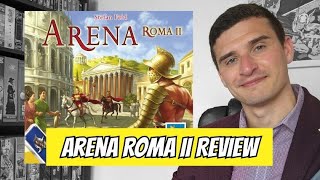
Arena: Roma II is a 2009 two-player dueling card game designed by Stefan Feld and published by Queen Games. It is also a sequel to Feld's earlier game Roma, and the two can be combined. The Chairman of the Board channel treats it as the most confrontational design in Feld's catalogue, a head-to-head contest in which players attack each other's cards and drain each other's victory points, repeatedly setting it apart from the point-salad style that made Feld known.
Where the channel's verdicts differ is on how much that confrontation pays off. The host finds the combat clever and the design tidy, but keeps returning to the same reservations: a dice economy with a heavy luck component, limited replayability, and games that can stretch well past their intended length. In one review the host rates it about six out of ten, saying it does what it does well but is not a game that keeps them coming back. In a later video ranking Feld's games, the host places it in the bottom tier, describing it as a game they appreciate but tired of quickly.
Core Mechanics That Define Arena: Roma II
Dice-Driven Pit Allocation
The engine of the game is a central strip of numbered pit spots, one through six, supplemented by a money spot, a draw spot, and a bribe spot. Each turn a player rolls their three dice in their own color and places them on these spots. The die value determines which card or ability activates. The channel gives examples: a five placed on its spot can remove three victory points from the general supply, the money spot pays coins equal to the pit value used, and the draw spot lets a player draw several cards while keeping only one. The bribe spot works differently, because the player must pay coins equal to the die placed there, so lower values are usually better for it. Because the dice set the options each turn, the allocation decision is the central choice of the game, even though the roll itself is outside the player's control.
Empty Slots and Point Bleed
The second core system is the row of six card slots on each player's side. At the start of a turn, a player loses one victory point for every empty slot, and that pressure drives much of the play. Attack cards can destroy an opposing card when the attack die matches or exceeds its defense value, and other cards discard the card opposite, forcing the opponent to forfeit more points on their next turn. Victory comes in two forms: reducing the opponent's victory points to nothing, or holding the most points when the common pool runs out. Cards such as the Aqueduct can remove points from that pool, letting a player who is ahead hasten the ending.
The Arena: Roma II Experience
Confrontational, but Eurofied
Reviewers describe a game that is more openly hostile than players might expect from Stefan Feld. Cards such as the Elephant automatically destroy an opposing card of value four or less, and the host notes that no other Feld game they know puts players in such direct conflict. Yet the fallout of combat is restrained. A destroyed card does not cost a player a large lump of points in one roll. Instead, a player who cannot replace the card loses a single point at the start of their next turn. That restraint gives the duel a calmer, more economic tone, and the channel says the way combat works is a Euro mechanic it had not seen before.
A Long War of Attrition
The other feeling that recurs is tension that builds slowly into attrition. When the game flows, the channel reports sessions of 10 to 15 minutes, but other games drift past half an hour and become a war of attrition rather than the quick dueling game the host expected. Because the outcome depends on which dice come up and which cards surface from the deck, a player who falls behind can find it hard to climb out. The channel observes that the game is not very swingy, so comebacks are difficult. Players who enjoy a long grind may find this satisfying, but those hoping for a snappy head-to-head contest may find the back and forth wearing.
What Makes Arena: Roma II Stand Out
Multiple Paths to Victory
The channel consistently praises the range of ways to win. The host describes character-driven strategies that reward holding more face-up characters than the opponent, building-driven strategies that score for each building, pure point gaining through dice, and aggressive play that bleeds the opponent dry. Individual cards reward specific approaches. The Speculator lets a player take a card from the opponent's hand, and the Taberna scores for each of the opponent's face-up characters. The host also likes that cards can point toward other cards, so a player can build a small engine tailored to a chosen strategy.
Clear Components and Production
Production draws consistent praise. The host finds the cards nicely illustrated and believes the artwork may be by Michael Menzel. The text is clear, the iconography is described as good and simple, and the strip of pit values on the central board fits together neatly. For a Queen Games release, the reviewer says the quality holds up well despite the game being an older design, and calls it a small box with a solid standard of production. The rules also keep the flow moving. Playing cards from hand does not use an action and has no hand limit, and most cards are cheap, with the most expensive costing around nine or ten coins.
Potential Drawbacks
Length That Can Outstay Its Welcome
The most persistent concern is that Arena: Roma II can run longer than its simple rules suggest. The host wanted a quick filler, and found the unpredictable running time undermined the experience, since a game that ends in 15 minutes and another that takes 45 can come from the same box. The problem is most acute when the game is used to fill a short gap in an evening. The host says the nagging doubt about whether the game will drag, and whether the right cards will come out, made them less willing to bring it to the table.
Luck and Limited Replayability
Reviewers also point to the role of chance. Because players are fighting through the deck and reacting to their dice, the host regards it as much more luck-dependent than a typical Stefan Feld design. Mitigation is limited to the occasional card that rerolls dice or redirects them, and the host notes that players are somewhat tunnel visioned by the dice they roll. On repeat plays the same cards tend to appear, which dulls the sense of discovery. The channel praised the variety of victory paths, but concluded that the game ultimately feels like the same experience each time, with a ceiling that keeps it from standing up to more traditional Euros. Players who value strategic depth may find this limiting, while those who enjoy a light, reactive duel may accept it.
If You Enjoy Arena: Roma II
The natural starting point is Roma, the game Arena expands. Arena is a sequel to Roma and is compatible with it, so players can mix the two card sets, have each player use a separate set, or each draft a 55-card deck from both games. For players drawn to the dueling format with a Euro flavor, Roma is the most logical place to see where that combination begins. The channel's own advice for Arena is to give it a look if you like dueling games with a Euro spin, but to look elsewhere if you want a faster two-player game.
What Reviewers Are Saying
"Ultimately you are mainly reacting to what dice you've rolled, so there is quite a lot of luck in this game. Yes, you can mitigate that, sometimes by getting the right colors out and spending your higher values in order to draw the particular card you want out and to allocate them, but you are still fighting through that deck and trying to get the card you want."
— Chairman of the Board
"Despite this one being relatively in your face and confrontational, it didn't feel that way to a point where it rubbed you the wrong way. It was quite eurofied in the way that this was a dueling game, so you don't normally get that."
— Chairman of the Board
"I actually played this one quite a few times in quite a quick succession and kind of tired of it quite quickly. I didn't really see the incentive to go back and play it much more because I'd seen all the cards, all the combos, and I also thought that it could be a bit grindy and a bit too long at times."
— Chairman of the Board