
Game Info
Year
2018
Players
2-4
Age
8+
Playtime
45 min
Collection
Ratings
Mechanic profile
Not enough video data yet
Vibe profile
Not enough video data yet
Description
Created by Michael Kiesling, Azul: Stained Glass of Sintra challenges players to carefully select glass panes to complete their windows while being careful not to damage or waste supplies in the process. The window panels are double-sided, providing players with a dynamic player board that affords nearly infinite variability!
Players can expect to discover new unique art and components in Azul: Stained Glass of Sintra, including translucent window pane pieces, a tower to hold discarded glass panes, and double-sided player boards and window pane panels, in addition to many other beautiful components!
—description from the publisher
Featured Videos


Ask a Rules Question
Images

GID0035051.jpg

GID0035051_thumb.jpg
All mentions
Browse transcript mentions, sentiments, pros/cons, mechanics, topics, quotes, and references.
Total mentions: 13
This page: 13
Sentiment:
pos 7 ·
mix 2 ·
neu 1 ·
neg 1
Showing 1–13 of 13
Video eOH3Ea9M0sM
Top List at 11:54 sentiment: positive
video_pk 134507 · mention_pk 383425

Click to watch at 11:54 · YouTube ↗
Overall sentiment (raw)
positive
Pros
- Really really like how different it is from the first
- Like the progression of moving your pawn to activate whatever is is in that row
- Feels a little more crunchy
- Different enough of a puzzle and an abstract game
- Really enjoy it
- Favorite Azul so far
Cons
- This is the only Azul on my entire list
- The other ones were like low hundreds
- Haven't played as much as the first and third
Thematic elements
Comparison games
- Azul
Mechanics (from transcript analysis)
- Drafting — Players draft tiles from a common pool.
- Pattern Building — Players arrange tiles on their player board to score points.
- Set Collection — Collecting sets of tiles to complete objectives.
Video topics + discussion points
No key topics recorded for this video.
Quotes (from this video)
- This is the first year that we've done a 100. Last year we did 50.
- make sure to go ahead and hit that subscribe button and turn on the notification bell so that way you can be informed when we actually upload the next one until we get to our top 10.
- We have played less games. Yes. Sadly, but we played new games.
- This list is going to be very interesting this year. Very, very interesting.
- Gizmos is needs to needs to have a redemption. Redemption arc for for Gizmos.
- This is my favorite or one of my favorite dexterity games.
- It's reverse Jenga. You're just trying to build and make sure that it's going to stay.
- It's so funny, too. It's so funny because you're just hanging your little uh spider monkeys and then you're just
- You're literally flipping tiles through the dark trying to navigate, trying to get out like and trying to survive these creatures.
- It's so scary.
- I am happy we are doing a top 100 so that way these games can get that recognition.
- turn on the notification bell. Turn it on. Make sure you click that button so that way you know when we are going to upload.
References (from this video)
No references stored for this video.
Video 8K97Ru99DO0
Getting Games Discussion at 17:35 sentiment: positive
video_pk 91920 · mention_pk 246751

Click to watch at 17:35 · YouTube ↗
Overall sentiment (raw)
positive
Pros
- visually appealing and thematic
- recognizable mechanics in a new framing
Cons
none
Thematic elements
- stained glass window construction
- abstract/architectural
Comparison games
none
Mechanics (from transcript analysis)
- tile drafting — draft tiles to place into a personal scheme
- Tile Placement — place tiles to build a window-like pattern
Video topics + discussion points
No key topics recorded for this video.
Quotes (from this video)
- I'm not making a review videos anymore
- I've been so excited to be playing games over this last month
- BoardGameGeek is an amazing resource for me as a content creator
References (from this video)
No references stored for this video.
Video fIQFp7oo1ZE
Getting Games Discussion at 5:43 sentiment: mixed
video_pk 91852 · mention_pk 246573

Click to watch at 5:43 · YouTube ↗
Overall sentiment (raw)
mixed
Pros
- new scoring and constraint system adds a fresh twist to Azul
- easier to teach than the original Azul
Cons
- randomness and placement restrictions can reduce flexibility
- early rounds can be hard to parse and may feel restrictive
Thematic elements
- color drafting with mosaic-like boards
- glass-stained mosaic theme
- racing/optimization Euro-style
Comparison games
- Azul
Mechanics (from transcript analysis)
- board-specific placement — tiles must be placed on specific color spots on your board according to the color you drafted
- color drafting from middle area — draft from coasters in the middle; colors shift into the middle after selection
- glazier mechanic — each player has a glazier determining placement across long skinny boards; you must place tiles in matching rows and cannot place behind the glazier on future turns
- reset action and selective placement constraints — you can reset the glazier to the left by passing your turn; initial drafts are constrained by color-specific spots
Video topics + discussion points
No key topics recorded for this video.
Quotes (from this video)
- this is definitely a light style game
- I think it's actually easier to teach than the original Azul
- the randomness of the card draw is gonna be a turn-off for some people
- I am looking forward to exploring this one more
- this was the biggest disappointment of the convention for me
References (from this video)
No references stored for this video.
Video un8kL0OyOWY
Meeple University Review at 2:09 sentiment: positive
video_pk 91024 · mention_pk 243940

Click to watch at 2:09 · YouTube ↗
Overall sentiment (raw)
positive
Pros
- Light complexity makes it accessible
- Tactile components enhance the experience
- Pattern-based scoring creates engaging decisions
- Supports 2-4 players
Cons
- Described as the most complex of the three Sol-themed games, indicating a relative difficulty within the group
Thematic elements
- color and pattern construction
- stained glass window patterns
Comparison games
- Stained Glass Indra
- Summer Pavilion
- Stained Glass of Sintra
Mechanics (from transcript analysis)
- pattern/cluster scoring — points awarded for clusters of tiles and specific color patterns.
- Set Collection — collecting tiles to form color or type sets.
- Tile Placement — placing tiles to form patterns or walls as the core action.
- tile wall building — constructing a 5x5 tile wall as the board is filled.
Video topics + discussion points
No key topics recorded for this video.
Quotes (from this video)
- the original and simplest
- accessible to everyone
- the games are of light complexity all
- with simple gameplay and tactile pieces
- points are scored for cluster of tiles and
- two to four players
References (from this video)
No references stored for this video.
Video dg3_Ka35M2c
3 Minute Board Games Discussion at 19:58:08
video_pk 90107 · mention_pk 240339

Click to watch at 19:58:08 · YouTube ↗
Pros
- Another of Steph's favorite games
Cons
none
Thematic elements
Comparison games
- Azul
Mechanics (from transcript analysis)
Mechanics unknown.
Video topics + discussion points
No key topics recorded for this video.
Quotes (from this video)
- Anacrony is a cooperative game for one to four players. So it's a cooperative game where you're working together to stop that end game timer.
- You're constantly making choices about how you're gonna spend your next X turns, and you've got to have enough resources.
- You've got to plan for months ahead. You've got to plan how you're gonna spend your next X turns.
- This is a really good cooperative game. I've played it a couple of times.
- It's a very thinky game. So you've got all these different tracks and your different workers and your different ways to score points.
References (from this video)
No references stored for this video.
Video E4Uw4TJBVvA
UndeadVikingVideos Discussion at 2:22 sentiment: negative
video_pk 88393 · mention_pk 232898

Click to watch at 2:22 · YouTube ↗
Overall sentiment (raw)
negative
Pros
none
Cons
- Left no impression
Thematic elements
Comparison games
none
Mechanics (from transcript analysis)
Mechanics unknown.
Video topics + discussion points
No key topics recorded for this video.
Quotes (from this video)
- I remember playing the the original one and I remember standing at the table playing with Don and JB no Jamie wasn't there it was uh Chris and a couple other guys and I remember the cover of the game but I do not remember playing the game you know it's like it left no impression on me whatsoever
- I mean it hit the table a couple times for me and then like then it did hit the table forever so it was one of those things where you know just give it up you know let somebody else you know
- but but highrise was one of those games that everybody said no it's just too expensive to publish now I have no idea what happened with his high-rise campaign or or how he did it but when he only raised like 52 grand for it and then like and then he did his high-rise Ultra plastic Edition and he raised like a little over 100 Grand like for the life of me I I think like basically he didn't my me personally with with covet and everything else it was like one of those things where I think it was just way too expensive I mean you can't make a big old plastic fancy thing for 100 grand
- It's like it's like the the the the the the best answer in most situations if you are stopped by a police officer um and asked hey uh where are you going your best answer is I don't answer questions that is just yeah and just yeah yeah and that's I mean and yeah they're they're gonna be annoyed with you and they're gonna but you know you're just better off not saying anything and and just go the fifth
- I think it's a good thing for the hobby I think it really is I think it's just gonna some of those people just uh suck it suck it uh go go work at UH Burger Time and and try to uh the same pre-insured me okay go to the work houses
- I just don't understand it neither do I if you if you can't find a game for fifty dollars that's available right now and you will go back some 300 no no backer no backer history no prior history game I just don't get it why would you do that
- I don't think it's a perfect solution would you want to get bigger anymore I don't think so I mean I really like it the way it is I feel like it's it's unwieldy
- I think it's a lot of potential here too people really seem to enjoy I don't think the coffee ones are that funny if I mean me personally
- Yeah the problem is those those rooms go into the block or don't go back into the block price so they go in for stupid price so you don't get a good deal
- I mean it's just it's crazy hard like what yeah you know we we ship out we don't really let stuff sit in orders for more than a day maybe a day at most and it still like takes a couple days takes two three days three or four days yeah
- it is rules dense but it is nowhere near as rules and sense as uh as as magic Rome was
- I'm going to hate doing the video I'm going to absolutely hate doing the video because it is going to be it is going to be uh uh it's going to be annoying to try to get all the rules correct
- magic realm was one of his all-time favorite games when he was a kid
- bo Jackson bo knows baby
- I just don't understand how you make money on honestly selling games it's really tough
- people don't want to buy games that exist already they want to buy games that don't exist for some reason I don't get it
- I mean it is like it is like there are pages and pages and pages of games that are just like who is this who is publishing this what is this you know
- the flea market spoken Lobster steak
- it's like the the ideal game library was a database of mine oh sorry a database of more than 700 short board game reviews in French and broken English
References (from this video)
No references stored for this video.
Video mLopZNrQEhs
Where There's A Wilz, There's a Play Revisiting Collection at 29:40 sentiment: positive
video_pk 82096 · mention_pk 206069

Click to watch at 29:40 · YouTube ↗
Overall sentiment (raw)
positive
Pros
- Fresh take on Azul with a new mechanic
- Beautiful components
Cons
- Requires re-reading to recall glazier interaction
Thematic elements
- tile drafting with a moving glazier mechanic
- Stained-glass workshop in Sintra
- thematic/ornamental
Comparison games
- Azul
Mechanics (from transcript analysis)
- glazier track — A moving track affects draft order as you place tiles
- tile drafting — Draft tiles and arrange on a panel
Video topics + discussion points
No key topics recorded for this video.
Quotes (from this video)
- Is it staying in our collection or is it time for it to move on to someone else's table?
- This is a keeper.
- Go.
References (from this video)
No references stored for this video.
Video Qxq2JIArNZE
Rules Teach at 0:12 sentiment: neutral
video_pk 79796 · mention_pk 193355

Click to watch at 0:12 · YouTube ↗
Overall sentiment (raw)
neutral
Pros
none
Cons
none
Thematic elements
- You take the role of stained glass artisans drafting windowpane pieces to place on your pattern strips trying to become the best stained glass artisan to furnish the palace windows.
Comparison games
none
Mechanics (from transcript analysis)
- End game scoring — Final scoring involves points for leftover pieces, penalties for broken glass, and bonus points based on completed columns and color majorities on the Palace Board.
- Pattern Building — Players place drafted pieces onto pattern strips on their player boards.
- Set Collection — Players aim to complete sets of colors on their pattern strips and then place pieces onto their Palace Board for scoring.
- tile drafting — Players draft windowpane pieces of one color from factory displays or the center of the table.
- Worker Placement (Glazier) — A glazier marker moves to indicate placement on pattern strips and influences how pieces are placed.
Video topics + discussion points
No key topics recorded for this video.
Quotes (from this video)
- welcome they're gonna be taking a look at as ool staying glass of Sentra this is a two to five player tile placement abstract strategy game where you take the role of stain glassed artisans drafting windowpane pieces to place on your pattern strips trying to become the best stained glass artisan to furnish the palace windows.
- how do you become the best a stained glass artisan by having the most points at the end of the sixth round now that we know what the winning condition is let's take a look at the components setup and how a round and turn work in Azul stained glass of Sentra
- on side a and final scoring you'll gain points for clustering around these squares on side B you gain points for finishing your windows and for the most of a particular color so we're going to play the game on side B
- if you placed that piece at the top you would follow those instructions by flipping this strip over and then if you place it at the bottom you would remove the strip from your palace board then you would score the window you would gain the points at the bottom of that column on your palace board and also add the points to the right of that column on your palace board if that column contains one or two pane pieces on your palace board turns would continue on until all of the pane pieces have been taken and that would indicate the end of the round
- once you finish these three steps the player with the highest score is considered the best stained glass artisan and wins Azul stained glass of Sentra
References (from this video)
No references stored for this video.
Video OzSar70bibM
Meeple University Rules Teach
video_pk 70284 · mention_pk 167210

Pros
none
Cons
none
Thematic elements
none
Comparison games
none
Mechanics (from transcript analysis)
Mechanics unknown.
Video topics + discussion points
No key topics recorded for this video.
Quotes (from this video)
- The Stained Glass of Sintra
- We're going to take you through the four rules for this game
- Hopefully you can pick up some tips and strategies along the way
- The Stained Glass of Sintra game by Michael Kiesling published by Next Move Games
- In the event of a tie whoever's lost the fewest points on the broken glass track wins and if still tied victory issue
References (from this video)
No references stored for this video.
Video 37cUyT60Dgw
kovray Review at 3:27 sentiment: positive
video_pk 68968 · mention_pk 238446
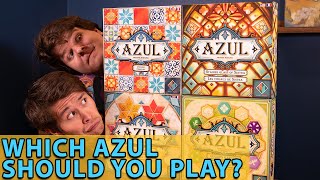
Click to watch at 3:27 · YouTube ↗
Overall sentiment (raw)
positive
Pros
- Loved the way points are captured.
- Combos feel very satisfying.
- Primal scoring opportunities.
- Allows for various strategies.
- Joyful experience.
Cons
- Many people dislike this game.
- A critique is the color similarity making tiles hard to differentiate.
- Can feel really bad when you can't complete the six tiles or symbols because you can't find them.
- Uncertainty of tile appearance impacts planning.
Thematic elements
- Abstract strategy tile placement
Comparison games
- Azul
- Azul: Summer Pavilion
- Azul: Queen's Garden
Mechanics (from transcript analysis)
- Negative scoring — This game gives negative points for different reasons than the other three, though they are not a significant thing.
- scoring — Getting points by filling up the panel, shifting tiles to the bottom, and based on surrounding bases and points below and to the right.
- Tile Placement — Collecting tiles and moving a worker to place tiles where the worker ends up.
- Worker Placement — Collecting tiles allows players to move their worker and place tiles based on the worker's final position.
Video topics + discussion points
No key topics recorded for this video.
Quotes (from this video)
- We are going to talk about our rankings, yeah we're going to dispute about it.
- They are very different and we believe that there is a space for them on our shelf all four of them.
- So what these games overall are is a drafting game where you're taking tiles and placing them on your own board in hopes of scoring the most points but having that placement be really strategic thoughtful and maybe clever.
- My four and three are like a sig like here and my one and two are like here but they're all here in the grand scheme.
- If everyone comes for my beautiful stay glass of cintra I'm gonna come for you in the comments below.
- I think there's nothing wrong with any of them and like I would recommend every single one of you who are interested in abstract strategy game like this is my go-to uh recommendation.
- Well basis rule is my go-to recommendation for any abstract style.
References (from this video)
No references stored for this video.
Video 95gpWwH7LMA
Board Game Coffee Discussion at 16:28 sentiment: positive
video_pk 6772 · mention_pk 20076

Click to watch at 16:28 · YouTube ↗
Overall sentiment (raw)
positive
Pros
- high-end visuals
- approachable to new players
- new color/shape combinations
Cons
- price premium due to components
Thematic elements
- gorgeous glass mosaic design
- stained glass windows and cathedral motifs
- abstract
Comparison games
- Azul
- Azul: Summer Pavilion
Mechanics (from transcript analysis)
- Pattern Building — build mosaics on scoring boards
- pattern_building — build mosaics on scoring boards
- tile-drafting — draft glass-like tiles with translucent aesthetics
Video topics + discussion points
No key topics recorded for this video.
Quotes (from this video)
- "we are giving board games to you in every episode"
- "donation pages to Sick Kids; money goes straight to hospitals"
- "have a happy holiday and good luck to all the entries"
References (from this video)
No references stored for this video.
Video 9TCryiEvpSc
The Dice Tower Top List at 3:13 sentiment: positive
video_pk 5987 · mention_pk 17749

Click to watch at 3:13 · YouTube ↗
Overall sentiment (raw)
positive
Pros
- simple rule with elegant depth
- multi-layered scoring by window completion
Cons
- glossy components can be visually dense for newcomers
Thematic elements
- artisanship, window design
- stained glass window production
- abstract elegance
Comparison games
none
Mechanics (from transcript analysis)
- pattern-building — draft pieces to fill a window, scoring on completion.
- reset-and-move — a key rule allows resetting a worker to the leftmost position to optimize flow.
- set-collection — collect colored glass from factories and place into your window.
Video topics + discussion points
No key topics recorded for this video.
Quotes (from this video)
- action discs are drawn from a bag until there are six action discs in every active slot.
- the action selection process is the biggest reason for this game being on my list.
- The glass factories are going to be seated with random pieces of color glass.
- The game mechanisms are pretty straightforward and relatively easy to learn.
- I split you choose mechanism, and going up tracks.
- The goal of this one is to conquer new land on behalf of the bunny king.
- logistics and how to transport goods around the board.
- You're playing three cards kind of overlapped. So depending on what is showing are the actions you can take.
- Finally, the legacy version gives you something new to play with each game.
References (from this video)
No references stored for this video.
Video Lymb83fvmcw
3 Minute Board Games Review at 0:00 sentiment: mixed
video_pk 2154 · mention_pk 6304

Click to watch at 0:00 · YouTube ↗
Overall sentiment (raw)
mixed
Pros
- Delicious-looking component pieces
- Tense drafting that drives decisions
- Solid core system for Azul fans
- Good fit for 2-4 players with approachable rules
Cons
- Not as strong as the original Azul
- Gameplay can feel less rewarding than the first game
- No solo mode mentioned
- Feels like the middle child in the Azul lineup
Thematic elements
- stained glass windows and architectural art
- Sintra, Portugal
- abstract puzzle with visual artifact crafting
Comparison games
- Azul (original)
- Sagrada
Mechanics (from transcript analysis)
- Drafting — select tiles from central displays or central area; may draft all tiles of a single color from a mat
- End-of-round refresh — round ends when all tiles are taken; displays are refreshed for a new round
- First-player token and round order — taking a color from a mat grants the first-player token for the next round
- Limited Points — discarded tiles advance you on a negative points track; hitting -18 resets to zero
- Negative points track — discarded tiles advance you on a negative points track; hitting -18 resets to zero
- Panel flipping and scoring for completed panels — finish a panel flips it to its other side and contributes to endgame scoring
- Score-based panel progression — score panels when completed, with bonuses from right-side panels
- Set Collection — complete panels by collecting the needed colors and tiles
- Tile Placement — place the chosen tiles on your personal mat, aligning with columns/rows below or to the right of the worker
- Worker track movement and left-pass — you may move your worker back to the leftmost track if space allows, adding tension
Video topics + discussion points
No key topics recorded for this video.
Quotes (from this video)
- The slightly awkward middle child.
- Is it better than the original Azul and the answer is a resounding nope, not even close
- The best thing about this game is the delicious candy looking pieces
- The crux of this is that the decisions just arent as fun
- If you are unfamiliar with the original, Stained glass is a tense abstract game that requires a lot of planning
- The system of passing to return your worker to the left also adds to this tension
- Azul stained glass is the slightly awkward middle child
- It’s still a good game, but as much as it benefits financially being Azul 2, it suffers when its gameplay is compared to the original
References (from this video)
No references stored for this video.
Transcript Navigation
Showing 1–13 of 13