



Bat Flip Dynasty Deep Dive
What the Community Thinks About Bat Flip Dynasty
Bat Flip Dynasty has captured the enthusiasm of board game reviewers who appreciate both its mechanical depth and thematic immersion. Reviewers universally highlight that this 2025 release from Scorelander Games successfully distills the excitement of building a baseball franchise into a compact, engaging experience. The game resonates most strongly with players who love drafting mechanics and resource management, but its appeal extends far beyond baseball enthusiasts. Multiple reviewers emphasize that knowing the sport is irrelevant to enjoying the game's core systems, making it accessible to anyone drawn to strategic card and dice gameplay. The consensus centers on Bat Flip Dynasty as a masterclass in translating a real-world passion (fantasy baseball draft day) into a tabletop experience that plays in roughly an hour yet retains meaningful decisions throughout.
Core Mechanics That Define Bat Flip Dynasty
Card Drafting and Team Building
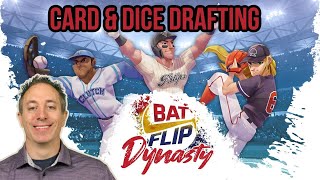
At its heart, Bat Flip Dynasty is a card drafting game designed around the team-building fantasy that appeals to baseball fans and strategy gamers alike. Each season, players receive a hand of player cards representing athletes available for their roster. On your turn, you either draft a player to your team (paying their listed salary) or discard a card to deny it to opponents. The draft mechanics work as a straightforward pass-and-play system, yet the strategic layer emerges from evaluating player value not just in isolation but in relation to your budget and existing roster. Players can draft prospects, who cost nothing in their first year but must be promoted to the major league roster in future seasons, adding a long-term investment dimension. Reviewers highlight that this draft focus captures the emotional high point of fantasy baseball, the one moment when you have absolute control over team composition. Scorelander Games even dedicated their design to emphasizing this draft feeling, recognizing that the thrill of picking the right player at the right moment is what keeps players engaged across multiple seasons of play.
Dice Drafting and Assignment Mechanics
After drafting players, the game shifts to a dice assignment phase where players roll colored dice and assign them to matching symbols on their player cards. Each player card shows a target zone with two to three symbols (representing abilities like batting, fielding, arm strength, or speed), and dice placed perfectly on matching symbols generate maximum win points. Mismatched dice turn sideways and score reduced points, creating a risk-reward tension in placement. This leads to the game's most innovative moment: the league dice draft. All players contribute team dice to a central pool, which gets rolled and laid out. Players then draft one die at a time in turn order, choosing which dice fill gaps on their cards or strategically picking dice opponents need to deny them high scores. This mechanic drew direct comparison to Sagrada, the popular dice placement game, as it creates a mini-game of drafting dice based on both your immediate needs and your opponents' aspirations. The dice assignment system makes every player's turn feel consequential without slowing the game's pace.
The Bat Flip Dynasty Experience
Draft-Day Excitement
The core appeal of Bat Flip Dynasty centers on recreating the dopamine hit of draft day. The game plays in a single season round structure that repeats until someone accumulates enough trophy points to win. In each round, players draft players, assign dice to build their team's performance, roll for playoff results, and conduct arbitration (cutting or retaining players for the next season). This cycle repeats with players constantly rebuilding their roster, creating a sense of perpetual team management and strategic adaptation. The drafting phase is where this feeling crystallizes most clearly. Reviewers note that the simple rules become invisible after the first round; everyone understands the flow immediately and play moves smoothly. The excitement comes from agonizing over pick decisions: is a star player worth half the available budget? Is it worth cutting a reliable veteran to make room for a prospect who might pan out? Is it worth hate-drafting a key piece away from the competition? The closed economy (you never gain additional salary beyond what you cut from your roster) means every dollar matters, and every decision has cascading consequences for your future rosters.
The Thematic Baseball Immersion
Despite its elegant mechanical design, Bat Flip Dynasty drips with baseball flavor in ways that engage even non-sports fans. The team cards are named after fictional baseball franchises with tongue-in-cheek references (the "New York Money Bags" clearly riff on the Yankees; the "Sous City Small Ballers" evoke small-market scrappiness). The player cards feature 144 pieces of original artwork depicting athletes with punny, reference-laden names that reward baseball knowledge without requiring it. The Yahtzee-style playoff rolling creates a dramatic moment where all players' accumulated seasons culminate in one final dice-rolling push for playoff trophies. Even the physical box design contributes to immersion: the inside features stadium artwork and functions as the dice tray, evoking the childhood experience of rolling dice directly in game boxes. This attention to theme ensures that the game feels like baseball management, not a generic worker-placement game with baseball label slapped on top. The theme and mechanics work in concert rather than existing as separate concerns.
What Makes Bat Flip Dynasty Stand Out
The Closed-Economy Arbitration System
One mechanic stands out as genuinely innovative: the arbitration system governing player contracts between seasons. At the end of each season, you iterate through your active roster and decide for each player whether to keep them (adding one million dollars to their existing salary) or cut them (refunding their full salary to your treasury). This closed-economy system means you never gain new money; you only recycle what you've previously spent or cut. Reviewers identified this as one of the best features of the game because it forces genuinely difficult decisions rooted in resource scarcity. A player might have been on the roster for three seasons, starting at five million and now costing eight million. Their abilities were synergistic at the time of drafting, but the surrounding roster has changed and the combos no longer trigger. Keep paying for sentimental reasons and nostalgia, or cut them loose and reinvest those eight million dollars in fresh talent? The arbitration system transforms the game from a series of independent rounds into a long-term franchise saga where every cut feels consequential and every contract represents a real economic trade-off.
Combo Building and Power Interactions
Bat Flip Dynasty rewards players who study the 144-card deck and discover synergistic abilities. Many player cards reference positions (pitcher, catcher, various infield and outfield positions) or teammates from the same franchise, and abilities trigger when conditions are met. One player might grant bonus wins if you have five different positions on your active roster; another generates wins whenever a pitcher appears on your lineup. The game encourages team construction that goes beyond simply drafting the highest-value players and instead demands puzzle-solving: Which combinations of cards, when combined, yield the greatest impact? This system scales from casual play, where new players can ignore combos and simply draft good cards, to expert play, where veterans hunt for specific card pairings that unlock explosive scoring. The replayability stems less from deck size than from how each new draft reveals different combo paths, one game rewarding a pitcher-heavy strategy, the next rewarding position diversity instead.
Potential Drawbacks
Dice Placement Instability
While the dice assignment system is elegant, reviewers noted one practical friction point: dice placed at a diagonal angle to indicate mismatches can slip or shift during gameplay, especially when the board gets jostled. When a die is placed perfectly on a matching symbol, it sits flat; when it doesn't match, it sits at a 45-degree angle, and that orientation can be fragile. Players reported needing to occasionally glance and verify whether a die's angle is genuine or accidental. Some workarounds exist, such as placing the die below the symbol instead, but these feel like patches rather than elegant solutions. It is a minor but persistent annoyance in a game that otherwise features clean component design.
Playoff Luck Increases at Higher Player Counts
The Yahtzee-style playoff rolling creates a dramatic climax, but the luck factor compounds when playing with more than three players. With five or six players, securing a trophy through regular-season wins becomes harder, so more players lean on a high-risk strategy of sacrificing regular-season performance to load up on dice for the playoff roll. When many players adopt this approach, the playoffs become a luck-dominated affair, and a carefully built season of drafting and combo-building can evaporate if the dice don't cooperate. Reviewers noted that the game shines with two to three players, where playoff luck feels like a valid alternative path to victory rather than the dominant strategy; at five or six, that luck factor becomes more pronounced, though not enough to break the game.
If You Enjoy Bat Flip Dynasty
Players who love Bat Flip Dynasty should explore Sagrada, which shares the dice-drafting core mechanic in a different thematic context. Magic: The Gathering fans will appreciate the card evaluation and resource management, though Bat Flip Dynasty compresses the game into a much smaller footprint and removes the CCG's secondary market complexity. Baseball Highlights 2045 and Strat-O-Matic Baseball offer deeper baseball simulation, though they require more time and rules overhead; Bat Flip Dynasty wins on accessibility and pace. King of Tokyo fans will recognize the Yahtzee dice rolling and will enjoy how Bat Flip Dynasty gives it narrative weight through franchise building. Tidal Blades: Heroes of the Reef offers a similar multi-season campaign structure with shifting rosters and economic constraints. The comparison games that work best are those emphasizing either drafting (Sagrada, draft-focused deckbuilders), or economic engine-building (games with closed resources and arbitration mechanics). For non-baseball fans, the game works perfectly fine: the theme is window dressing on genuinely engaging mechanical systems. For baseball enthusiasts, the theme adds an extra layer of immersion that deepens engagement with every decision.
What Reviewers Are Saying
"I like the closed economy where you're deciding whether to cut the player and take the money back or adding a dollar to them and keeping them. That's a great great great mechanism. It's one of the best things in this game."
— TheGameBoyGeek
"I think the artwork is amazing. I think the presentation is amazing. I really enjoy the kind of tongue-in cheek jokes that they have for a lot of the different player names."
— UndeadVikingVideos
"It's just a super light dice chucking game. It's fun with the draft. I love the theme of baseball."
— Scott the Frozen Gamer