/pic1145197.jpg)
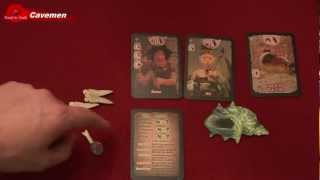
Cavemen: The Quest for Fire is a card-drafting game in which players take the role of tribal leaders. The tribes compete for opportunities to hunt dinosaurs, recruit tribesmen, and discover new technologies, vying to be the first with enough knowledge and prestige to invent fire and usher in the age of modern humanity!
You have two resources to manage: Food and Teeth. You must spend Food each turn in order to keep your Tribe from starving. Teeth indicate prestige among the tribes. Use Teeth to bid for the conch and to acquire Cavemen and Caves.
Each turn, cards are drawn from the deck to fill a common Card Pool. Players take actions based on what is available in the pool. For example, if a Beast is drawn into the Card Pool, you can hunt it for Food and claim its Teeth as a sign of your bravery.
If you hold the conch during the Action Phase, you benefit by taking your Action first and taking a second Action after everyone else has gone once. Players can bid Teeth to take control of the Conch from another player. This can be important to get the first pick of the cards in the Card Pool.
The game features 21 different inventions that allow players to evolve diverse strategies, capitalizing on their tribe's individual strengths. There are challenging decisions every turn as players must evaluate what resources are available, guess what their opponents will do, and weigh the amount of risk they're willing to take.


- Auction for the starting player adds a lot of interesting tension and is a major decision each round
- Light engine building with a variety of technologies and synergies
- Art is unique and compelling; every card is a photograph of a claymation sculpture
- Easy to teach and enjoyable with new players
- Technologies interact in engaging ways (e.g., shamanism with elders) and create engine-building depth
- Overall aesthetic and thematic vibe are strong; the art is enchanting
- Runaway leader syndrome can occur and slow down the game
- Fighting monsters is quite random and can cause abrupt casualties, which can be frustrating
- Replayability is limited due to many similar cards and a discard mechanism that reduces available options
- Many creatures and cards feel identical, reducing strategic variety
- No practical way to gang up on a leading player; game is mostly one-on-one even when asymmetrical engines exist
- High-value technologies can be discarded early, reducing long-term access to powerful options
- invention of fire and development through technologies
- a village with cave people, a tribal leader and a fighter
- explanation and demonstration of gameplay
- Crocodile
- Coconut boards
- Concordia
- Suburbia
- Suburbia Inc
Mechanics (from transcript analysis)
- Card Drafting — Most actions involve taking cards from a card row; foraging is handled separately.
- card row drafting — Most actions involve taking cards from a card row; foraging is handled separately.
- Combat with creatures — Fight creatures by meeting attack power; drawing the top card determines casualties; if casualty occurs you gain rewards and lose cave people (but not the tribal leader).
- Deck/discard mechanics — Technologies shown on the table are discarded when not purchased, and the discard pile is reshuffled later; many cards may become unavailable as the game progresses.
- End Game Bonuses — All players take one action per round; the starting player takes an extra action, effectively giving two actions.
- End of round / starting player bonus — All players take one action per round; the starting player takes an extra action, effectively giving two actions.
- Exploration with explorers — Explorers enable free exploration of caves and provide a foot symbol to allow exploring without losing the explorer.
- feeding phase — At the start of a round you feed your village; the starting player pays one food per cave person, others pay one food for the entire village.
- Foraging — Take food equal to the foraging value (apple icon) of your village.
- Recruiting cave people — Recruit fighters, explorers, thinkers, or elders by paying resources; each type provides different benefits.
- Starting-player auction — Bid teeth to determine who starts; the winner pays the bid amount to the bank.
- Technology invention — Invent technologies by having a number of light bulbs equal to the technology value; some technologies enable engine-building synergies.
Video topics + discussion points
Quotes (from this video)
- it's almost the most important decision you're gonna make in a game in a turn
- I really like the auction in this game
- the art in this game is very interesting in that every single card is unique and every single card is a photograph of an actual claymation sculpture
- I just love the art in this game
- it's easy to teach
- I enjoy playing it with new people
- I would definitely acquire it
- I really like the way these things interact with each other
References (from this video)

- Really quirky game
- Enough depth to keep experienced folks involved
- Plays quick
- Can be approached in many different ways
- Looked really weird at the time
- Might not match the perceived complexity and strategic breath
- Early civilization building, cavemen survival
- Prehistoric era
- Race for the Galaxy
Mechanics (from transcript analysis)
- Card game — A card game where players manage different types of cavemen with abilities.
- civilization building — Focuses on the very early part of civilization building.
- Engine Building — Players build an engine with their card display.
- Invention development — Players can invent early technologies, leading to different strategies.
- Resource Management — Managing resources like food and bones is crucial for survival.
Video topics + discussion points
Quotes (from this video)
- hey everybody welcome to another top 10 list today as you can tell from the title we are covering the top 10 misfit games
- jamie from the secret cabal he's a friend of mine and he's struggling right now he's recovering from esophageal cancer he's on the mend
- these are games that for whatever reason kind of just flew under the radar didn't really make a splash there's something kind of weird about them but games that i really would enjoy and recommend
- the order is actually i'm going to go from oldest to newest so we're going to go way back way back when
- this is the one game on the list i do not think you will be able to find if you can find it good luck to you
- it's hard to explain in short summary
- i think the best resident evil style board game that i've played
- i loved it and had a blast with it so there you go
- i think all these you can get on the cheap
- it's going to take a couple of plays but the rest of these it was like huh this game's kind of weird let's play this again this is weird and then we'd play it a couple times and then then actually this is actually really neat game really different and kind of a unique experience
References (from this video)
- engaging deck-building mechanic that feels thematic
- presents a compact, approachable 30-minute playtime
- strong production quality and visual aesthetic
- learns interesting dinosaur or prehistoric terms while playing
- clear, accessible rules for new players compared with heavier engines
- replay value is not guaranteed to be high across sessions
- some players reported potential steamrolling depending on player skill and tile draws
- head-swap style artwork may distract or confuse some players
- tribal resource management and invention as a driver of progress
- Prehistoric tribal society on the path to discovering fire
- lightly thematic engine-building with quick, player-driven rounds
Mechanics (from transcript analysis)
- action selection — on each turn, players choose one of five actions: recruit, hunt, invent, forge, or explore
- conch bidding — the conch token controls the turn order; owning it grants an extra action and initiates bidding cycles with tooth tokens
- Deck Building — players acquire and add center-row cards to their personal tableau to improve tribe capabilities
- deck-building — players acquire and add center-row cards to their personal tableau to improve tribe capabilities
- explore — explore to reveal caves and potentially grow your tribe’s maximum population
- forge — forge resources into food tokens by summing forge values under your control
- hunt — hunt beasts to gain food and teeth; success depends on the hunting score of your cavemen and may cause casualties
- invent — create inventions using tribal intelligence to gain lasting abilities for your tribe
- recruit — spend resources to gain a caveman from the center and add them to your tribe
Video topics + discussion points
Quotes (from this video)
- The game is really nice.
- The artwork is really cool.
- it's a deck building feel
- if you're looking for a quick deck building type game with not too many rules you should look into this one
- The Conch holder takes one additional action