




Choose Your Own Adventure: House of Danger Deep Dive
What the Community Thinks About Choose Your Own Adventure: House of Danger
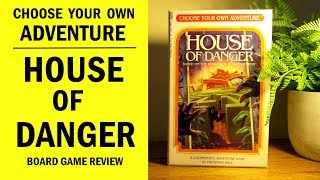
Reviewers generally treat Choose Your Own Adventure: House of Danger as a short, story-first cooperative game that succeeds on atmosphere and humor more than on mechanical depth. Board Game Sanctuary describes it as a simple, easy-to-teach game with a rich narrative that plays in about an hour. The Dice Tower's Tom Vassel calls it a silly, fun cooperative game and says it is the better of the two Choose Your Own Adventure board games. Where There's A Wilz, There's a Play offers the sharpest dissent, rating it sideways and calling it one of the bigger disappointments in their collection.
The agreement centers on the source material. Reviewers see the game as an adaptation of the Choose Your Own Adventure books by R.A. Montgomery that gives players more control than the original pages did. The disagreement is about pacing and player count. Board Game Sanctuary says the game plays best with one or two people, while the Wilz hosts found that a gap between chapters made it hard to pick the story back up.
Core Mechanics That Define Choose Your Own Adventure: House of Danger
Dice Rolling Against the Danger Level
Board Game Sanctuary explains that the danger level sets the difficulty of each challenge. To succeed, a player rolls a number equal to or higher than the current danger level, and a roll of one is always a loss while a six is always a win. A challenge booster item can add to the roll, but only if it matches the type of challenge being faced, and the item is discarded when it is used on a won challenge. Failed challenges tend to raise the danger level, which makes later checks harder. If the danger meter reaches its peak, players lose psychic points and the level resets to three.
Narrative Choice
Story cards are the core of the experience. Players draw from the chapter deck, read the flavor text, and then either face a mandatory or optional challenge or make a narrative decision. Each decision points to a numbered card, and most cards end with a choice that leads somewhere else in the chapter. Board Game Sanctuary notes that the choices can feel like guide rails in the way the original books did, with one option leading left and another leading right. Reviewers say that this randomness is part of the charm, since players often pick the most outrageous option just to see where it goes. Each chapter has an overarching goal, and a story card with a green border marks that goal as complete.
The Choose Your Own Adventure: House of Danger Experience
Comedic
Humor is the element reviewers mention most often. The Dice Tower describes a story that begins normally and then turns absurd at the end of chapter one. Board Game Sanctuary says the story moments are genuinely funny, particularly in House of Danger, and admits the narrative writing is slightly cheesy. That cheesiness is part of the nostalgic appeal, and the unpredictability is what makes the game entertaining. Players are invited to lean into silly premises, and reviewers frame the game as low-stakes fun rather than a tense strategic contest.
Narrative-Driven
Reviewers describe the game as immersive because it places players in the role of detectives and psychic investigators drawn into a mysterious mansion. Board Game Sanctuary says the game elevates the original books by making them interactive and by putting the player at the forefront of each decision. The Wilz hosts describe the experience as stepping in and out of the story, reading a passage, then managing items and dice, then returning to the narrative. That rhythm can be engrossing when the session is continuous, but it also means the plot can slip away when a chapter is split across days.
What Makes Choose Your Own Adventure: House of Danger Stand Out
Going Back Without a Reset
Board Game Sanctuary highlights how the game handles dead ends. When a player reaches a card that ends the story, they are not forced to reset the whole chapter. Instead, they return to a previous story card and continue from there, which keeps the flow of the game moving forward. Reaching the green-bordered goal card also opens the rest of the chapter, letting players revisit side areas and gather items they may need in later chapters. The reviewer argues this rewards thorough exploration without punishing an unlucky choice.
Easy to Teach and Suited to Family Play
Board Game Sanctuary presents the game as an accessible entry point. It calls the game simple, easy to teach, and perfect for families, and says it plays in about an hour. Its five chapters are designed for separate sessions, so the box works as a compact story that can sit on a shelf much like a novel. The same reviewer also notes that the game does not require other people, which makes it a practical choice for a quiet evening.
Potential Drawbacks
Limited Role for Larger Groups
Board Game Sanctuary says the game plays best with one or two players. At higher player counts, the reviewer finds that there is not much for everyone to do beyond taking a card, reading it aloud, and asking the group what they think they should do. Combat is described as a simple die roll with a modifier, which suits a single decision maker more than a crowd. The reviewer also wishes the game included a puzzle element that players could solve along the way, though acknowledges that a sequel might add one.
Difficulty Resuming Between Sessions
Where There's A Wilz, There's a Play found that the structure works against casual play. The hosts played the first chapter, waited a day or two, and could not remember what they had been doing. They suggest playing through the game quickly or keeping notes to track progress. One host notes that the original books held their attention well enough to pick up where they left off, but the board game broke that continuity. The couple ultimately rated the game sideways and called it one of the bigger disappointments in their collection.
If You Enjoy Choose Your Own Adventure: House of Danger
Board Game Sanctuary places House of Danger alongside Unlock as a candidate for game night, since both offer a short, self-contained play session that suits a small group. Players who enjoy the classic adventure feel of the game may also appreciate Return to Zork and Myst, which Board Game Sanctuary cites as examples of turning a branching narrative into an exploratory walk through an adventure. Those who like the social deduction element of House of Danger may enjoy The Resistance and Secret Hitler, which Board Game Sanctuary groups with it. For players who want more of the same format, Board Game Sanctuary points to the follow-up, War with the Evil Power Master.
What Reviewers Are Saying
"House of Danger is a simple easy to teach superbly rich storytelling cooperative adventure game that plays in about one hour. It's perfect for the family. I love how the game evokes that beautiful nostalgic value and draws itself from the source material."
— Board Game Sanctuary
"This one is hilarious because it starts off fairly normal and at the end of chapter one suddenly you go, 'Wait, what?' And it just zonkers and bonkers. And I I don't mind that at all. It's a silly fun game, a cooperative game."
— The Dice Tower
"The problem with this that we found was we played the first chapter and then it was a day or two before we played the second chapter. We didn't remember what we were doing."
— Where There's A Wilz, There's a Play