

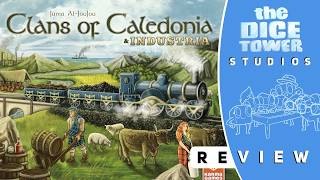



Clans of Caledonia: Industria Deep Dive
What the Community Thinks About Clans of Caledonia: Industria
Clans of Caledonia: Industria arrives as the first expansion for a beloved base game, and the community's response reflects genuine enthusiasm tempered by significant reservations. Reviewers uniformly praise Clans of Caledonia itself, often citing it as a nine out of ten or higher. Yet when it comes to Industria, opinion splits decisively. The Dice Tower and BoardGameBollocks both found the expansion disappointing, assigning it a five out of ten. Their core complaint is consistent: the expansion introduces too much complexity and mental load without proportional fun or reward. BoardGameCo approaches the modules with curiosity and hope, intrigued by what the expansion might add. The Board Gaming Doctor expresses interest in revisiting the base game with the expansion in hand. This divergence points to a fundamental tension in Industria's design, particularly around its marquee feature, the train module.
Core Mechanics That Define Clans of Caledonia: Industria
The Train Board and Delivery System
The train module forms the expansion's centerpiece. Players move trains up to two spaces on a secondary board, paying delivery costs when landing on towns or cities to unlock bonuses. The system introduces milestone mechanics, where completing deliveries earns markers that unlock locked regions, cities, and special tunnels that grant bonus actions. The delivery bonuses are visually abundant, offering resources and points for what reviewers called "wild" transactions. However, this same complexity creates friction. The iconography is dense and difficult to parse even at close distance, forcing players to reference rulebooks repeatedly. The costs to access destinations are substantial, often as expensive as fulfilling a contract that would directly earn victory points, creating a persistent tension: every resource spent on the train is a resource not spent on the core economy. Reviewers noted that despite the elaborate design, winners consistently ignored the train board entirely, suggesting it functions as optional chrome rather than a meaningful strategic layer.
Modular Map Expansions and Clan Abilities
Industria includes four new map tiles, each double-sided, introducing waterfall spaces that bridge separated tiles and create novel adjacency patterns. Nine new clans arrive with mechanics like allowing multiple tokens in a single space, creating production chains through kilts production, or offering cost reductions on expensive buildings. The expansion also includes additional port tiles and end-of-round scoring conditions. These components address a legitimate limitation of the base game, adding replayability through fresh strategic options. Reviewers appreciated this "more stuff" approach, noting that new clans open different pathways and that varied map configurations keep the core experience fresh. The contract display board likewise provides transparency about upcoming options, allowing more planning. Yet even these well-received additions come bundled with the iconography problem and cognitive overhead of the train system.
The Clans of Caledonia: Industria Experience
Intellectual Satisfaction Amid Complexity
The base game of Clans of Caledonia is celebrated for delivering intellectual depth in a compact box, a "big heavy euro that came in a teeny tiny box." Industria preserves that puzzle-solving quality in its core systems but adds layers that some reviewers felt diluted rather than enhanced the experience. The game's appeal hinges on optimizing a tight economy and building production chains. When players invest resources into the train system hoping for payoff, only to fall behind because contracts offer better value, that tension reads as poorly calibrated. Reviewers reported playing competent games where they simply ignored entire mechanics and won comfortably, which undermines the expansion's purpose.
Visual and Cognitive Overload
Multiple reviewers highlighted a shift in the expansion's presentation. The base game achieves elegance partly through clarity and restraint. The train board map, by contrast, is sprawling and visually busy. Dozens of interconnected spaces, multiple locked regions, and tightly arranged iconography create a visual puzzle that slows play. One reviewer described struggling to parse which train tracks were accessible and which remained locked because the visual distinction was unclear. The separate rulebook compounds this friction, forcing players to flip between two references mid-game. This cognitive load works against the base game's approachable appeal, transforming play sessions into exercises in rulebook consultation.
What Makes Clans of Caledonia: Industria Stand Out
Modular Content That Respects Preferences
Industria's modular design allows tables to adopt modules à la carte. Players who love the core Clans experience can layer on extra clans and map tiles without touching the train board. This architecture is genuinely thoughtful, acknowledging that not every expansion works for every table. The new clans introduce compelling asymmetries, such as clans that reduce building costs or create new production chains. The waterfall mechanic elegantly expands map variety without requiring entirely new rules. Reviewers appreciated this flexibility, with one noting that the base game "without the train board is, in our opinion, the better game," hinting that Industria succeeds when players cherry-pick its offerings.
Ambitious Economic and Milestone Systems
The delivery bonuses are genuinely enticing on paper. Reviewers acknowledged the bonuses are "wild" and can feel generous, offering resources or points that reshape the board state. The milestone progression, where unlocking cities and tunnels grants bonus actions, creates a progression fantasy that appeals to players who enjoy unlocking mechanisms. The system attempts to create meaningful interactions between the train layer and the core economy. That this intention doesn't fully land in practice reflects ambition rather than negligence. The expansion reaches for a deeper economic game, even if execution falls short of the mark.
Potential Drawbacks
Iconography Overload and Visual Complexity
The train board's delivery bonus tiles pack dozens of outcomes into small spaces, rendering them unreadable from a distance. Icons blur together, and players must constantly reference the rulebook to understand what each delivery grants. As one reviewer put it, the iconography was "such a problem" and "a struggle," requiring constant lookups even after understanding the basic system. The base game also uses icons, but reviewers only had to look up a handful before play flowed naturally. Industria reverses that ratio, making the train board feel like a rulebook-heavy subsystem grafted onto an elegant core.
Economic Misalignment and Opportunity Cost
The expansion's critical flaw is that engaging with its marquee mechanic actively weakens a player's position. Resources in the base Clans economy are deliberately tight, creating tension and forcing choices. Spending a production cycle's goods to pay a delivery cost, hoping for a bonus, competes directly with fulfilling a contract that guarantees victory points. Reviewers reported that in multiple games, the player who won ignored the train board entirely, focusing solely on contracts and core economy. One reviewer noted that when they didn't engage with the train board, they won comfortably, sometimes by a substantial margin. This outcome suggests the module is not a strategic upgrade but an optional distraction that penalizes engagement.
If You Enjoy Clans of Caledonia: Industria
Reviewers compared Industria unfavorably to Terra Mystica and Gaia Project when discussing games that layer complexity onto elegant cores. If you enjoy those titles despite their cognitive overhead, Industria's modular approach may appeal more than it does to lighter players. Yokohama, designed by the same designer who created Clans of Caledonia, offers a similar economic sandbox with route-building tension. Oranburger Canal, another heavy euro with map interaction and economic chains, scratches a similar itch without the expansion's baggage. For players content with the base Clans experience, these alternatives or simply returning to the base game deliver more consistent satisfaction than Industria's bundle of hit-or-miss modules.
What Reviewers Are Saying
"The iconography was such a problem. It was such a struggle with this industria map. So you have the delivery bonus tiles, right, and some of them are large big pictures and some of them they had to squeeze a bunch of icons into a tiny little space and so from a distance like I can't see the what it is."
- The Dice Tower
"Every time we played this, the player who won the game didn't actually use the train board at all. All the players that went over to the train board and tried to get them bonuses ended up falling way behind, sometimes by quite a substantial margin."
- BoardGameBollocks
"I think it's a fantastic game. I absolutely loved it. It's one of those games that's incredibly simple to actually play through. The game, the game complexity is not high, but the amount of decision space around that complexity is incredibly satisfying and incredibly rewarding."
- BoardGameCo