


Come Together Deep Dive
What the Community Thinks About Come Together
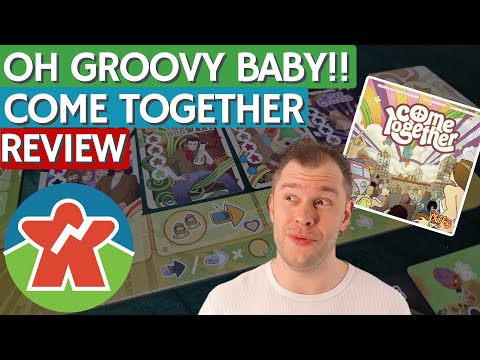
Reviewers generally agree that Come Together, published by Chili Fox Games, takes a familiar genre and bends it into something recognizable but distinct. Players organize a 1960s music festival, booking artists, building stages and campgrounds, and pushing publicity across several tracks over three festival days. Luke Hector of The Broken Meeple called it a refreshing twist on worker placement and scored it 7 out of 10. Kovray's first look at the game, filmed at Essen, described a title that improved with each play, and their later Wallacon roundup named it among the top games they played at that convention.
The main points of disagreement concern player count. Kovray found the game shines at four players, and Meeple University reported that it still plays well at five. The Broken Meeple, by contrast, recommends three or four players and found that larger groups stretch the game past its welcome. Rahdo Runs Through included Come Together in a top 100 countdown of all time, praising its interaction and crunch. Sir Thecos placed it in a middle tier in a monthly ranking, calling the theme excellent but the gameplay merely okay.
Core Mechanics That Define Come Together
Worker Placement
Come Together is a worker placement game with a deliberate delay built into its rewards. Placing a worker on one of the four locations grants only that space's immediate bonus, while the card above it is claimed later, when a player spends a turn activating the location and every worker present there triggers at once. The Broken Meeple described the resulting dilemma as the choice between the card a player truly wants and a less attractive card that brings more publicity by joining other players. Kovray noted the tug and pull of this design: a location you would rather skip may still be worth joining, because someone else will activate it and you will lose publicity if you wait.
Retrieving workers is the second half of this cycle. Workers do not return to a personal mat after activation, so players must periodically spend a turn retrieving them. Meeple University explained the choice that follows: a player can take a new worker from the reserve, discard an active worker to take an immediate extra placement action, or draw a card. Jamie of Stonemire Games highlighted the discard option as a way to take back-to-back turns, a feeling compared to the double turns found in Scout. Kovray likened the ongoing cycle of placing and retrieving to Honey Buzz, a builder that keeps going without imposing much structure on each round.
Compound Scoring
Final standings in Come Together are built from several independently tallied categories rather than one dominant track. Publicity is spread across radio, television, and newspaper tracks on each player board, with a magazine track on camp cards. At the end of each round, Kovray explained that up-and-coming performers score according to the player's radial publicity track, while star performers score according to the television track, with stage points for matching meeples added on top. Each round also resolves a newspaper objective whose reward or penalty depends on how far a player has climbed the newspaper track, and Meeple University noted that this track resets every round.
The game then closes with end-game bonuses. The player with the most remaining meeples in their camp gains points, the player with the fewest loses points, and completed booths between stages add further scoring. Because so many categories feed the total, The Broken Meeple observed that players who ignored the newspaper objectives had lost every game, while Kovray recalled losing a game by two points after a single newspaper misstep.
The Come Together Experience
Tense Timing
Playing Come Together feels like watching a crowd gather and waiting to see when the music starts. Because a location activates only when a player chooses to trigger it, reviewers describe a constant calculation about who is about to act and where. Meeple University described the pressure at the end of a round, when a player who has not positioned workers at the right location can lose three or four publicity advancements in a single activation. That reviewer called this the game's unforgiving side, and admitted that the punishing timing was exactly what they liked about it.
Festival Atmosphere
The theme is the other half of the experience. Reviewers praise how the game conveys the bustle of a summer festival, from the bright artwork and screen-printed meeples to the way artists are booked for specific stages. Kovray said the theme really does shine as the game flows, and Sir Thecos rated the theme far higher than the mechanics. The Broken Meeple enjoyed the wordplay that names artists after board games, such as Wiki Culture for Viticulture or Tiny Towns, and described the result as a charming gimmick that fits the 60s setting. Kovray also compared the experience to Woodstock, noting that players who have attended festivals will recognize the choices of tents, crowds, and set times.
What Makes Come Together Stand Out
Shared Activations That Keep Everyone Involved
Reviewers consistently point to group activation as the feature that reduces downtime. Jamie described the positive player interaction as a feeling that works well: when a location activates, each player with workers there advances on the publicity tracks once for every occupied space, so a crowded location pays out for everyone. The Broken Meeple said the design keeps turns fluid, since players are not simply taking actions one after another and can instead join activations and react to the table. Meeple University singled out the timing and interaction between players as the elements they enjoyed most.
Presentation and Reference Materials
Reviewers also praise how well Come Together is produced for its price. The Broken Meeple singled out the colorful cards, screen-printed meeples, wooden flower power tokens, and the reference card, which the reviewer called one of the best seen in a while. That card lets new players understand the actions and the step-by-step activation process with little help from the rulebook.
Potential Drawbacks
Player Count Scaling
The most common reservation concerns games with five or six players. The Broken Meeple argued that the board does not scale well beyond four because only one or two extra activation spaces are added, which leaves locations activating unpredictably and crowded spaces cornering off important actions. That reviewer also noted that four-player games can pass 90 minutes and that six-player games become messy to coordinate. The two-player variant uses a neutral opponent that adds a page of rules and a layer of randomness, and The Broken Meeple recommended three human opponents over two. The solo mode was described as easier to learn and quick to play, though the reviewer wished for a more developed automated opponent.
Newspaper Pressure and Iconography
Some reviewers felt that the newspaper objective pushes players toward a narrow route. The Broken Meeple noted that the newspaper tiles can be worth up to 12 points, and that a poor showing can cost points, so players often feel forced to chase specific meeple types rather than follow their own plans. Kovray warned that the game uses a great deal of iconography, and that the opening turns can feel overwhelming because each card and location adds nuances to learn. Kovray cautioned that players seeking a lighter experience may want something else, while The Broken Meeple found the reference card made the learning curve manageable.
If You Enjoy Come Together
Players who enjoy Come Together's worker placement will find related satisfaction in several titles that the reviewers themselves used as comparisons.
- Honey Buzz: Kovray compared the way workers are locked up until a row activates, and the way retrieval resets the board, to Come Together's central rhythm.
- Viticulture: Kovray linked the interconnected steps of building a festival, from camps to artists to newspaper bonuses, to the chain of interlocking actions in Viticulture.
- Lords of Waterdeep: The Broken Meeple drew a parallel with buildings that other players can use, offering a reward to anyone who visits them.
- The Manhattan Project Series: The Broken Meeple compared the way workers return at different points in a round to the dynamic timing found in that series.
- Architects of the West Kingdom: The Broken Meeple contrasted Come Together's worker pool, which grows through retrieval, with Architects, where players start with all their workers.
- Scout: Jamie cited Scout as an example of how a double turn can feel as satisfying as gaining a new worker, which mirrors Come Together's discard option.
What Reviewers Are Saying
"The more that we played it, the more it connected to my soul. There's just a lot of things in it that are just so clever and makes me want to come back to it."
— Kovray
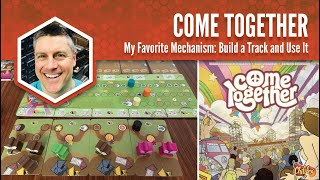
"I think this is brilliant. I know there are a few games that have this, but this was a reminder to me how enjoyable it is to not just have a preset track, but to be able to build the track as you go."
— Jamie, Stonemire Games
"Come Together makes for a very refreshing twist on the typical worker placement genre, and if you're gonna make a name for yourself in the genre, you have to do something different."
— Luke Hector, The Broken Meeple