







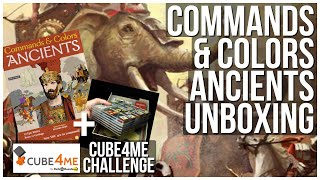
Commands & Colors: Ancients Deep Dive
What the Community Thinks About Commands & Colors: Ancients
Reviewers consistently treat Commands & Colors: Ancients as one of the most respected wargames of the past two decades, and most of them place it as the most tactically demanding entry in the Commands & Colors family. Tom Vasel of The Dice Tower ranked it alongside Memoir '44 on a long-running personal top 100 list, arguing that Ancients is the better game because its play revolves around lines, controlling leaders, and not letting your line get broken. The same channel's later look-back review still gave it an 8 out of 10, while noting that the reviewer no longer played it as often.
The debate among reviewers is less about quality than about fit. The consensus is that Ancients rewards a player who wants to think hard and outflank an opponent, while Memoir '44 is the friendlier, more streamlined choice for a casual evening. When Harry Met Board Games described Ancients as the superior game for a thinking person's table, pointing to the much greater variety between unit types and how they move and attack. Several reviewers also acknowledged that the wooden-block presentation is less visually striking than the miniatures in Memoir '44, a point that did not seem to diminish their enthusiasm for the gameplay.
Core Mechanics That Define Commands & Colors: Ancients
Command Cards and Section Activation
The defining feature of the system, which Richard Borg designed and GMT Games publishes, is the division of the battlefield into three sections: center, left flank, and right flank. In Zilla Blitz's unboxing, the reviewer explained that the command deck is built around section cards that activate a specific section of your army, and that this section-based activation is one of the defining features of the system. Basic order cards direct a set number of units in one section, while separate tactics cards allow more unusual actions such as a double-time move for a small group of units or a first-strike order.
The Discriminating Gamer, Cody Carlson, described the same flow in more practical terms. Players are constantly playing cards to activate a set number of units in one part of the board, and an opponent's sections are mirrored, so every decision involves choosing which flank to commit to and when. This means that the cards you hold are never just a shopping list of actions. They dictate where your strength is concentrated, and they are the main source of the "line" play that reviewers praised.
Unit-Specific Battle Dice
The second mechanic that reviewers describe is combat resolution. Ancients does not use standard numbered dice. Each battle die shows icons such as colored squares, triangles, swords, and flags, and the result of a roll depends on the type of unit involved. Zilla Blitz noted that the dice are not a straight numerical system but an integration of a combat results table with the icons on each face, with separate reference cards covering ranged and close combat, foot and mounted units, and the leaders who can influence a fight.
Cody Carlson pointed to the same feature when praising the game's "great dice combat" and the ranged abilities of archers. Because a unit's class determines which icons count, a roll that looks disappointing on paper can still be useful against the right target. This is the link between the dice and the card system that reviewers repeatedly singled out.
The Commands & Colors: Ancients Experience
A Tactical Battlefield Feel
Reviewers consistently describe Ancients as a game that feels like commanding real troops across a real landscape. Zilla Blitz was struck by the scale of the map, which is 30 inches by 20 inches with hexes that are about two and a quarter inches across, and by the way the stacked blocks give the table a miniatures-like presence despite the small footprint of the play area. Tom Vasel summed up the emotional core of the experience as line-keeping: the satisfaction of holding a formation together while looking for the moment to flank the opponent.
Players who come to the game expecting a light skirmish are often surprised by how much it asks of them. The Discriminating Gamer's comment that the system has "great dice combat" and a strong theme points to the way the battle feels grounded in the period, with each unit's role clearly reflected in the rules rather than in abstract stats.
Tense, Thinking-Person's Play
The second feeling that reviewers mention is tension. Because every turn depends on the cards in hand and the dice that land, players must weigh a plan against the possibility that the cards will not cooperate. Tom Vasel describes the choice between a strategic line-control game and a looser battle of tanks, artillery, and troops as a matter of mood, but makes clear that Ancients is the version that demands sustained concentration. The Board Games UnLocked channel made a similar point about the broader system, observing that these games can be decided by a series of tight, consequential choices rather than by luck alone.
What Makes Commands & Colors: Ancients Stand Out
Tactical Depth Beyond Memoir '44
The most common praise is that Ancients offers more tactical depth than its sibling system. When Harry compared it to Memoir '44, the point was not that Memoir '44 is weak, but that Ancients offers more variety in how units maneuver and attack, which turns the game into a more thoughtful contest. Tom Vasel's preference for Ancients rested on the same idea, and The Discriminating Gamer called it "the most tactically involved of all the Commands and Colors games."
A Family of Games Built on One System
Reviewers also value the fact that Ancients is the foundation of a long line of wargames. Zilla Blitz traced the lineage from Battle Cry and Memoir '44 through Commands & Colors Napoleonics, Commands & Colors Medieval, Commands & Colors Samurai Battles, Great War: Red Alert, and Jacobite Rising, and noted that the system has defined wargaming for roughly twenty years. Pair Of Dice Paradise made the point that Battle Lore uses the same system but applies it to a completely different setting, which reviewers saw as proof that the mechanics can carry very different themes.
Potential Drawbacks
Component Prep and Presentation
The most practical concern is the work required before the first game. Zilla Blitz spent a considerable amount of time applying double-sided stickers to the blocks, comparing the job to watching several sporting events back to back, and found that the included storage arrangement was not obvious. The reviewer had to work out on their own which trays could be single-stacked and which could be double-stacked, and wished for instructions or a link to a setup guide. Tom Vasel also noted that the game is not as visually impressive as miniatures-based titles and that the stickering is a chore.
A Demanding Fit for Casual Tables
Reviewers are generally clear that Ancients is not the easiest entry point. Tom Vasel explained that the choice between Ancients and Memoir '44 comes down to what the group wants that day, and Harry described Memoir '44 as the more streamlined and Gateway-friendly option. Players who want a quick, low-commitment wargame may find Ancients heavier, and the strategic depth that reviewers praise is also what makes it a poor match for a relaxed evening.
If You Enjoy Commands & Colors: Ancients
Players who enjoy Commands & Colors: Ancients's section-based command cards will find similar satisfaction in Memoir '44, which uses the same system with a World War II setting and a more accessible rules footprint. Reviewers describe it as the most streamlined and intuitive member of the family, making it a natural next step for groups that want the same feel with less friction.
Players who appreciate the battle dice and flank control can explore Commands & Colors: Samurai Battles, which The Discriminating Gamer praised for its dragon cards and for keeping the core activation-and-dice gameplay intact. Commands & Colors: Napoleonics and Commands & Colors: Medieval extend the same tactical approach to later periods, and Battle Lore applies the system to a fantasy setting that Pair Of Dice Paradise considered a meaningful contrast. For players drawn to the system's historical depth, Great War: Red Alert and Jacobite Rising from the same family offer different campaigns with the same underlying flow of cards, flanks, and dice.
What Reviewers Are Saying
"Commands and Colors Ancients, don't get me wrong, an amazing game. I don't play it as much these days. Hence, now I'm giving it an eight out of 10. But still, if you want the most tactically involved of all the Commands and Colors games, this definitely is it."
— Tom Vasel, The Dice Tower
"I think commands and colors system is definitely one of those kind of iconic systems that have defined wargaming over the past 20 years. Now this game here was really kind of if you would the almost the third game system that used the commands and color system."
— Zilla Blitz
"This obviously uses the same system as Battle Lore, but it's for a completely different time period. And I hear people talk about these games still. They're not the same game just because they use the same system."
— Pair Of Dice Paradise