/pic918568.jpg)
/pic6738336.jpg)
/pic1387599.jpg)
/pic6738101.jpg)
Dixit Odyssey is both a standalone game and an expansion (Dixit: Odyssey (expansion)) for Jean-Louis Roubira's Dixit, which won Germany's Spiel des Jahres award in 2010.
Game play in Dixit Odyssey matches that of Dixit: Each turn one player is the storyteller. This player secretly chooses one card in his hand, then gives a word or sentence to describe this card—but not too obviously. Each other player chooses a card in hand that matches this word/sentence and gives it to the storyteller. The storyteller then lays out the cards, and all other players vote on which card belongs to the storyteller. If no one or everyone guesses the storyteller's card, the storyteller receives no points and all players receive two; otherwise the storyteller and the correct guesser(s) each receive three points. Players score one point for each vote their image receives. Players refill their hands, and the next player becomes the storyteller. When the deck runs out, the player with the most points wins.
Dixit Odyssey contains 84 new cards, each with a unique image drawn by Pierô and colored by Marie Cardouat, artist of Dixit and Dixit 2. The stand alone version also includes a folding game board, 6 new rabbit scoring tokens (12 total), and a box large enough to hold all the Dixit cards released to date. The stand alone version of Dixit Odyssey includes enough components for up to twelve players and also has variant rules for team play and for new ways to play with the cards.
Expansion versus standalone versions of the game.
Standalone version is in a square box (released in 2011 but may still be available).
Expansion version is in a rectangular box (available from 2013 onwards): Dixit: Odyssey (expansion)
Part of the Dixit family — see Dixit for the combined view.
/pic918568.jpg)
/pic7403703.png)


- Feels better at six players
- Perfect amount of noise and creativity at six
- Captures the feeling of knowing what someone meant and trying to mess with them
- Too clear and you score nothing.
- Too obscure and you also score nothing.
- Surreal illustrated cards
- Giving and interpreting clues
Mechanics (from transcript analysis)
- Deduction — Scoring is the clever bit. If everyone finds the storyteller's card or if nobody finds it, the storyteller scores zero and everyone else gets two points. If some people find it but not all, the storyteller and the people who guessed correctly each get three. You also score bonus points for every vote your own decoy card received, up to a maximum of three.
- Hand Management — Everyone else secretly chooses a card from their own hand that they think matches that clue.
- Storytelling — One person is the storyteller. Each turn they look at their hand of these surreal illustrated cards, pick one, and give a clue. A word, a phrase, a quote, whatever comes to mind.
- Voting — All the cards go into a central pile, get shuffled, and then you vote.
Video topics + discussion points
Quotes (from this video)
- So today, I want to walk through the ones that actually feel better when that six person sits down.
- Six is hard. Most games either drag or fall apart under it.
- These 11 are the ones that actually reward having the extra players at the table.
- Choose according to how much time and how much table talk your group can handle.
References (from this video)
- Accessible and social; great for casual players
- Encourages conversation and imagination
- Works well with large groups
- Less depth for strategic gamers
- Scoring can feel opaque for newcomers
- Imaginative storytelling through associations
- Fantasy storytelling world illustrated on abstract art cards
- whimsical and surreal
- Apples to Apples
Mechanics (from transcript analysis)
- card drafting and clue-based storytelling — One player selects a card and gives a clue; others choose a card that could relate; players guess which card matches the clue.
Video topics + discussion points
Quotes (from this video)
- one player chooses a card and says any word or words that might relate to it
- every answer feels kind of right and every card is inherently interesting
- it is all kind of zen and people get so wrapped up in the pictures and the guessing that it is rare that anybody gets too serious about the score
- flip a card then everyone draws the tetra shape on their maps
- the rules are simple
- you all play it once all the time
- the lines on one card need to match the lines on the other
- this is an ultra fast and ultra messy card game
- the art is adorable look at those guys
- draft asaurus which plays up to five all the fun of drafting but with the cool tactile pieces shaped like dinosaurs
- survive escape atlantis
References (from this video)
Mechanics (from transcript analysis)
Video topics + discussion points
Quotes (from this video)
- Times Up, one of the greatest party games ever.
- Pictures is a game I don't understand.
- Just One's such a great game. It works in every situation.
- Detective Club where everyone's lying.
References (from this video)
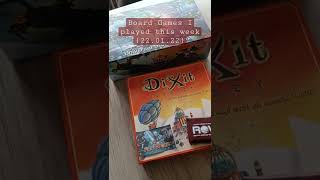
- Accessible party game
- Re-plays well in social settings
- Great addition to any collection
- Potential for chaos without good facilitator
- creative storytelling and interpretation
Mechanics (from transcript analysis)
Video topics + discussion points
Quotes (from this video)
- here what there's echoes and let me show
- okay of course i played star wars again
- i played more than 200 games by now
- also played dixit odyssey again
- i like ascension tech building
- record quite soon for the channel
- keep an eye out for that
- what did you play this week
- cheers