


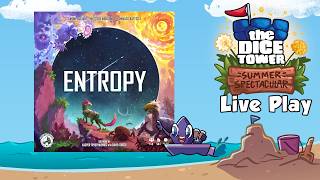

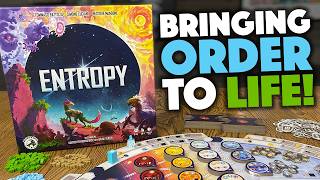
Entropy box art

Entropy

Game Info
Year
2015
Players
1-4
Age
Playtime
Publisher
Collection
Ratings
Creator Score
Mechanic profile
Percentile rank vs. all games
Vibe profile
How this game feels to play
Description

Entropy is a competitive card game of risk, deception and action management for 2 to 6 players.

Five parallel worlds have collided, forming a Nexus where time and space is folded unto itself. You play as one of five characters jettisoned from their world and into the Nexus. Through the use of unique character abilities and special actions, players must find fragments of their reality and be the first to piece them back together in order to find their way back home.

Each turn players select an action card in secret. Once players are ready, they simultaneously reveal their selected card. Players then resolve the chosen action in order of the card's initiative, with a value of 1 going first.

Should two or more players select the same action, a temporal clash occurs and players involved in the clash do not get to resolve their action.

After four actions have been played, the game moves into a temporal reset phase. During this phase, all cards in the discard pile are shuffled back into the Nexus deck. Players then return played action cards back to their hand and a new round begins.

The game continues until one player have revealed all four fragments from their character's reality.

Ask a Rules Question
All mentions
Browse transcript mentions, sentiments, pros/cons, mechanics, topics, quotes, and references.
Total mentions: 60
This page: 10
Sentiment: pos 8 · mix 0 · neu 1 · neg 0
Mentions per page
Showing 51–60 of 60
Video OIIbtLxGv6s Tantrum House Preview at 1:13 sentiment: positive
Tantrum House - Entropy video thumbnail
Click to watch at 1:13 · YouTube ↗
Overall sentiment (raw)
positive
Pros
  • really enjoyed it
Cons
none
Thematic elements
none
Comparison games
none
Mechanics (from transcript analysis)
Mechanics unknown.
Video topics + discussion points
No key topics recorded for this video.
Quotes (from this video)
  • Let me know in the comments which ones you're interested.
  • Let me know in the comments which one you want us to talk about next.
References (from this video)
No references stored for this video.
Video YklseJ6Dkhw Board Gaming Ramblings Discussion at 3:55 sentiment: neutral
Board Gaming Ramblings - Entropy video thumbnail
Click to watch at 3:55 · YouTube ↗
Overall sentiment (raw)
neutral
Pros
none
Cons
none
Thematic elements
none
Comparison games
none
Mechanics (from transcript analysis)
Mechanics unknown.
Video topics + discussion points
No key topics recorded for this video.
Quotes (from this video)
  • We played games again this month. Maybe Yes, but almost a couple of months ago we almost didn't play games.
  • The longest trick taking Two Towers trick taking game.
  • I had so much fun playing Flip 7 the other day.
  • My biggest letdown was Luna.
  • My biggest surprise this game also was like a really strong contender for most fun experience because we couldn't stop like laughing when we played this game.
  • My number three was the Lord of the Rings: The Two Towers trick-taking game.
  • My number three was Lands of Ever Shade.
  • My number two is Architects of the West Kingdom.
  • My number one is Rosalee.
References (from this video)
No references stored for this video.
Video 8VVJvd2RdLs Going Analog Analysis at 6:23 sentiment: positive
Going Analog - Entropy video thumbnail
Click to watch at 6:23 · YouTube ↗
Overall sentiment (raw)
positive
Pros
  • The rondel system is unique and fun.
  • High quality production from Board and Dice.
  • Offers a lot of variety and strategic depth.
  • Fascinating timing and choices.
  • Feels like an open universe with many directions to explore.
Cons
  • May not be for players who dislike multiplayer solitaire.
  • Endgame scoring could feel uneven, with less incentive once milestones are hit.
  • The actual endgame scoring is not as exciting as the core gameplay for one reviewer.
Thematic elements
  • World building, creating solar systems, planets, and life
  • Universe/Space
Comparison games
Mechanics (from transcript analysis)
  • Engine Building — Players build up planets, stars, and biomes, which grant bonuses and make actions more powerful, leading to combos.
  • Race — Players compete for objectives and milestones, with the first to complete certain goals receiving points.
  • Rondel — Players move around a rondel, choosing how many spaces to advance, with bonuses for shorter moves and cooldowns for major actions.
  • Set Collection — Players collect different forms of life and upgrade stars and planets, with bonuses associated with each.
Video topics + discussion points
No key topics recorded for this video.
Quotes (from this video)
  • So, we have noticed,
  • Everyone I've shown it to all they all walk away like really loving it and really impressed or really drawn deep into it.
  • The trick taking part is very straightforward. There's no kind of twist there but all the cards you get in the different suits you will take them backwards.
  • So, first you deal everyone the cards and then you're going to sort them by color and within each color ascending or descending in one direction and then you're going to hand those cards over to your person on your left face down.
  • It's like mixing logic deduction with trick taking and it's uh very clever.
  • It's such an honest. You just have this table of everyone's looking at each other's cards like spin that towards me. Look at this.
  • It feels really good. Yeah, great pick. My gosh.
  • It's kind of like Dominion mixed with tricking.
  • So you're playing trick ticking, but often times, uh, players, I know I mentioned this, but want more control over their hand. So, your deck building, you're putting whatever you want into your hand.
  • It gets a little wacky. It's definitely um uh yeah it it's you can build the market so you can you can kind of create really wild setups.
  • And then we are super excited. I'm doing the um kind of final touches on sail legacy. So, I'm super excited for that to come out. It is just such a big game. So my goodness.
  • And then um just some of the projects. I know the return of the king is coming out later, so I'm super excited for folks to um catch that. Um it's the kind of big finale to all the trick taking ones.
References (from this video)
No references stored for this video.
Video Mq3AqquzOSs The Brothers Murph Top List at 27:52 sentiment: other
The Brothers Murph - Entropy video thumbnail
Click to watch at 27:52 · YouTube ↗
Overall sentiment (raw)
Very excited
Pros
  • Unique rondelle mechanism with strategic movement choices
  • Satisfying engine building potential
  • Visually stunning with colorful, alien art
  • Engaging sci-fi and 'god simulator' theme
  • Designed by a renowned designer (Simone Luchiani)
Cons
none
Thematic elements
  • Creation and simulation
  • Space
  • God simulator
Comparison games
Mechanics (from transcript analysis)
  • action selection — moving around the circular board taking actions to essentially thematically like we're in a simulation
  • Engine Building — you're just racing to kind of build this like huge engine for yourself uh as you kind of go around
  • Rondel — This game is a rondelle game where you are going to be uh moving around the circular board taking actions
  • Set Collection — creating stars, building solar systems, uh populating those solar systems with planets, right? Um and then uh playing down life cards. So essentially there's like bacteria, plant life, and animal life.
  • Variable player powers — Simone Luchiani among them uh that did Barrage.
Video topics + discussion points
No key topics recorded for this video.
Quotes (from this video)
  • The last game I ever expected to exist, uh, Mountain Ghost Legacy, and now I really want it.
  • Maestro is an interesting game where it's like a two I think maybe you can play it three, but it's like basically a two to four player game.
  • I love Operation Barlay. So anything by Salt and Pepper that's like in their two-player line. I'm immediately like I want it. I want to try it.
  • They they're CGE games are very often our number one game of the year. Yeah, they are just so consistently good. Like they just do such a good job.
  • This game is a rondelle game where you are going to be uh moving around the circular board taking actions to essentially thematically like we're in a simulation.
  • I really enjoy these kind of like god simulator games I think it's an interesting thematic space to play in where you're like ah you're like just making stuff and seeing what happens and it's just it's a cool kind of place to be in and so like I I really really enjoy it.
References (from this video)
No references stored for this video.
Video bmbUFPsuZqU News at 1:42 sentiment: positive
Entropy video thumbnail
Click to watch at 1:42 · YouTube ↗
Overall sentiment (raw)
positive
Pros
  • Liked it a lot.
  • Player-determined end game is preferred.
  • Actions become more powerful as the game progresses.
Cons
  • Too many amazing Eurogames make it hard to be selective.
  • November delivery is the only option currently.
  • Gen Con and August delivery options are temporarily sold out.
Thematic elements
  • Entropy of the universe used to create galaxies
Comparison games
none
Mechanics (from transcript analysis)
  • Engine Building — Players upgrade suns, build planets, and fulfill habitats to increase action power and scoring multipliers.
  • Rondel — Players move scientists around a rondel to take actions.
  • Set Collection — Players collect planet tiles and life forms to fulfill habitat requirements.
Video topics + discussion points
No key topics recorded for this video.
Quotes (from this video)
  • If you've been around for a bit on the channel, then you know that I have the series Chewback or Not to Back, one of my most popular series, but one that I ultimately stopped doing for a variety of reasons.
  • I'm not yet sure if it's a keeper for me. There's many things that I really enjoyed, and I do want more plays out of it for now, but it's one of those games that the biggest problem with Entropy, as far as I'm concerned, is that there are so many amazing Eurogames, and I have to be very particular which games actually get my time versus which games do I want to give more time to.
  • I don't think games need to be forever.
  • These are by far the best swappable dice faces I have ever played in any game.
  • The testimonial they have of Blatro is like, 'These dice really work well.' Which is true. The dice do really work well, and I was concerned they wouldn't.
  • For clarity, I love the game. I thought it was great.
References (from this video)
No references stored for this video.
Video phj1-3l_5dU Review at 0:04 sentiment: positive
Entropy video thumbnail
Click to watch at 0:04 · YouTube ↗
Overall sentiment (raw)
positive
Pros
  • Actions quickly become 'combatastic' (combabilistic).
  • New planets, life, and stars gain better actions.
  • Biomes combo with actions.
  • Powerful stars generate victory points.
  • Race to generate life.
  • End game objectives worth more by advancing on a track.
  • Filling tableau with solar systems and chasing goals leads to winning.
Cons
none
Thematic elements
  • Shaping solar systems with entropy and filling planets with life.
  • solar systems
Comparison games
none
Mechanics (from transcript analysis)
  • Engine Building — Players gain better actions by upgrading solar systems with stars, planets, and life, which then combo with their existing actions.
  • Rondel — Players move around a rondel, choosing actions on the inner or outer path. Action selection is limited by a creation token which requires a full lap to retrieve.
  • Set Collection — Chasing end game objectives and filling a tableau with solar systems implies a form of set collection or objective fulfillment.
  • Tableau Building — Players fill their player area with solar systems.
Video topics + discussion points
No key topics recorded for this video.
Quotes (from this video)
  • Shape solar systems with entropy.
  • Timing the rondel action is the key because those actions are the ones that give you most points.
  • A few simple actions quickly become combatastic since new planets, life, and stars all find ways of gaining you better and better actions and biomes combo with the actions you're already taking.
References (from this video)
No references stored for this video.
Video idbjMEfkAdU Rules Teach at 1:00 sentiment: positive
Entropy video thumbnail
Click to watch at 1:00 · YouTube ↗
Overall sentiment (raw)
positive
Pros
  • Cascading bonuses
  • Engine building potential
  • Tactile component interaction
  • Multiple paths to objectives and endgame triggers
  • Interesting upgrade paths for suns and actions
Cons
none
Thematic elements
  • creating new galaxies, solar systems, planets, biomes, and life
  • sci-fi galaxy
Comparison games
none
Mechanics (from transcript analysis)
  • Action Point Allowance — Players have movement options (1, 2, or 3 spaces) which influences bonuses and options.
  • Area Control — Implicit in creating solar systems and competing for objectives, with players aiming to have the most of certain elements.
  • Resource Management — Players manage resources like entropy and mass to perform actions and build components.
  • Rondel — Action spaces are arranged around the outside, and players move their workers along the rondel to take actions, with bonuses depending on distance traveled and if others are in the space.
  • Set Collection — Players collect different types of life forms and upgrade biomes, and potentially aim for specific combinations of planets or suns for scoring.
  • Tableau Building — Players build up their own player board with planets, suns, biomes, and life forms.
  • Worker Placement — Players use little workers to move along action spaces on the rondel.
Video topics + discussion points
No key topics recorded for this video.
Quotes (from this video)
  • Entropy, which is a big Euro set in space.
  • This is going to be a Rondel action game.
  • The less you travel, the better you get.
  • Cascading bonuses.
  • I really want to be able to play some cards out here.
  • So, every planet can only have one biome, which makes sense, right? This is Star Wars planet rules. You're a desert. The whole planet desert.
  • As you upgrade these suns, they're uh their entrop, you pay entropy to activate their actions, they're so much better.
  • You're tempted to kind of go wide with lots of solar systems. You're also tempted to upgrade a single one. It's super far.
References (from this video)
No references stored for this video.
Video XMGhxyPkZmY Top List at 8:00 sentiment: positive
Entropy video thumbnail
Click to watch at 8:00 · YouTube ↗
Overall sentiment (raw)
positive
Pros
  • Heavy Euro with lots of decisions.
  • Unique worker movement/sliding mechanics.
  • Colorful theme and components.
Cons
none
Thematic elements
  • Space, time, meteorites, and evolution.
  • Space
Comparison games
none
Mechanics (from transcript analysis)
  • Resource Management — Actions give planets and cards to create organisms.
  • Set Collection — Collecting planets and cards to create organisms.
  • worker movement — Scientists (workers) move around the board to use actions.
  • Worker Sliding — A unique mechanic involving sliding workers.
Video topics + discussion points
No key topics recorded for this video.
Quotes (from this video)
  • It's time for the hottest board games of the month.
  • I don't know what shug means, but I don't know what shug is.
  • I would say that this is a game where you take Talisman and then add a party game to it and this is what you get.
  • Lightning train arrived like a lightning. And I don't know, will it stay here?
  • Why is it suddenly hot? Well, we have that game and we have also the reason why it's hot right here in the studio.
  • This month is a unique worker game. Why a unique worker? Because usually it's worker placement, but this time it's going to be worker movement and worker sliding.
  • Osprey Games have announced that they're going to close their board game line. So, get their games while they last.
  • Eight dragons has a little bit of set collection, a little bit of worker pushing, unique components.
  • This is a deck builder.
  • Harmonies is a little chill game where you're building your little plot of land right here trying to satisfy requirements of different animal cards.
  • This is a secret worker placement.
  • So, the unique secret worker placement, the moving up the tracks makes this a very unique experience.
  • I still feel like Wondrous Creatures is the most wondrous game on this list.
References (from this video)
No references stored for this video.
Video esGICwOw3MU Review at 0:02 sentiment: positive
Entropy video thumbnail
Click to watch at 0:02 · YouTube ↗
Overall sentiment (raw)
positive
Pros
  • Satisfying turns and combos
  • Modern and colorful euro aesthetic
  • Strategic depth with meaningful decisions
  • Built-in tension and player interaction
Cons
  • Can feel crowded in a four-player game
  • Requires careful planning to avoid discarding valuable scoring cards
Thematic elements
  • harnessing entropy to create life
  • the evolution of the universe
Comparison games
Mechanics (from transcript analysis)
  • action selection — The moving of your piece, the taking of your action is pretty straightforward.
  • Engine Building — All of these different elements include engine building, a significant amount of engine building in the game.
  • Resource Management — You're going to want to take those into consideration. And then mechanically, like Ryan alluded to, this revolves around this sort of Rondelle system.
  • Rondelle — This revolves around this sort of Rondelle system. It's a conditional rondelle system because you're not simply moving your piece around to the next place that you want to use and using it.
  • Set Collection — Some of them require you to get rid of something as well. But when you're playing a card, you can also discard one other card to fulfill one of those icons as long as it's on the card.
  • Tableau Building — A lot of that is into the tableau building and and using a lot of that is using these these creation discs.
  • Worker Placement — If there's someone else there, kind of like some worker placement games, if there's someone else there, there's maybe a little bit of a penalty.
Video topics + discussion points
No key topics recorded for this video.
Quotes (from this video)
  • This is Entropy and this has a design team behind it that is going to be music to any Euro lover's ears.
  • His last three major designs, which I've all loved, have an element of round.
  • This really is like this is a at its heart a rondelle.
  • This is a more modern colorful feel and thematically this is like we're we're throwing a lot of names at you. I know that. Uh, but this is like in video game terms a game by Will Wright.
  • The puzzle of the game is watching what other players are doing, figuring out how many steps you want to move to really maximize what you're doing on a turn.
  • The decisions I feel like compound to a really satisfying Yeah. uh turn because when you hit it, when you bounce everything in the right way to like pull off one of those big turns, you do feel pretty smart.
  • That turn in and of itself was an absolute blast.
  • It is definitely one of those games where you think don't take that David I need two more turns and if you take that then the game ends and I only get one more that definitely factors into it.
  • There's that tension. I guess less of a race and more of just a built-in tension of like should I do this now or are they going to do this?
  • It's a very strategic game. It's a very deterministic game. I would say there's like little no look practically in this game other than the fact that they've split the decks.
References (from this video)
No references stored for this video.
Video nm04IBHQeo0 Rules Teach at 2:45 sentiment: positive
Entropy video thumbnail
Click to watch at 2:45 · YouTube ↗
Overall sentiment (raw)
positive
Pros
  • The game offers considerable strategic depth with various upgrade paths and scoring opportunities.
  • The interaction between mechanics like star evolution, biome placement, and card play creates interesting combos.
  • The game leads to very close and tense finishes.
  • The game has good component quality and table presence (implied by 'cute little pieces of wood').
Cons
  • The game rules, particularly around traffic bonuses and biome bonuses, can be complex and lead to mistakes if not followed precisely.
  • The 'wild marker' mechanic for gaining the marker back via a different route means you don't get the bonus, which is a subtle but important rule.
  • The game can feel slow at the start due to the need to build up resources and upgrade cards.
Thematic elements
  • Creating life and stars through harnessing entropy.
  • Way into the future where humanity has learned to understand and harness entropy, allowing them to create their own stars, evolve stars, coalesce planets from matter, and create life on planets, becoming superpowered gods.
Comparison games
Mechanics (from transcript analysis)
  • action selection — Players move their scientist to spaces on the board to perform actions, which are categorized as main (inner) or secondary (outer) actions.
  • Area Majority — The game features scoring objectives that award points based on having the most of certain types of planets or biomes.
  • Card Drafting — Players draw life form cards, and there is an opportunity to choose which cards to take from a revealed selection.
  • Route Building — Evolving stars involves moving along a progression of tiers, from 1B to higher levels like 2A, 2B, 2C, 3B, 3C, 3D, 4B, 4C.
  • Set Collection — Collecting different types of stars and life forms contributes to victory points and fulfills certain requirements for other actions.
  • Take That — Asteroids can be placed on planets to destroy life forms, which is a direct player interaction.
  • Variable player powers — Players upgrade their 'console' to gain new abilities and bonuses throughout the game.
  • Worker Placement — Players place 'creation markers' on action spaces to perform actions, and these markers remain until retrieved, limiting future action choices.
Video topics + discussion points
No key topics recorded for this video.
Quotes (from this video)
  • We're here tonight to show you how it plays.
  • This is a new game coming from Board and Dice designed by Simony Luchani, Neestor Mangonei, and Tomaso Batista.
  • We're kind of becoming like superpowered gods, whatever, by creating all of this stuff.
  • This is probably the smallest scoring pad that I have ever seen in the game.
  • So, you are restricted in what actions you can do based on the creation markers. That's kind of the twist in this game as to the actions that you can do.
  • This is the best action in the game because it's called primordial soup.
  • Generally speaking, to put plant life onto a planet, you need to consume or at least have bacteria. And to put animals onto a planet, you generally need to have or consume plants.
  • The game is going a bit better. Bit better than the last round.
  • This is the point in the game where I'm losing what I should be doing.
  • It's clear on the card. I just didn't read it.
  • So, I'm going to play this one. So, one carbon, two water, two water, and a green. And I get nine points. I don't get any animals, but nine points is nine points.
  • So, I put the asteroid on there. Oh, which the two bacteria which I put on there to flip this, but then I forgot to flip it.
  • So, the game is going a bit better. Bit better than the last round.
  • I think this end game's going to sneak up on us cuz I'm close to getting that.
  • My best option. So this may have been the first time in the entire game I've moved three.
References (from this video)
No references stored for this video.
Transcript Navigation
Showing 51–60 of 60
Game Deep Dive