/pic2415140.jpg)
































Entropy Deep Dive
What the Community Thinks About Entropy
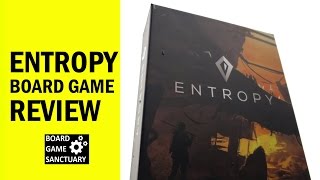
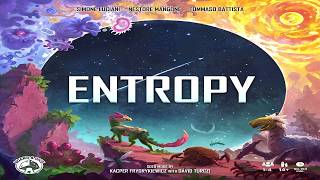
Entropy arrives as a genuinely beloved rondelle game, with reviewers consistently praising both its thematic execution and mechanical elegance. Designed by Tomaso Batista, Simone Luciani, and Neestor Mangone (two of whom previously collaborated on Barrage), published by Board and Dice, the game has generated remarkable enthusiasm across the review landscape. The consensus is clear: despite its heft and complexity, Entropy delivers a deeply satisfying experience that rewards planning and produces those magical moments of engine-building payoff that define great Eurogames. Reviewers consistently call it a top-tier euro, with some ranking it among their favorite games of the year.
Core Mechanics That Define Entropy
The Rondelle with Travel Bonuses
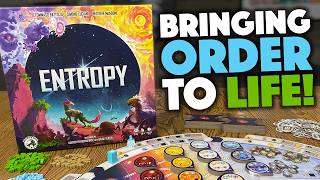
At its heart, Entropy is a rondelle game where players move their scientists one to three spaces around a circular board to activate actions. What makes this rondelle special is the travel bonus system: the fewer spaces you move, the stronger your bonus. This creates a constant tension. You want to move slowly to maximize resource rewards, but you also need to move quickly around the board to unlock your creation tokens and access key actions again. When other players occupy your destination, the bonus deteriorates further, adding a layer of indirect player interaction that keeps the puzzle engaging without requiring direct confrontation.
Creation Tokens and Gating
The three main actions—evolving stars, acquiring planets, and playing life cards—require placing creation tokens on the board. Once placed, these tokens block access to that action until your scientist travels all the way around the rondelle and passes that space again. This gating mechanism forces forward planning. You must decide whether to move slowly to maximize bonuses and hold onto your options, or commit tokens to lock in a strategy. It's a brilliant way to create tension without resorting to worker placement blocking, since no space is ever truly denied to you—you just have to decide if the penalty is worth it.
The Entropy Experience
Building Your Own Universe with Divine Intent
Reviewers consistently note the god-simulator feeling of the game. You're not just pushing cubes or optimizing resources in the abstract; you're actively creating solar systems, evolving stars, populating planets with life. The theme permeates the mechanics in meaningful ways. Each planet type specializes in particular life conditions (heat, water, carbon, radiation), and life forms progress from bacteria to plants to animals in a natural sequence. This creates a sense of progression and causality that makes every action feel purposeful. You're orchestrating evolution itself.
Explosive, Chaining Turns and Satisfying Complexity
The game produces moments of remarkable payoff where bonuses cascade into each other—place a life card, gain an asteroid bonus that triggers a biome effect, which lets you draw more cards, which enables another action. These turns can feel like solving a puzzle where all the pieces finally click into place. Yet reviewers note that the game remains manageable despite this complexity. The mechanics follow logical patterns, the turn order is clearly signposted, and repeated play reveals the underlying elegance. Even when teaching, the cognitive load feels justified by the depth it provides.
What Makes Entropy Stand Out
Asymmetric Personal Abilities That Matter
Each player receives one of four asymmetric sets of focus cards—cards that grant bonuses when you place their corresponding creation tokens. One set might reward you for evolving stars with free asteroid-catching actions. Another might give you life tokens when aggregating planets. These asymmetries create genuinely different strategic paths, meaning no two players have identical optimal strategies. This variability matters enough to influence how you approach the game without being so deterministic that randomization of the sets feels unfair.
Multiple Viable Paths to Victory
Entropy deliberately avoids funneling all players toward a single winning strategy. You can build deep by investing heavily in a few upgraded stars and biomes. You can build wide, creating many planets and solar systems. You can focus on triggering end-game multipliers by carefully managing specific life form counts. You can chase the objectives that drive the end condition. All of these paths can lead to victory, and part of the game's magic is discovering which path your available resources and starting conditions best enable. Reviewers note that you can win by deliberately ignoring 80% of the game and focusing on just one avenue, which speaks to the depth of available decisions.
Potential Drawbacks
Rules Density and Turn Order Complexity
Entropy is a teaching game. The rules are learnable but carry genuine weight. The order of operations on your turn matters—you move, retrieve tokens, place tokens, gain bonuses, and then take actions, and several of these steps interact with special abilities in ways that new players frequently forget. The rules text on player aid cards (where many special abilities live) isn't repeated in the rulebook, so teaching requires either reading cards aloud or directing new players to specific player aids. Experienced reviewers report that this complexity mostly disappears after one or two plays, but it does tax the table on first learning.
Limited Direct Interaction in Lower Player Counts
At two players, Entropy is almost entirely a multi-player solitaire experience. You rarely directly block each other. You mostly affect each other through traffic bonus penalties. The game acknowledges this by merging action spaces at lower player counts and providing alternative linking rules, which helps but doesn't fundamentally change the feel. Reviewers who love the game at two players are enthusiastic about it, noting that the mechanical puzzle remains engaging. But those seeking tight player interaction may find the experience feels looser than expected. Higher player counts add crowding and more dynamic interaction, though this also extends play time significantly.
If You Enjoy Entropy
Players drawn to Entropy's engine-building satisfaction will find similar mechanical depth in Barrage, the designers' earlier masterwork. Those who appreciate the rondelle action-selection puzzle should explore Shackleton and Baghdad, both of which use circular boards to generate decision tension. If you love the theme of building up systems from simple elements, Race for the Galaxy captures a similar sense of long-term strategy and satisfying payoff chains. And for those who enjoy the complex tableau-building that Entropy requires, Primordial Soup (which earns a direct callout in the game itself) offers comparable strategic depth at a lighter weight.
What Reviewers Are Saying
"I really do like what the game is and what you're doing in the game, the gameplay, and so far for 2026, this is one of my favorite Euro games that I've played. It's definitely up in at least the top five, if not the top one so far."
— Tantrum House
"When you hit it, when you bounce everything in the right way to pull off one of those big turns, you do feel pretty smart. That turn is why I play board games."
— Watch Review
"This game looks awesome. The colorful art, the sci-fi setting, the theme of creating stars, planets, and life—it all feels really cohesive. And I'm just so excited for any big Board and Dice game, and this one is definitely at the top of my list."
— The Brothers Murph