







Fallout: Wasteland Warfare Deep Dive
What the Community Thinks About Fallout: Wasteland Warfare
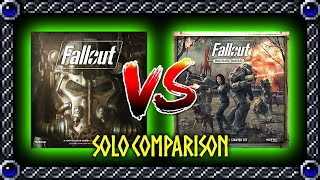
Reviewers judge Fallout: Wasteland Warfare mainly as a miniatures skirmish game that happens to carry the Fallout license. In a head-to-head with the Fantasy Flight Games Fallout board game, AzureDeath | Solo Board Gaming said that even without the Fallout skin the game is a strong skirmish game in its own right, and that it was the reviewer's most enjoyable pure gameplay experience. The same channel's list video reached a different verdict on fidelity. It named the Fantasy Flight board game the more faithful adaptation, describing Wasteland Warfare as a complex miniatures game with a well-written rulebook that scratches a Warhammer itch.
The solo play is the feature that most reviewers single out. Board Games UnLocked said the game was approachable only because a solo AI deck covers every faction, and called the core set serviceable, with plenty of factions and scenery to add later. Tabletop Minions placed Wasteland Warfare among the single-player war games worth considering, next to Rangers of Shadow Deep and the Mantic titles. Opinions diverge on cost and difficulty. Reviewers agree that the game is expensive once terrain is included, and they disagree over whether its campaign layer is deep enough to justify the investment. A Tabletop Minions livestream from Adepticon noted that a Fallout: Wasteland Warfare tournament was on the convention schedule, a sign that the game has an organized competitive scene alongside its solo audience.
Core Mechanics That Define Fallout: Wasteland Warfare
Dice-Driven Skill Tests with Modifier Dice
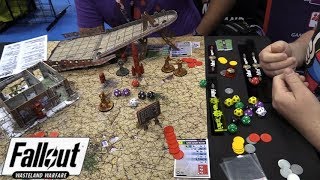
Every attack is resolved by rolling a skill die along with modifier dice, and the results are read as symbols. Board Game Replay walked through a combat shotgun attack in which a shield reduced the target's armor by one and a starburst added one point of damage, and showed how a critical result accumulates into a crit meter that can later force a critical hit. Armor works through the same system. A power armor card lets the wearer block incoming damage with a roll, and the reviewer explained that a higher target number on the armor die blocks more damage. The reviewers did not describe the dice as a gimmick. AzureDeath | Solo Board Gaming called rolling the colorful dice "very fun," which is the reason the reviewer considers the skirmish side the strongest part of the game.
Alternating Activations and Ready Markers
Activations alternate between the two sides, one figure at a time, and each figure can take two actions such as moving, shooting, charging, or making a melee attack. Board Game Replay explained that a figure can be given a ready marker instead of acting, so that a player can stack several figures and act with them as a squad later. The reviewer described the cost of that choice, because a readied figure that is killed before it acts wastes its turn. Board Game Replay also observed that the super mutants in the demo worked best when they teamed up, since a one-on-one attack loses the bonuses for outnumbering a target. Reviewers described the system as a reasonable alternative to the all-of-one-side-then-the-other turns used in Warhammer 40,000.
The Fallout: Wasteland Warfare Experience
A Solo Skirmish Against an AI Deck
The experience most reviewers describe is a tense, back-and-forth fight against a computer-controlled opponent. AzureDeath | Solo Board Gaming praised the AI cards as intuitive and well made, noting that they produce sensible actions that adapt to the board, although the player occasionally has to push the AI in a certain direction in edge cases. The same reviewer pointed out the physical side of the experience. Because the player controls both sides, the reviewer has to stand, walk to the far side of a large table, and move the enemy models, which turns a solo session into a full table exercise. The reviewer's table advice was a clear step up in size, with at least a 3 by 3 foot area and ideally 4 or 5 feet by 3 feet, so that cards, tokens, and terrain all fit.
Fallout Flavor Through Campaign Play
The narrative layer is where the Fallout identity becomes most visible. Board Game Replay described four modes in the starter box, including single player, head-to-head, co-op, and a campaign system in which the survivors gain stats and go searching at Nuka-Cola machines, open safes, and explore locations as in the video game. The campaign is also where a settlement phase between skirmishes lets a player level up a base, acquire gear, and carry progress from one mission to the next. AzureDeath | Solo Board Gaming described that persistent element as the feature that gives Wasteland Warfare the most content for players who want to expand the game with new scenarios or RPG elements.
What Makes Fallout: Wasteland Warfare Stand Out
An AI Deck That Plays the Opposing Faction
The solo AI deck is the feature reviewers praise most often. Board Games UnLocked said the AI deck is the reason a two-player miniatures game became something the reviewer could play alone, and noted that the company continues to add factions and sets. Tabletop Minions pointed to rules for the super mutants and other monsters as a reason to treat the game as a true solo option, not an afterthought. The AI deck replicates faction tactics, and that design allows the player to learn the rules, practice builds, and play whole missions without an opponent.
A Clear, Indexed Rulebook
Reviewers repeatedly praised the organization of the rules. AzureDeath | Solo Board Gaming described the rulebook of nearly 60 pages as a master class in clarity, with everything indexed and no need to juggle multiple books. The same channel's list video called the rulebook very well written. The comparison with the Fantasy Flight Fallout board game was pointed. That game spread its rules across a base guide, an extended reference, and a separate book for each expansion, and the reviewer found its rules easy to misread. A longer rulebook that is easy to navigate was judged the better experience.
Potential Drawbacks
Cost, Terrain, and Table Space
The core set is widely described as costing around $80, and reviewers said players should budget at least $20 to $30 for terrain before the game feels right. AzureDeath | Solo Board Gaming said the terrain requirement is the main reason the game is harder to start than a boxed board game, and that expansions make it a lifestyle purchase. Board Games UnLocked noted that the factions and sets can be difficult to obtain at a fair price because of distribution and shipping. Space is the other constraint, since the reviewer had to buy a folding table to play at all. Setup also takes longer than with the Fantasy Flight board game, because the map has to be built before play begins.
A Campaign Timer and One-Character Pressure
The solo campaign runs on a clock that reviewers found stressful. AzureDeath | Solo Board Gaming explained that the player cannot explore indefinitely and must eventually tackle the main quest, so the experience can feel like a race. Some scenarios also require controlling several characters, which the reviewer found unfair when playing with one. The reviewer noted that the timer can be adjusted by house rules, but that the straight-out-of-the-box version can feel rushed. Tabletop Minions raised a separate complaint about dependence on proprietary dice. Its reviewer argued that companies use custom dice to make players buy more product, and that Fallout: Wasteland Warfare relies on custom dice that cannot easily be replaced.
If You Enjoy Fallout: Wasteland Warfare
- Fallout: The Board Game from Fantasy Flight Games is the reviewers' choice for players who want the Fallout adventure itself. AzureDeath | Solo Board Gaming named it the more faithful adaptation, because its quests, loot, and character growth carry the feel of the video game from start to finish within a session or two.
- Rangers of Shadow Deep is the closest match for players who want a single-player skirmish game with campaign upgrades. Tabletop Minions described it as a game with heavy RPG elements, skills, and upgrades that can be played solo, cooperatively, or against an opponent.
- Warhammer and other Warhammer-style skirmish games appeal to the same tactical audience. AzureDeath | Solo Board Gaming said that Wasteland Warfare offers a solo skirmish experience for players who have no one to play Warhammer with, and that is the audience that will find it most valuable.
What Reviewers Are Saying
"It is a master class rule book and everything is very clear, easy to find, everything is indexed. You're not going to have to juggle between different rule books."
— AzureDeath | Solo Board Gaming
"That is a really interesting thing, I like it a lot, it's cool, extra like risk reward mechanic. You sit there and do nothing, so if you get taken out you wasted that turn, but if you survive and they don't manage to kill you, you can now activate."
— Board Game Replay
"Generally I believe that companies want to use custom dice for their games because then it's just another thing that you have to buy from them. [...] If you want GW don't care, but try and play like Fallout Wasteland Warfare without their crazy custom like weird d12s, that's a problem."
— Tabletop Minions