/pic7111597.jpg)
/pic4082414.jpg)
They were tough times, the days when swords and magic still ruled the world. A long, destructive war had ended, and the entire continent had been unified. Before the empire's subjects had even come to know peace, however, their great emperor fell victim to disease, having never declared a successor...
We must not return to that war-torn world! Thankfully you are an influential figure in the empire. Quickly lay claim to the throne and ensure the rock-solid unity and peace of the continent. Though the emperor had no son, there are seven candidates for succession, starting with the two lineal princesses. Now, let's get your favorite princess on the emperor's throne! Garner support from all over the country, clash with rival candidates and depend on your special skill!
Heart of Crown is a deck-building card game. Each player starts with the same deck, strengthens that deck with strategic cards, and finally one player will declare victory by throning the princess he controls. Each player's deck starts with seven "Rural" territory cards and three "Apprentice Handmaid" succession cards (an unreliable subject). Using the currency (coins) generated by your "Rural" territory cards, you incorporate cards from the market into your deck according to your own strategy.
Each player's main goal is to give the princess he's fielded the throne. First, collect stronger territory cards such as "City" and "Metropolis" to increase your coins, and declare fielding a princess using these coins. There are five princesses and one set of twin princesses, totaling six princess cards. Each princess has special support abilities, but with only one of each, you need to be quick to field the right princess and get the support you need!
For your princess to take the throne, you must collect Succession Points, which represent the support of your loyal subjects and influential figures in the empire. Once you control 20 Succession Points, you may declare a coronation. Your opponents get one more turn to interrupt your coronation, but if your points remain at or above 20 by your next turn, the coronation succeeds and your princess takes the throne!
This page includes videos and mentions from the whole Heart of Crown family. Drill into a specific game below.
/pic7111597.jpg)


Mechanics (from transcript analysis)
Video topics + discussion points
Quotes (from this video)
- two to four players with deck-building as the main mechanics and is of light medium complexity
- you can buy more currency cards
- when you can afford to bet a princess card you get a different power
- the succession points game introduced by at least one player with 20 points
- it's interesting once you secure princess card your strategy could get towards the power
References (from this video)
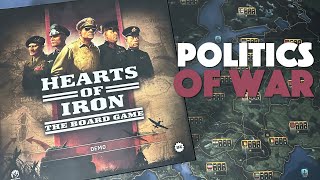
- Heavy focus on politics and political maneuvering
- More than just building armies and battling
- Players have control over how they score victory points
- Phases are easy to understand
- Engine cards and focus cards are easy to understand
- Great for Hearts of Iron fans or World War II enthusiasts
- Brain-burning aspect is political and physical maneuvering
- Decisions might come back to haunt you if you declare war on a needed ally
- Can be pure chaos on the board in high player count games
- Need to hold objectives for the whole game to score points
- Politics and political maneuvering, building war force, and going to battle
- World War II
- Axis and Allies
Mechanics (from transcript analysis)
- Dice rolling combat — Battles are resolved by rolling dice, and to conquer a country, players must defeat any units in the space, then attack the country itself, requiring a certain number of hits.
- Engine Cards — In the engine phase, players secretly choose engine cards that provide instant benefits (usually resources) and secondary benefits to improve specific actions for the turn.
- event cards — In the end phase, event cards are drawn, affecting everyone equally.
- Focus cards — Each faction has a set of Focus cards, some general and some specific to chosen ideologies, which introduce new cards into the player's deck and provide unique goals or abilities.
- Ideology Selection — Player boards can be linked to different ideologies, which provide different ways to score victory points and grant specific in-game focused cards.
- Income generation — Players generate income and resources during the end phase.
- Order Tokens/Command Tokens — In the conflict phase, players use order tokens which are placed out in locations and revealed to indicate movement (one, two, or no moves), requiring prediction of opponent actions.
- Phase-based turns — The game progresses through distinct phases: Engine, Action, Political, Conflict, and End Phase.
- Political Board Interaction — Players spend political power to interact with the political board, influencing relationships with other countries, moving from an 'allyship' position to 'at war'.
- Production and Unit Building — Players build factories and spend production to create new troops, which are then deployed.
- Research — Players can research new cards to upgrade their units, with options to speed up research by spending resources.
- Resource Management — Players manage four different resources: stability, political power, production, and manpower, which are spent to perform actions.
- Stability Check — Players check their stability, which can affect resource generation if it drops too low.
- Unit Stats and Combat — Units have stat blocks for soft attack, hard attack, production value, and special abilities. Combat involves rolling dice and dealing damage, with different values for soft and hard attacks.
- Victory Points — The game uses victory points and has a score track, and players are rewarded for conquering other players, holding capital cities, and there are many other ways to score points that players have some control over.
Video topics + discussion points
Quotes (from this video)
- this is not a game of direct Conquest
- this is actually a game that uses victory points and has a score track
- the real brain burning aspect of this game is all of the political maneuvering and the physical maneuvering of this bored
- this is a a great game obviously for Hearts of Iron fans or anyone that's a big fan of World War II
References (from this video)
- Engaging path to a victory with a clear scoring arc
- Tie-breakers can be thematically integrated into gameplay
- Requires careful planning to avoid ties
- May have moderate to high rule complexity for new players
- political maneuvering and point accumulation
- Fantasy kingdom with political intrigue and courtly machinations
- card-driven, thematic control
- Arboretum
Mechanics (from transcript analysis)
- Card Drafting — Players draft action cards to attempt to maximize scoring opportunities.
- Point accumulation — A race to a target score with tie-breaking mechanics to resolve ties.
Video topics + discussion points
Quotes (from this video)
- the best tiebreaker ever is the one for Arboretum where the Tide players are to both plant trees and then revisit them in a few years to see which ones grew the tallest
- breaking a tie with something like rock paper scissors is something I love
- two, three, or more tiebreakers can be a good thing if the game supports it; otherwise it can feel artificial
- returning to a random or secondary criterion as a tiebreaker can either save the game from a dull tie or undermine the core mechanics
- if a tournament has ties, you typically need a clear elimination structure and a robust tiebreaking method to preserve competitive integrity
References (from this video)

- immersive theme
- deep strategic decisions
- potential downtime in some interactions
- courtly power and influence
- Medieval royal court in a world of intrigue
- thematic, flavor-rich political drama
Mechanics (from transcript analysis)
- Deck Building — Build and optimize a deck to acquire resources and take actions.
- deck-building — Build and optimize a deck to acquire resources and take actions.
- Hand Management — Careful play of cards to maximize synergies and timing.
- Set Collection — Acquire cards and resources to advance toward victory.
- set collection / resource management — Acquire cards and resources to advance toward victory.
- Unique Player Powers — Different paths to victory through card effects.
- Variable player powers — Different paths to victory through card effects.
Video topics + discussion points
Quotes (from this video)
- this game is so fun and it's really easy to learn how to play
- adorable robot minis
- rich narrative with intuitive yet unique game mechanisms making every game a new adventure
- i love role play i can't wait for this campaign-style game
- beautiful and clean abstract game
- epic cataclysm that shakes the foundations of the entire circadians world
- secret personality with specific victory conditions
- the only thing i love more than somewhat abstract 3d worker placement is something else
References (from this video)

Mechanics (from transcript analysis)
Video topics + discussion points
Quotes (from this video)
- What enters my collection is a whole another story.
- I'm absolutely hooked on it. I love Primal.
- If I add something to my collection, ideally I want to see it there a year from now, at least a year from now.
- It is such a good implementation of the Glass Road system.
- It's not forever, but it feels like a forever game for me.
References (from this video)
- fun little deck builder
- Dominion with a twist
- takes a long time with three or four players
- anime theme
- princesses
- Dominion
Mechanics (from transcript analysis)
Video topics + discussion points
Quotes (from this video)
- Remember it's only a game
- I am very much one of these people that if you go after my family or friends there will be hell to pay
- Five out of ten is average, it's a game that I would still play if you put it on the table
- I do really like closed drafting in games
- I love the way that you plan for this sort of stuff
- Power Grid is the worst contender for this, auctions in this just refuse to freaking end
- I want to see it more - the typewriter mechanic
- Area control is just kind of meh
- It's just so many of these games are just like oh we need to make a quick buck