/pic5715770.jpg)
Extended edition includes Crisis & Control expansion.
The Nation is in disarray and a war is waging between the classes. The working class faces a dismantled welfare system, the capitalists are losing their hard-earned profits, the middle class is gradually fading and the state is sinking into a deep deficit. Amidst all this chaos, the only person who can provide guidance is... you. Will you take the side of the working class and fight for social reforms? Or will you stand with the corporations and the free market? Will you help the government try to keep it all together, or will you try to enforce your agenda no matter the cost to the country?
Hegemony is an asymmetric politico-economic card-driven board game for 2-4 players that puts you in the role of one of the socio-economic groups in a fictional state: The Working Class, the Middle Class, the Capitalist Class and the State itself.
The Working class controls the workers. The Capitalist class controls the companies. The Middle class combines elements from both the Working class and the Capitalist. It has workers who can work in the Capitalist's companies but it can also build companies of its own, yet smaller. Finally the State is trying to keep everyone happy, providing benefits and subsidies when needed but trying also to maintain a steady income through taxes to avoid going into debt.
While players have their own separate goals, they are all limited by a series of policies that affect most of their actions, like Taxation, Labor Market, Foreign Trade etc. Voting on those policies and using their influence to change them is also very important. Through careful planning, strategic actions and political maneuvering, you will do your best to increase the power of your class and carry out your agenda. Will you be the one to lead your class to victory?
Hegemony is heavily based on actual academic principles such as Social-Democracy, Neoliberalism, Nationalism and Globalism, and allows players to see their real world applications through engaging gameplay. There are many ways to achieve hegemony- which one will you take?
—description from the publisher

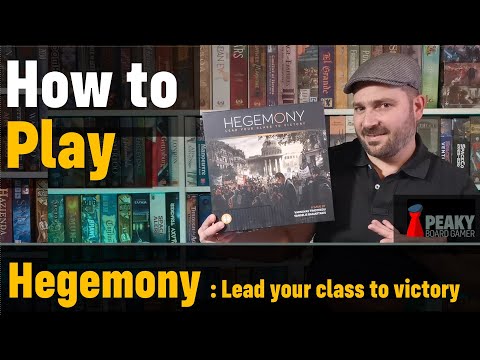
- Surprising immersion for a pure economic Euro
- Social politics element creates rich thematic gameplay
- Classes interact cleverly, making politics both in-game and out-of-game engaging
- Despite being a brain burner, immersion is maintained throughout
- Long game length (4+ hours)
- Could potentially rank higher but held back slightly by cult of the new concerns
- Not a typical theme for Luke but surprisingly effective
- Social politics and class struggle in economic simulation
- Economic and political systems
- Emergent narrative through social interaction and mechanics
Mechanics (from transcript analysis)
- Class system — Working class, capitalists, state, and middle class with distinct interests
- Economic system — Managing economics, tax, and capital
- Voting — Working class can exert pressure on voting for laws
- Voting system — Working class can exert pressure on voting for laws
Video topics + discussion points
Quotes (from this video)
- good mechanics will make a game good but a good theme will bring me back for the second play
- Luke's law: theme makes a game a lot better for me
- immersion is not just a case of oh the game has a good theme but it's how immersed in the world am I
- there is a little bit of a difference between the two [thematic and immersive]
- it doesn't matter how rich that story you make it would still suck as a game
- I feel like I'm just basically telling my own MCU movie
- the world feels alive and therefore I'm going to get immersed in it
- when I'm playing the game I don't feel like I'm just playing a bunch of mechanics I feel like I'm telling my character story
- I am invested in what people are doing I am role playing my character
- this is a very dark game okay and not for the fainthearted not for the easily triggered
- I have never sweated in a card game so much before
- you will be sucked into this world and you will care about the characters
- the king of all campaign story driven games that I know of
- some of the best writing I have seen in any campaign game to date
- regardless of what kind of world you'd find yourself immersed in remember to come back to reality at some point and still remember it's only a game
References (from this video)

- Works great as 1v1 and multiplayer
- Expansion allows AI opponents
- Highly asymmetrical and thematic
- One of favorite games played this year
- Requires significant table space
- Heavy rules and learning curve
- Expensive with expansions
- Very time-consuming
- Class struggle between capitalists, working class, and state
- Modern socio-political world
- Asymmetrical role-playing simulation
Mechanics (from transcript analysis)
- Asymmetric Teams — Different factions with completely different mechanics: capitalists, working class, state
- Asymmetrical roles — Different factions with completely different mechanics: capitalists, working class, state
- Automated opponents — AI can control additional factions for multiplayer experience
- head-to-head competition — Two players directly competing with opposing goals
Video topics + discussion points
Quotes (from this video)
- through the Ages it has basically killed the physical version of this game with the app and I'm the bad guy
- Magic the Gathering is still one of the best Advanced two-player games out there
- this is basically if you took the Pixar movie Inside Out and turned it into a giant three hour Euro game
- I pretty much I you can convince me to play this for free I will outright refuse to play it with four
- this is just one of the best Star Wars games that's out there
- I love this Euro this euro is so much fun it has climbed up my top 100
- give me a game that gives me a lot of options you know it's not a case of oh it's so tight
- it's gonna be an absolute blast
- this game has a ton of rules the FAQ is 20 miles long
References (from this video)
- Richly thematic and structurally deep; four asymmetrical classes drive varied strategies.
- Layered mechanics (cards, workers, production, elections) create emergent strategic depth.
- Policy/election subsystem provides meaningful, recurring tension and scoring opportunities.
- Steep learning curve; rules are extensive and interdependent.
- Very long setup and playtime, which may deter casual players.
- Requires careful tracking of multiple tracks (wages, legitimacy, policy markers, storage).
- Class struggle, political economy, policymaking, and legitimacy dynamics
- A nation-state with four competing classes (Working Class, Middle Class, Capitalist Class, State) across five rounds, with policies, elections, and public services shaping outcomes.
- asymmetric multi-class political economy simulation with elections and policy shifts
Mechanics (from transcript analysis)
- card-driven action system — Each class uses an action card deck to perform a main action, followed by basic and free actions; cards are drafted from class-specific decks and discarded after use.
- Legitimacy and scoring — Legitimacy tracks for each class impact scoring; events and policy changes alter legitimacy; at endgame, points are allocated based on remaining resources and policy markers.
- Market and export — Export/Import cards govern trading transactions; foreign trade and tariffs affect pricing and revenue; some goods can be stored in a free trade zone with different rules.
- Policy tracks and elections — Seven policy tracks (A/B/C sections) influence rules; proposals trigger elections, which determine if policy changes pass and reward victory points.
- Production and needs management — In production, all operating classes produce goods/services and pay wages; players must meet population needs with food/health/education; storage capacity matters.
- Resource management and procurement — Vardus (currency) and goods/services are managed; resources are bought from multiple sources (capitalist, middle class, state public services, foreign market) with tariffs and tariffs implications.
- Taxes, loans, and IMF intervention — Taxes are multipliers based on policy; loans can be taken with penalties; IMF intervention can reorder policy tracks and wage levels under stress.
- Worker assignment and company operation — Players assign workers to company slots to activate operations; middle class can open and staff its own companies; skill matching and commitment affect production.
Video topics + discussion points
Quotes (from this video)
- hegemony is a highly thematic asymmetric political economic car driven board game for two to four players simulating an entire nation its policies and its economy
- Germany is played over a series of five rounds
- this is a highly asymmetrical game in all classes performed differently in each one of these faces