






Hollywood 1947 Deep Dive
What the Community Thinks About Hollywood 1947
Reviewers present Hollywood 1947 as a social deduction game built around its setting. Travis Hancock designed the game, and Facade Games published it as the fifth entry in its Dark Cities series, following Salem 1692 and Tortuga 1667. Before You Play, whose hosts Moni and Naveen walk through a full tutorial, frames the game against the Red Scare, when suspicion of Communist influence reached the film industry. Board Game Club's Adam makes the same historical point at the start of the session, describing the setting as a beautiful but disturbing chapter of American history. Scratch Off Board Games places the game fourth on its top-50 list, and The Dice Tower notes that the game has sold incredibly well even though the host has not played it yet. The Broken Meeple is the most cautious voice. That reviewer finds the artwork and the 1940s styling appealing but questions whether the Kickstarter pledge is worth the money. The consensus is that the theme and the table tension are the main draws, with price as the main reservation.
Core Mechanics That Define Hollywood 1947
Job Cards as Movie Actions
Before You Play explains that each player begins with one of nine job cards, and each job grants a special action during the production phase. The screenwriter draws two genre cards and chooses one to set the film for the round. Each genre carries loyalty symbols, so a comedy with two Patriot symbols can tilt the film before a single propaganda card is played. The producer may swap any two job cards, including their own, and the gaffer may re-roll dice up to three times. A player who does not want to use a job can instead swap it with a card from the center to reserve it for the next round, or re-roll up to two different dice. Board Game Club's session shows how the table treats these declared roles as evidence. Players announce that they are Patriots, challenge one another to prove it, and then test those claims in the following rounds.
Star Dice and the Premiere Reveal
The premiere phase is where secret loyalties become visible. Each player who rolls a star on their die contributes a propaganda card face down, and a director's token allows an extra contribution. Before You Play notes that the editor can view a card before it is discarded and decide whether it returns to the movie. The reveal then counts the symbols on every played card, along with the symbols printed on the genre card. The side with the majority wins the round, and four round wins end the game. Because only players showing a star can contribute, the gaffer's re-rolls become a way to influence who gets into the film. The dice therefore function as a suspicion tool as much as a random element.
The Hollywood 1947 Experience
Paranoia Across the Table
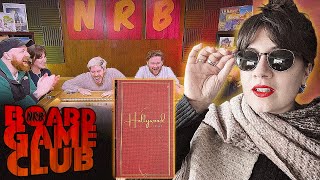
Board Game Club's table is the clearest example of the paranoia that reviewers describe. Players close their eyes at the start while the Communists learn one another's identities, and the rest of the session revolves around accusation, defense, and second-guessing. Adam frames the Patriots as operating in the dark, with little idea who among the group can be trusted. Scratch Off Board Games describes the game as one where people point fingers and accusations fly, and where the real challenge is telling the liars from the truth tellers. Before You Play adds that open discussion is encouraged and that lying can sometimes be necessary, which makes every statement at the table a potential bluff.
Period Flavor and Tongue in Cheek Humor
Reviewers respond warmly to the aesthetic. Scratch Off Board Games describes its host as a vintage enthusiast who would buy the game on the strength of its golden age of Hollywood theme alone, and says the 1940s styling is exactly the oldtimey feel the game delivers. The Broken Meeple likes the artwork and the old-fashioned movie credit signs in the components, and says the presentation is good even before the rules come into play.
What Makes Hollywood 1947 Stand Out
Three Factions With Overlapping Goals
Before You Play explains that the Patriots and the Communists each need four round wins, while the rising star plays both sides. Patriots always hold the majority of loyalty cards, which means the Communists must hide well to avoid early exposure. The rising star wants the game to stay balanced, and the ending depends on it. If the Patriots and Communists each win three rounds, the seventh round decides the outcome. The rising star wins if the round is tied or decided by only one symbol, and the rules reward a table that keeps everyone close. Board Game Club's Adam highlights the same three goals and notes that the rising star simply wants to be in as many movies as possible.
Theme Built Into Every Action
Reviewers consistently point to the way the theme shapes the mechanics. Each job, genre, and propaganda card reflects a moment in the film industry, so the act of making a movie feels like a historical role-play rather than an abstract set of actions. Board Game Club describes the Communist cards as propaganda aimed at the films, and the table treats each finished movie as a political statement. Scratch Off Board Games ties its enthusiasm directly to the era, saying the golden age of Hollywood setting is what makes the game feel right to a player who loves that period.
Potential Drawbacks
Price and Pledge Structure
The Broken Meeple is the most skeptical voice in the group. The reviewer reads the Kickstarter pledge levels as roughly $27 for the costumes pack and $44 for a deluxe edition that includes tokens. That reviewer dislikes having to pay extra just to receive a few additional cards, and notes that the campaign competes for attention with several other crowdfunded titles. The Broken Meeple still describes Hollywood 1947 as not bad, but the review makes clear that the price is the main barrier for backers who are trying to limit their spending.
Bluffing Depends on the Table
Because the game relies on social pressure, its enjoyment depends heavily on who sits down to play. Board Game Club's session shows how quickly accusations can dominate the discussion, and how Patriots without information must often guess. Before You Play also encourages open discussion, which can be uncomfortable for players who prefer quieter games. The game is built for groups that enjoy bluffing and accusation, and the rules make open lying part of normal play, so a group that dislikes direct confrontation may find the experience less comfortable.
If You Enjoy Hollywood 1947
Players who enjoy the Red Scare setting and hidden loyalties will find a natural follow-up in Salem 1692, which The Dice Tower identifies as Facade Games' most popular title. Its social deduction structure rewards the same careful reading of other players. Tortuga 1667, another entry in the Dark Cities series, keeps the publisher's bluffing style in a different historical setting. Players who want a lighter take on accusation games can look at Scapegoat, which The Dice Tower describes as a game about escaping prison as a group of goats while one player tries to make someone else the scapegoat. Players who enjoy Hollywood 1947's deduction and suspicion will likely appreciate how each of these titles turns trust into the central puzzle.
What Reviewers Are Saying
"The rising star on the other hand wants to kind of keep things even and so we'll discuss their objective towards the end."
— Moni and Naveen, Before You Play
"A beautiful game set in a disturbing time in American history where McCarthyism was rampant and people were being accused of being communist left right and center."
— Adam, Board Game Club
"You will be pointing fingers. Accusations will be flying. Can you tell the liars from the truth tellers?"
— Scratch Off Board Games