/pic1113708.jpg)
Homesteaders is an auction and resource management game in which players bid on the opportunity to build certain types of buildings, then spend resource cubes to build one of several buildings of that type. The buildings confer abilities, income, and points; some automatically and some requiring a worker.
The game lasts ten rounds, with each round consisting of an auction phase followed by a building phase. After the last round, players take one final income phase and have one last chance to buy and sell goods and use their building abilities before scores are tallied.
Players score for their buildings, bonuses conferred by buildings, and points earned throughout the game from selling resource cubes. The player who builds the best combination of buildings and best manages the nine different resources in the game will score the most points and win – as long as they don't take on too much debt!
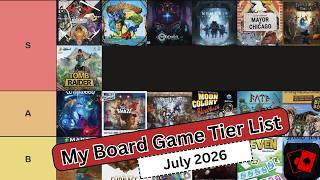
- Good
- Great game
- Didn't really warm up to it before
Mechanics (from transcript analysis)
Video topics + discussion points
Quotes (from this video)
- This is just my opinion. Your opinion may very well differ and if it does, great.
- Bullet, it's one of the best games in my in my in my collection.
- it's such an amazing game and that I haven't shown it off on the channel yet is a crime.
- Both really amazing hidden movement games.
- this game does everything I want in a farming game.
- This is a game I'm currently reviewing, so I don't really like to rank that before yet.
- This is a deduction game where you try to guess like the five numbers that are on your board like in your in a row.
- Really weird. It's like a card placement game where you like build like a tableau like a weird manor and if you manage to fulfill specific conditions, then you can play review cards in there that's like extra guests that give you points, and it's like really weird. But I like it.
- man, this is good.
- This is a very cute game of you just turning over card, like drawing cards, and trying to have like a you you put like groups of the same animal uh together here, and if you have like the same number of cards for one animal, the opponent does, then you can like switch both groups.
- Wow. Uh this is amazing.
- This by Tim Fowers, who also did the Burgle Bros series, and this is a really good two-player game.
- Descent always gets an A for me.
- it does a few things like really well, but there are also a few things holding it back, so that's why it's only an A and not an S.
- Want to play a simpler version of Wingspan that feels still feels like the game, it only plays in half an half an hour? This is it.
- It is so luck-based.
- I'm really conflicted here. I like this game.
- Oh man, I'm so conflicted here.
- I really like the idea of Doomtown. I like what it tries to do. I like the theme.
- Tomb Raider is clear as rank, very clear as rank.
- This is such a good game.
- These are all the games that I played. Not as many as as some as in some other months, but like there were like some a lot of time intensive games here.
References (from this video)

- The host will keep this game for the rest of his life.
- The game is amazing.
Mechanics (from transcript analysis)
- Auction — It is an auction game.
Video topics + discussion points
Quotes (from this video)
- the whole uh idea behind this and theoretically videos later will be to talk about certain mechanisms uh that I've enjoyed and why I've enjoyed them and these are the mechanisms that I like the ones that if I see them in a game um unless the game really does something bad to screw it up I'm probably going to enjoy myself and today it is uh auction or bidding
- when I was probably like six or seven watching all these old people just saying you know seven n 15 16 17 okay go ahead you know and I was like what what are they I just heard these numbers being thrown out into the universe and I didn't really get what was going on
- it's a complete free form depending upon the game it is a complete free form uh of aspect of the game that is completely removed from the the the core mechanisms of the game and it is completely and totally dependent upon the people that are playing at it
- most board games you play are very very very regimented and very structured they they are set up in a way that like the rules State this and you can't change it
- I really liked that aspect of it and and so in a weird way and I I don't think it's like a subconscious reason why I enjoy it but I can see the connection there between like I can do whatever I want with this aspect of the game
- I do feel better when I achieve something really really good in a game because of my skill uh not just because I happen to just get the right card at the right time kind of situation
- so yeah I mean and that's just kind of why I I just like it I I I like how the interaction is I like how it affects the game I like how it challenges me challenges the other players and there really is some head-to-head there going on it isn't a garden aspect I'm not auctioning with myself I I am auctioning with the other players and I'm trying to outsmart them and I'm trying to outdo them if you will
References (from this video)

- One of the best auction games ever made
- Solid gameplay
- Can get stuck behind the eightball if you start your town with the wrong building
- Can take out way more loans than you actually do
- Auction mechanics
- Town building
Mechanics (from transcript analysis)
- Auction — Considered one of the best auction games made.
- Engine Building — Can make a bad choice early and be on the back foot.
Video topics + discussion points
Quotes (from this video)
- And then and then um you know, could I get some bacon? And she's like, of course you can get some bacon now. But I'm I with the bacon, if you could if you could make it really rare, like really rare, like very I mean like raw if possible, if that's possible, if I get get that. And she's looking at him like, 'What do you'
- It is the greatest game. Every single group of people that I've introduced that game to that I've seen people immediately take out their phone and buy it.
- He's like, 'It's raining outside. this this this guy standing next to me with a with a Viking sweatshirt on and and he's with with with Crocs with Ver Crocs and and uh and and gym shorts screaming at me that I yelled at this kid a couple of You know what? I'm just going to throw my cigarette away and get back on my bus and drive away.
- I'll fight it and send it to you.
- And the thing is like she's got like 20,000 subscribers and it's just she just doesn't care. She's just like yeah I'm going to do this. This is this is what I'm going to do. I'm just going to talk about every episode of Columbbo and I just god bless her heart you know.
References (from this video)

- really good
Mechanics (from transcript analysis)
Video topics + discussion points
Quotes (from this video)
- Movie Tricks is really good. Movie Tricks is from Chitty Fox Games. It's a trick taker, but it's got a bit of a kick and I really like that.
- Severton is a game from Vlades Shaattle. You may have heard of Vlad Shaattle, but he's got a new game this year called Severton. It's the first time he's had a new game published for about 10 years. And a little bit like Dutch Resistance: Orange Shall Overcome, it's a cooperative game where you're trying to complete missions. And it's really, really good. And not many people are talking about it.
- The new version for me is an improved version of the game. So, if you like Ingenious or Genal, whatever you want to call it, then have a look at the 3D version. That was really good.
- we played this game called drop alter and I absolutely blitzed it. I mean I think I won I think I won six of five of the six rounds that we played or something like that.
- In general, I don't play abstract games. But there are certain ones which I do play and I do like.
- Project L is another really really good game and I really like Project L and uh and that is a completely abstract game.
- I dread the day when I have to play on Mars again because I don't have the time, mental energy, everything else to go back and relearn on Mars.
- Talisman. 34 year gap between playing it.
- as much as A Trespass Odyssey was the most complicated game that I've ever played and some of the rules were extremely confusing and we weren't sure of some of the rules after 25 games, that game had things in it which I have never had that experience from any other game ever.
- And I've heard that Kingdoms for Lawn offers a similar experience.
- But when I'm playing it solo, if I'm not live streaming it, my brain because of the weird memory issues that I have, literally gets to a point and I go up and it just stops and my short-term memory disappears and I'm like, I have no idea not only what I was doing, but where we are, what phase we're on, or anything like that.
- live streaming it and talking to the audience and keeping things going is the only way that I can actually get my brain to, you know, work and be able to cope with playing the actual game itself.
References (from this video)

- a different flavor of worker placement
- auction adds strategic depth
- not as mainstream as heavier titles
- agriculture and development via auctions
- frontier settlement
- economic-light
- Agricola
- Pillars of the Earth
Mechanics (from transcript analysis)
- auction/bidding — players bid for resources or buildings.
- Worker Placement — workers activate buildings for resources.
Video topics + discussion points
Quotes (from this video)
- it's agonizing as to which choosing which one to pick first
- there's a bit of a gambling element
- Pillars of the Earth I realize that's one of my favorites as well
References (from this video)
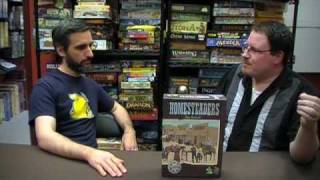
- The cowboy/homestead theme with cow-themed components (cowboy and cow meeples) provides a charming and memorable aesthetic that complements the Euro mechanics.
- Pacing is solid: around 60–90 minutes, often closer to an hour for experienced players, making it accessible and quick for casual sessions.
- The auction/bidding mechanism is well balanced; even when you miss a bid, there are always meaningful actions you can take, reducing frustration and maintaining engagement.
- Debt mechanics offer a safety valve when you miscalculate; taking on debt can enable a comeback and keeps options open during tight rounds.
- Replayability is strong due to dynamic routes: different auction outcomes and railroad track choices mean no two games feel the same.
- Strategic flexibility is high: there are multiple viable paths (big buildings late in the game, railroad-focused routes, or more balanced/resource-driven strategies).
- Accessibility with depth: relatively light and casual compared to heavier euros, yet still provides meaningful decisions and strategic nuance.
- Some players may feel the game lacks a truly wide-open strategic sandbox; the discussion acknowledges it can feel a bit looser or loopy compared to other heavyweight auction games.
- Endgame emphasis on large city buildings can create a pressure point where late auction wins feel pivotal; misjudging which buildings to pursue can swing the outcome heavily.
- While debt is a feature, it can be punishing if mismanaged; aggressive debt usage should be balanced with long-term scoring potential.
- economic development through building, resource management, debt, and railroad expansion
- 19th-century American West frontier; homesteading, cowboys, and frontier development
- lighthearted, thematic but accessible; playful cow/cowboy motifs
- Stone Age
- Puerto Rico
- Coliseum
Mechanics (from transcript analysis)
- auction/bidding — Players bid on buildings by category; the auction phase determines access to new abilities, resources, and the opportunity to advance on the track. Winning a bid influences not only immediate gains but future options as the first player position shifts.
- debt/credit system — Players can take debt tokens when they cannot afford an intended purchase; while giving continued agency, debt can be detrimental later and influences endgame scoring dynamics.
- end-game scoring and big buildings — Scoring occurs after a final income phase, with large end-game buildings often having outsized impact on victory points.
- market/trade — Trade tokens are spent at the market for favorable exchanges, enabling flexible responses to auction outcomes and building plans.
- railroad development track — After the auction phase, players may take actions related to the railroad track; advancing on this track unlocks or modifies capabilities and can influence subsequent turns.
- resource/goods management — Gaining and managing various resources (Goods, money, and trade tokens) which fuel purchases, trade, and bidding strategies.
- worker placement into buildings — At the start of each round, players place workers in their buildings to gain Goods, money, or trade tokens which are then used to interact with the market.
Video topics + discussion points
Quotes (from this video)
- Round homesteaders by Alex Rockwell, so this is pretty much an auction game.
- The theme—the cowboy meeples, the cow meeples are good; there’s also cow meeples; yeah, there’s cow meeples, they’re very cute, they’re painted cows.
- It says 90 minutes but it’s not bad; a lot of games like this feel like there are ten things you want to do and they let you do one, whereas this one there’re five things you want to do and they let you do four.
- There’s enough auctions for everyone except for one person to win, and then that person gets to go along on the railroad track.
- The big buildings at the end are kind of game-winners.
- Replayability is huge because no two games are ever going to be the same; it all depends on the people you’re playing with and what route you choose to go.
- This is a real brain burner, like this this is so light.
- It’s not like Puerto Rico where the buildings complement each other; it’s looser, which I like, but not that loose.
- I think you want it to be fairly loose so that you can have all these different approaches.
- Anyone can win just picking it up; pro level comes with time and you can save up by a building, but which building, and how much are you willing to pay.