








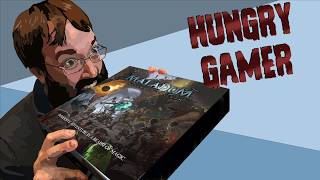

Maladum: Dungeons of Enveron Deep Dive
What the Community Thinks About Maladum: Dungeons of Enveron
Maladum: Dungeons of Enveron has quietly become a standout experience for solo and small-group dungeon crawlers. The consensus among experienced reviewers is clear: this is a game that rewards exploration, punishes hesitation, and delivers remarkable production value. Critics consistently praise the 3D cardboard scenery as industry-changing, while the campaign system and character progression mechanics have earned comparisons to celebrated lifestyle games like Dungeon Universalis and League of Dungeoneers. Rob's Tabletop World calls it an "under the radar" game that deserves far more attention, and the Hungry Gamer's recurring coverage across multiple monthly roundups reflects how the game has grown stronger with each expansion release. Where reviewers do differ is on pacing and rule complexity, but even those who acknowledge the hefty rulebook appreciate that the gameplay itself remains surprisingly elegant underneath.
Core Mechanics That Define Maladum: Dungeons of Enveron
Threat-Driven Racing
At its heart, Maladum: Dungeons of Enveron is a race against escalating danger. Every turn, the threat level rises, spawning more enemies from entry and grave points. Reviewers emphasize that this creates a visceral tension: you can stay longer to search for treasure and objectives, but only at the cost of facing increasingly difficult opposition. The Hungry Gamer describes it as "a clever balance of speed versus efficiency," where the decision to grab one more piece of loot or search one more room carries real consequence. This mechanic transforms the game from a simple "kill monsters and collect treasure" crawl into a tightly paced puzzle of priorities. You must decide in each turn whether the value of what you might find justifies the escalating risk.
Campaign Progression and Character Advancement
Between scenarios, adventurers return to town where they level up, acquire skills, and equip themselves with the spoils of dungeon delving. This persistent advancement creates what reviewers call a "lifestyle" experience, where the same characters grow more capable over multiple play sessions. The system ties directly to resource management: early scenarios yield smaller payouts that limit which skills you can afford, while successful dungeon runs fund better gear and faster advancement. Players are continuously making long-term strategic choices about which attributes to develop and which equipment to pursue, giving each campaign a distinct feel based on the decisions made between expeditions.
The Maladum: Dungeons of Enveron Experience
Elegant Gameplay Under Complex Rules
Despite a rulebook that could intimidate newcomers, Maladum plays deceptively light. The Hungry Gamer notes that it feels "pretty simple dungeon crawl as far as the gameplay goes," even when compared to rules-heavy games like Dungeon Universalis. Once the core loop is understood, turns flow naturally: move, search, fight, or evade. The complexity lies in depth of options rather than obtuse mechanics. Reviewers appreciate that the game respects player intelligence, offering granular rules for nearly every situation without forcing you to consult the rulebook mid-turn if you understand the basics. The experience becomes meditative in solo play, encouraging careful planning and tactical positioning rather than mindless action.
The Beautiful Cardboard World
The 3D cardboard scenery has sparked genuine awe from multiple reviewers. Rob's Tabletop World argues that Battle Systems' approach to terrain design "changed the industry forever," and the experience of building and exploring these handcrafted environments is central to Maladum's appeal. The Hungry Gamer admits that the scenery is so compelling they felt compelled to paint the miniatures instead of leaving them in gray plastic. There is something tactile and immersive about moving figures through these card-stock corridors and crypts. The visuals elevate what could be a dry rules exercise into a genuinely atmospheric adventure. This production quality has inspired comparisons to classic Games Workshop miniatures games like Mordheim, suggesting that Maladum occupies a unique space where presentation and mechanics align perfectly.
What Makes Maladum: Dungeons of Enveron Stand Out
Victory Without Slaughter
The game's most refreshing innovation is that killing enemies is never mandatory. Objectives can be found through searching, and scenarios can be won by collecting the right treasures and escaping alive. The Hungry Gamer discovered this while playing and found it liberating: "One of the cool things about this game is it's not necessarily about killing things." This opens the design space for non-combat solutions and encourages exploration over pure combat optimization. It rewards curiosity and risk assessment, making each run feel like a real expedition where your goal is survival and treasure, not body count.
Expanding Content That Keeps Improving
Rob's Tabletop World observed that "the more they come out with it, the better it's getting," reflecting how each expansion has refined and expanded the experience. The Oblivion's Maul expansion introduced new mechanics and enemies that raised the bar for complexity and replayability. This steady stream of new scenarios and rules modules has kept the community engaged and returning to the game even months after initial release. Reviewers appreciate that Battle Systems and designer Tom Woods continue to support the system with fresh challenges and mechanics rather than moving on to the next project.
Potential Drawbacks
Setup and Table Space Requirements
The 3D terrain is beautiful, but it demands real estate. Reviewers mention the physical space needed to construct and navigate the board, which can be limiting for some tables. Additionally, the initial setup can be time-consuming as you assemble the card-stock walls and arrange enemy tokens. For players with limited table space or those seeking quick-play dungeon crawlers, this overhead may feel excessive. The scenery's visual payoff is worth it for most, but it's not a game you can flip open and play in five minutes.
Rulebook Density and Learning Curve
While the gameplay is elegant, the rulebook is intimidating. Reviewers candidly acknowledge that there are "rules for almost everything," creating a reference burden for new players. The Hungry Gamer compared it to Dungeon Universalis in scope, which is both a compliment and a warning: this is a game that rewards deep engagement and study. If you prefer streamlined, pick-up-and-play experiences, Maladum will feel heavy. The payoff for mastering the rules is substantial, but the initial learning curve is steeper than many board games.
If You Enjoy Maladum: Dungeons of Enveron
Players who appreciate Maladum's campaign-driven design should explore League of Dungeoneers and Dungeon Universalis, both of which offer similar lifestyle experiences with deep rulesets and persistent character growth. If you're drawn to the incredible terrain design, Mordheim offers a similar miniatures-focused experience with Games Workshop's classic aesthetic. For those who love the scenario-based structure and tactical miniatures play without the campaign layer, Core Space (the original sci-fi iteration) delivers the same elegant core mechanic in a different theme. Tales from the Red Dragon Inn and Wanderer's Cult of Barnacle Bay provide lighter alternatives for dungeon crawling if you want fewer rules but comparable atmosphere.
What Reviewers Are Saying
The way that they've created a terrain and done terrain has changed the industry I think forever. And it's just amazing what they've been able to do. I wanted to start my Mordheim collection again. And then I went to Battle Systems and they had an entire city, a ruined village, and it just makes a world of difference compared to the old stuff that I used to play with.
— Rob, Rob's Tabletop World
This is a dungeon crawl that's actually a pretty light and simple dungeon crawl as far as the gameplay goes, but like a Dungeon Universalis, has all of the rules that you can imagine. Rules for almost everything, and the stick is it has this beautiful cardboard scenery. I mean beautiful scenery. I have to paint the minis because the scenery is already beautiful.
— Hungry Gamer
Maladum, another good one that is working its way for me because I'm really enjoying it. The more they come out with it, the better it's getting.
— Rob, Rob's Tabletop World