/pic4195323.jpg)
/pic5261714.jpg)

In New Frontiers, a standalone game in the Race for the Galaxy family, players build galactic empires by selecting, in turn, an action that everyone may do, with only the selecting player gaining that action's bonus.
The developments to be used are determined during setup, allowing players to make strategic plans based on them before play begins. One group of eight developments is always in play. The game includes a suggested set of sixteen additional developments for your first game; in later games, players randomly select which side of eight double-sided "small" developments and eight double-sided "large" 9-cost developments to use during setup.
Many worlds that players can acquire have special powers, with these worlds being drawn from a bag during the Explore phase. Unlike in Race, in New Frontiers worlds need colonists to be settled, in addition to either payments or conquest.
Some worlds are "windfall" worlds and receive a good upon being settled. Others are production worlds and receive goods when the Produce action is selected. Goods can be traded for credits or consumed for victory points.
Play continues until one or more of four game ending conditions is reached. After all actions for that round have been done, the player with the most victory points from settled worlds, developments, 9-cost development bonuses, and VP chips earned from consuming goods wins.
Part of the Race for the Galaxy family — see Race for the Galaxy for the combined view.
/pic4195323.jpg)


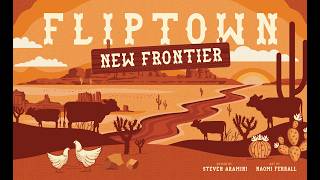
- Adds new boards with new gameplay elements.
- Blackjack mechanic is interesting and well-implemented.
- River section makes gold pans more useful.
- New buildings add variety and strategic options.
- Chickens offer a new scoring path, though difficult.
- Combination of boards creates interesting synergies.
- Extra round in combined play feels like a good addition.
- The new board sections are generally preferred over the old ones.
- Adds good variety and is enjoyable.
- Requires cards and rulebook from the original game.
- Rulebook for the expansion is not well-organized and requires referencing the original rulebook.
- Playing the combined game takes up significant table space.
- The expansion format (not standalone) is a detractor for some.
- The chicken strategy can be difficult to execute effectively.
- Expansion for Flip Town, adding new boards and gameplay options.
- Flip Town
Mechanics (from transcript analysis)
- Area Movement — Players move through different regions on the board, with some movement rules like not being able to go back on the railroad tracks.
- Blackjack — A new mechanic on the board involves playing a game of blackjack to gain rewards, with options to bust, push, or succeed.
- Flip and Write/Roll and Write — The game is a flip and write/roll and write game, and this is an expansion to an existing game in that category.
- Set Collection — Collecting chickens is a mechanic, with a multiplier for them at the end of the game. Collecting cows of different colors is also mentioned.
Video topics + discussion points
Quotes (from this video)
- You'll have to know how to play Flip Town to understand what I'm talking about here.
- My fairly a annoyance at the fact that this is an expansion.
- I think the rulebook is the weirdest part because you could you could buy this and just put in your own deck of cards.
- It's not a great rulebook, frankly, because it jumps around a lot.
- I went over the rules and I was like, I don't want to play with that much board. I just want to play with the new board and test it out.
- I really like the chickens.
- I love the new blackjack.
- This is a tricky one for me to rate because I love Flip Down. It's one of my favorite, if not my favorite, you know, flip and write, roll and write type thing.
- I think it's just it's solid.
References (from this video)

- race-for-the-galaxy/ Puerto Rico-inspired
- progression toward a new frontier
- put Rico-style action selection
Mechanics (from transcript analysis)
- action selection — choose and execute one action per turn
- board tiling and building — place or build on a shared board
Video topics + discussion points
Quotes (from this video)
- I'm not making a review videos anymore
- I've been so excited to be playing games over this last month
- BoardGameGeek is an amazing resource for me as a content creator
References (from this video)

- Engine building is good and provides multiple viable paths to victory.
- Alien Robotics Factory offers a solid production boost and pairs well with consume powers.
- Tourist World and Galactic Advertisers enable turning lower-value blue novelty goods into money and victory points.
- Windfall worlds create engaging engine-building opportunities and resource management.
- Diversified economy and related developments add meaningful scoring and economic options.
- Artist Settlement is described as not very exciting, implying some less appealing options exist.
- The game can end quickly if players optimize endgame timing, which may surprise players who misread the timing.
- Some strategic paths may be overlooked or misplayed, as noted by the player reflecting on choices near the end.
- expansion, exploration, and settlement of colonies, production and trade
- galaxy
- rule-teaching through live play
- Race for the Galaxy
- Puerto Rico
Mechanics (from transcript analysis)
- Action Following — Active player chooses actions from a shared set; all players may take the chosen action.
- Action selection on priority track — Active player chooses actions from a shared set; all players may take the chosen action.
- Chart Galactic Goals — Players draw three goals and choose one; end-game goals are revealed later and grant end-game points based on meeting conditions.
- Developments (small/large) — Eight fixed developments are available; they can be flipped to active, provide bonuses, and affect end-game scoring via red locations and placement slots.
- Diplomatic Envoys & Goals — Envoys can shift turn order and grant points; goals influence scoring and timing.
- Diversified economy and other developments — Developments provideVP and income; placement constraints prevent covering red spots until all smaller spots are filled.
- end-game triggers — End the game under three conditions: (a) a player has more than seven settled worlds, (b) all red development locations are filled, or (c) the victory point token pool dries up.
- explore action — Draw seven colonies from a bag, pick one for yourself and in turn order for opponents, flip colonies to explored or settled, and return unpicked colonies to the bag.
- Income — Produce phase places resources on colonies; windfall colonies provide immediate or ongoing benefits; production can generate credits and influence scoring.
- Production and windfall mechanics — Produce phase places resources on colonies; windfall colonies provide immediate or ongoing benefits; production can generate credits and influence scoring.
- Settlement/colonization — Spend credits and/or colonists to flip explored colonies to settled and place colonists; some colonies are windfall and have special effects.
- Stockpile action — Stockpile allows players to store goods on a dedicated tile and score points later based on stockpiled goods.
- Trade and Consume actions — Trade converts goods to credits (with various bonuses); Consume powers convert goods to victory points and/or credits depending on the tile.
- Windfall world aura — Windfall colonies start with a good; some effects interact with production and consumption in future turns.
Video topics + discussion points
Quotes (from this video)
- engine building is good
- this game does live in the Race for the Galaxy thematic universe
- the end game triggers are: seven settled worlds, red spots, or the VP tokens
References (from this video)

- Faster than it looks, ideal for fast-paced decision making.
- Lots of empire building in a short time.
- Multiple endgame triggers prevent dragging.
- Variable setup with double-sided tokens adds replayability.
- Great presentation, especially world tiles.
- Action selection system rewards maximizing gain and hindering opponents.
- Military strategy seems obvious and easy to win.
- Counters to military strategy require deep understanding.
- Can give a bad first impression if one strategy seems stronger.
- Competing for the same sets/bonuses can cause mutual loss.
- Oversized trade cubes are 'ridiculous overkill'.
- Competing colonies expanding into space for resources, planets, and technology to become the premier galactic power.
- Space colonization
- Empire building, space exploration.
- Race for the Galaxy
- Roll for the Galaxy
Mechanics (from transcript analysis)
- action selection — Players select one action to take each round, with the selecting player getting a bonus.
- Card drafting (world tiles) — Taking seven world tiles, selecting one, and passing the rest.
- Colonization — Placing colonists on worlds to flip them to their active side.
- Development — Buying tactiles (tech cards) with credits.
- Resource Production — Producing goods on settled worlds.
- Set Collection — Collecting sets for victory points.
- Trading — Selling goods for money.
Video topics + discussion points
Quotes (from this video)
References (from this video)
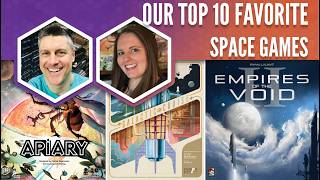
- High player agency and strong thematic cohesion
- Solid engine with pacing that remains tactical
- Recall necessary to relearn extended rule sets
- Array
- Space exploration with action resolution
- Action-choice-driven progression with thematic engine building
- Race for the Galaxy
Mechanics (from transcript analysis)
- Action Draft/Resolution — One player triggers an action that everyone executes, with bonuses for the triggering player.
- Action Drafting — One player triggers an action that everyone executes, with bonuses for the triggering player.
Video topics + discussion points
Quotes (from this video)
- "Mlem Space Agency is so much fun."
- "This is a wonderful game for families with its cute theme, fun dice rolling, and quick turns."
- "Apiary matches your shirt. It’s Bees in Space—positive player interaction throughout."
- "Things go wrong. This engine that you built up gets destroyed."
- "Star Wars: The Deck-Building Game is perhaps my favorite deck-building game right now."
References (from this video)
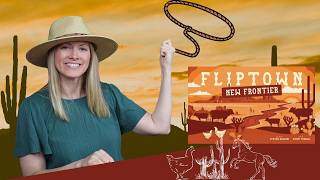
- Offers more to do and see compared to the base game.
- Introduces new locations and mechanics.
- The 'ricochet' feature is very cool and clever.
- Hard luck is a fantastic feature.
- The blackjack mechanic feels thematic.
- Provides a ton of thematic fun.
- Great additional content to the base game.
- The press your luck elements (sheriff card, Badlands flip) are not enjoyed by everyone.
- The game is longer in double barrel mode.
- Wild West
- Flip Town
- Flip Voyage
Mechanics (from transcript analysis)
- Blackjack — A mechanic in the hills section where players try to beat certain totals.
- Bounty objectives — New bounty cards offer specific goals for players to achieve for victory points.
- Card Drafting — Players select cards to determine actions and build poker hands.
- Dual board play — The game can be played with one (single barrel) or both (double barrel) boards, with double barrel offering more content and rounds.
- Hard luck mitigation — Players can pay resources to remove or delay hard luck, but face penalties if they have too much.
- Press Your Luck — Included in features like the sheriff card and the Badlands card flips.
- Resource Management — Players manage gold nuggets, dollar bills, and victory points.
- Ricochet bonus actions — Bonus actions on one board can trigger effects on the other board.
- Set Collection — Collecting chickens, cows, and stopping at rail stations are examples of set collection objectives.
- Variable player powers — New characters with unique abilities tied to specific game locations are introduced.
Video topics + discussion points
Quotes (from this video)
- I think it made one of my top games of the year.
- Couldn't be a better packaging system with a 52 card deck that essentially just generates all of your actions for the game.
- So, that is an interesting feature that I really, really like cuz you're pingponging from board to board.
- This is the kind of uh perfect solo game, solo experience of you just sitting around puzzling it out, trying to maximize your turn, get the most bang for your buck.
- And a lot of great additional things with New Frontier, the expansion to Flip Town.
- Flip Voyage really surprised me and is a nice different game with the core system that you get here in Flip Town
References (from this video)
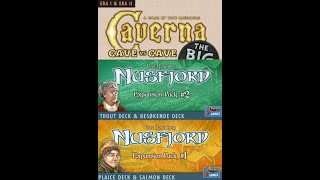
- Includes all base game components plus additional wooden coins.
- Contains 25 Elder cards, including base game, expansions, and promo cards.
- Adds a new expansion by Tony Boell called the BOK deck.
- The 'Guests' mechanism adds variety and efficiency opportunities.
- Wooden coins instead of metal ones.
Mechanics (from transcript analysis)
- Elder cards — Includes base game, expansions, promo cards, and new expansion cards.
- Guests — Wild cards/tokens acquired through building certain cards, used to decrease building costs, substitute for fish when serving elders, or permanently added to fishing boats to increase fish gain during the income phase.
Video topics + discussion points
Quotes (from this video)
- The Big Box will include all the components that are found in the base game plus 50 additional wooden versions of the coins instead of the metal ones which is a bummer to some who would have liked that but it is what it is.
- These guest tokens are virtually wild cards or wild tokens and you acquire them through building certain building cards in this expansion deck and when you acquire them you place them into your personal Supply and can use them in one of three major ways you can discard them and put them back in the General Supply to decrease the cost of future building cards you can count them as one plate when you serve fish to the elders so if you're missing fish you can use them to supplant that but you can also use them and permanently put them onto your boats that you include in your fishing row to increase the amount of fish that you gain in the income phase.
- Caverna: Cave vs. Cave is more of a mechanically similar game rather than thematically since you do pair out a lot of the mechanisms and abilities that you find in the original Caverna which allow you to farm and make it reminiscent of Agricola.
- Cave vs. Cave is mostly a resource tracking resource conversion and Tableau building with tiles type of game that has the look and some of the feel of the original Caverna.
- The way that you excavate especially if you play randomly with the random seating of these buildings the way that these buildings come out after you excavate the order in which they come out can I feel drastically alter the way that you approach the game.
- In complete transparency I have personally not played through era 2 yet.
- The wall mechanism of cave versus cave is reutilized in games like orani and burger canal with the different types of routes being placed on and around your building tiles allows them to activate in certain ways but in cave versus cave they're building requirements and so or at labora kind of has that similar Vibe going as well where it's more of a fact of the way that you place your buildings in relation to each other on your Tableau results in points scored during the game and at the end of the game and so I like that fact as well that is that is represented in cave versus cave and happy to see that type of spatial puzzle reutilized in a two-player version of the game.
References (from this video)

- varied strategic routes
- colorful components and thematic flavor
- unclear or inconsistent rule set at times
- not as widely known as other space games
- expansion and planetary development
- space exploration and empire-building
- techno-scientific flavor
- Race for the Galaxy
- New Frontiers
Mechanics (from transcript analysis)
- draft and resource management — players draft cards and manage cubes/resources to build outposts
- tile/planet drafting — planets are drafted, colonized, and developed for points
Video topics + discussion points
Quotes (from this video)
- today the first place or actually the last place in my ranking is smallworld
- we will fight for control over the areas
- it's a wonderful world really great game
- I really like to play this board game and definitely recommend it if you don't know it yet
- screens are a lovely mechanic for hiding your money during bidding
- the decisions of how to allocate the dice and the results behind the screens are the best moment
References (from this video)
- Tom's possible favorite on fourth shelf
- Not in top several hundred games
- Galactic civilization building
- Space exploration
- Race for the Galaxy
Mechanics (from transcript analysis)
Video topics + discussion points
Quotes (from this video)
- This is easily on this shelf. The most checked out game. Wonderlands War I see played every time.
- Foundations of Rome despite how big this game is. It gets checked out all the time.
- Everyone's really upset with Grimlord Games cuz they never delivered their last Kickstarter, but another company has picked it up.
- I don't I still don't understand why companies can't put names on the sides of their boxes. Come on now.
- Frostpunk, the board game if you're ready to have a depressing day.
- I think Mosaic is a fantastic civilization game. So fast and easy to play.
- People love Smashup. I have almost everything for Smashup, but it just barely gets played.
- Probably Twilight Imperium is my favorite of all these here, even though I don't play it that much.
- Last Kingdom is a kind of a really fun game from Games based on said TV series. Uh but pretty good. Think Game of Thrones style.
References (from this video)
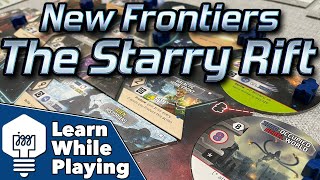
- Star Rift expansion adds 16 new empires via 8 double-sided empire mats
- Zeno worlds introduce high-stakes exploration with significant scoring swings
- New small and large development boards expand options and pacing
- Expanded goals and Explorer modifications increase variability and replayability
- Solid solo campaign mode with a structured progression and multiple campaigns
- Increases game complexity and requires careful tracking of many new rules
- Solo rules are detailed and may be daunting for new players
- End-game scoring has many moving parts and can be fiddly
- Galactic conquest with xenophobic aliens (Zenos) and imperial factions
- Interstellar empire exploration and colonization
- educational/tutorial
Mechanics (from transcript analysis)
- developments — buy and activate development tiles that modify actions and end-game scoring
- explore — draw tiles from the bag and pick which worlds to reveal; expansion adds more exploration options
- Galactic Goals / Explorer choices — draw and select goals; expansion increases pool and unlocks more scoring paths
- Produce — place goods on colonized worlds and potentially windfall worlds; production can chain with other effects
- Settle / colonize — spend colonists and resources to settle explored worlds, with military requirements and zone interactions
- Solo Campaign — structured solo play with dummy players and campaign win conditions, including Emergence and other campaigns
- Zeno / Xenophobia interaction — Zeno worlds impose penalties if not colonized; require military strength to overcome
Video topics + discussion points
Quotes (from this video)
- I have added everything that comes with the star Rift expansion into the base game
- The expansion is called The Starry Rift
- I think we'll play with the alien historians
- Xenos are hostile; if you explore forward and don't settle, you lose points
- we're going to play through a full solo game and explain how all of the elements work as we go
References (from this video)
- Fast-paced empire-building with a compact playtime
- Engaging action-selection mechanic that drives decisions
- Compelling world tile visuals and component presentation
- Oversized trade cubes add thematic flair and satisfaction
- Multiple ways to end the game reduces drag and increases variety
- Military-centric strategies can dominate and skew balance
- First impressions can be misleading if one path seems clearly stronger
- Some competition over shared sets can hurt payoff when multiple players chase the same bonuses
- Resource acquisition, colonization, and political strategy in a sci-fi setting
- Interstellar colonies, space empire-building across multiple worlds
- Eurogame-like strategic planning with deterministic outcomes
- Race for the Galaxy
- Roll for the Galaxy
- Puerto Rico
Mechanics (from transcript analysis)
- Action Following — Each round a player selects one action; all players execute it; the chooser receives a bonus.
- action selection — Each round a player selects one action; all players execute it; the chooser receives a bonus.
- Closed Drafting — Explore action draws seven world tiles, keep one, and pass the rest; the chooser gains an extra world after all others finish.
- Develop and tech tile acquisition — Develop lets you acquire tech tiles for a discount based on the number on the tile.
- Military conquest — Red-writed worlds must be conquered using military score equal to their rating; military score also comes from developments.
- Produce and trade economy — Produce places goods on normal worlds; trade converts goods to money; consume powers provide victory points.
- Retreat into isolation — An isolation action that gives money to the player who uses it while others cannot take it.
- Set Collection — Players collect world tiles and sets to maximize scoring potential.
- Settling and colonization — Settling allows taking colonists or placing them on a world and flipping it to its active side.
- Tile drafting/exploration — Explore action draws seven world tiles, keep one, and pass the rest; the chooser gains an extra world after all others finish.
- Tile/Map Shifting — Develop lets you acquire tech tiles for a discount based on the number on the tile.
- Windfall worlds — Windfall worlds (white circle with colored ring) yield a matching trade good when settled.
Video topics + discussion points
Quotes (from this video)
- the best thing about this game is the ridiculous oversized trade cubes, they're totally overkill and i love them for it
- new frontiers is a much quicker game than it initially looks
- it's puerto rico in space
- the heart of the game is its action selection system
References (from this video)
- did not latch on; clunky flow and complex steps
- Puerto Rico
- Race for the Galaxy
Mechanics (from transcript analysis)
- multi-system euro — several integrated euro-style systems
Video topics + discussion points
Quotes (from this video)
- this is experimentation month
- I want to be less stubborn
- the sticker shock issue really rears its head
- please give me feedback about this specific log
- it's a big box if it was a smaller box I think you'd be much more likely to have a state in the collection
- I think it's really important to be introspective and be honest with myself