


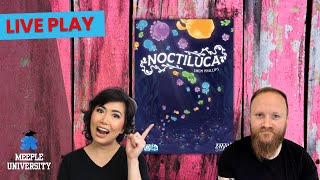




Noctiluca Deep Dive
What the Community Thinks About Noctiluca
Reviewers describe Noctiluca as a light, fast game that turns out to be more thoughtful than its box suggests. Designed by Shem Phillips and published by Z-Man Games, this 1 to 4 player title asks players to dive for glowing dice and deliver them to healers for points. 3 Minute Board Games opens by calling it a deceptively simple experience, while Before You Play presents it as a filler style game that its hosts admit can run well past the 30 minutes printed on the box. Both perspectives agree that the real length depends heavily on who is at the table.
The shared view is that the game rewards careful action selection and punishes slow decision making. Watch It Played uses a full rules walkthrough to show how the two round structure and the scoring steps fit together, which makes the game easy to picture before the first turn. Meeple University approaches it from the design side, with its host praising the look of the game and calling it simple yet deep. Where opinions diverge is on how relaxing the game feels. Some reviewers find the soothing colors and quick turns calming, while others find the pressure of passing dice to a neighbor stressful.
Core Mechanics That Define Noctiluca
Dice Drafting
The most distinctive system in Noctiluca is the way leftover dice travel around the table. A player places a pawn on one of the shorelines, looks down a line, calls a number, and takes every die showing that number along the path. Those dice must go onto matching colored spaces in the player's jars. Any die that cannot be placed passes to the next player, who may take only one before passing the rest along. Before You Play explains that this passing continues until no dice remain or nobody has room, so every pick shapes what the next player receives. The community treats this as a spatial puzzle as much as a selection contest. Choosing a number that yields exactly the colors you need, without handing your neighbor a useful die, is where most of the thinking happens.
Set Collection
Each jar is a set that must be filled with dice of one color in specific positions. Watch It Played stresses that a placed die can never be moved, so a player has to decide which jar to fill before committing dice to it. When a jar is full, its top scoring token goes to the player's pile, the completed jar is flipped face down, and a fresh jar is drawn from one of the face up stacks. That keeps new sets in play throughout the game. Reviewers note that the higher value jars are harder to complete because they demand more dice of a single color, which pushes players to weigh the payoff of a difficult set against the easier options already on the table.
The Noctiluca Experience
Pleasant Tension
Reviewers repeatedly describe Noctiluca as soothing to look at while still being stressful to play. The board fills with bright, translucent dice, and the calm of choosing a single number is undercut by the knowledge that every line you take may hand a useful die to someone else. Before You Play sums up the feeling as pleasant and stressful at the same time, a combination the hosts found interesting given how simple the surface rules are. Because each turn is quick, the mood stays light even as the board tightens toward the end of a round.
Brain-Burning Focus
The other prominent feeling is intense concentration. 3 Minute Board Games calls the action selection brain burning, and says that trying to collect the exact dice you want without giving any away is intense enough to wear out the reviewer. With only a dozen pawns spread across two rounds, almost every move feels consequential. That same intensity is what makes the game feel demanding rather than casual, and it is the reason the reviewer describes the experience as more of a puzzle than a breezy filler.
What Makes Noctiluca Stand Out
Two Rounds With Reversed Turn Order
3 Minute Board Games praises the short, two round structure and the way player order reverses in the second round. The reviewer argues that this keeps any single seat from holding an obvious advantage, since going first or last swaps over the course of the game. Before You Play makes a related point from the player's side: each person gets only twelve turns for the whole game, so the experience is tight, direct, and finishes before fatigue sets in.
Hidden Color Objectives
Reviewers highlight the secret color objective as a real source of depth. Each player holds a private reference card that favors dice of one color, and Before You Play points out that when some cards only offer a point or two in bonuses, the secret color can be worth a point for each matching die in completed jars. That gives players a reason to pursue a color others may ignore, and it turns final scoring into a reveal. Watch It Played walks through the end game scoring step by step, which helps viewers see how majority tokens, completed jars, and the secret color combine.
Potential Drawbacks
Analysis Paralysis Among Slow Players
The most common concern is slow decision making. 3 Minute Board Games warns that the game is rough when it comes to analysis paralysis, since players can stare at the dice for minutes before picking a placement. Before You Play agrees that the length can grow, especially with more players, because the board state shifts on every pick and waiting for a turn gives people time to overthink. Both perspectives suggest that groups who are comfortable with quick turns will enjoy the game most, while players who struggle with long decisions may find it drags.
Handling Dice and Color Differences
Two smaller concerns involve the physical components. 3 Minute Board Games objects to having to tip the dice into the box lid at the end of a round and says the game should have included a dice bag, a gap the reviewer filled with an aftermarket bag. Before You Play raises a possible issue for players with color vision differences once the board is nearly full, although the hosts note that the jars carry symbols that identify each token type and that the dice colors avoid close shades such as pink and red.
If You Enjoy Noctiluca
Players who enjoy Noctiluca's dice passing and pick-the-number decisions will find a similar sense of puzzle in Sagrada, which 3 Minute Board Games recommends for anyone who loves dice and puzzles. For a different style from the same designer, the same reviewer points to Raiders of the North Sea. Before You Play places Shem Phillips among the designers of Architects of the West Kingdom, a title that will appeal to players who value the majority scoring and the tension between competing scoring avenues in Noctiluca.
What Reviewers Are Saying
"Noctiluca is one of those deceptive games it looks like it will be a breezy fun lightweight jolly old time but really it's an intense brain-melting puzzle where you constantly second-guess yourself about what action to take and actions are so limited in the game every single move feels important."
— 3 Minute Board Games
"I like this game best at two players because there's only 12 spots on on the game board so at a higher player count you could just be sitting around waiting for your turn where you're not really manipulating the dice on the board or doing much actions."
— Before You Play
"It's a really like it's really gorgeous game it's really simple yet it's very deep."
— Stella, Meeple University