










Papyria Deep Dive
What the Community Thinks About Papyria
Papyria has earned appreciation as a hidden gem among board game reviewers, though not always at first glance. The game represents a triumph of clever design over flashy presentation, and reviewers consistently found themselves changing their minds as they played more. Board Gaming Ramblings spent hours discussing the game's depth, noting how their perspective shifted across multiple plays. Meeple University called it underrated and clever. The Buzz Murfs, meanwhile, were struck by how dramatically Papyria escalates in scoring, part of their broader interest in games that ramp up mechanically. Even reviewers initially skeptical of its plain aesthetic came to appreciate the elegant systems hiding beneath the surface. Capstone Games picking up the game for wider North American distribution suggests confidence in its long-term appeal, moving it beyond the niche European publisher market where it debuted.
Core Mechanics That Define Papyria
Double Rondel Movement
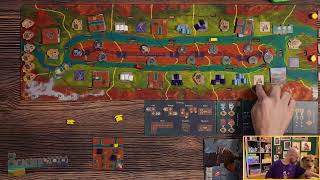
At the heart of Papyria lies an elegant dual-track rondel system. Players control both a wanderer and a boat moving around concentric rings, each occupying slightly different action spaces. On your turn, you move one of your pieces one or two spaces clockwise, optionally paying the precious resource lapis to move further. The true elegance emerges when your two pieces land on the same action space: suddenly your priest can teleport anywhere on the board, freeing you from the usual spatial restrictions. This single mechanic generates enormous decision-making tension. Do you keep your wanderer and boat apart to maximize distinct actions, or synchronize them for the flexibility to reposition? Reviewers consistently highlighted this design as "very clever" and the source of what makes Papyria feel strategic despite its straightforward ruleset.
Worker Bumping and Player Interaction
When you land on a space where another player already stands, you face a choice. Skip that space and move further, or pay them one lapis to bump them out and claim their spot yourself. This simple rule generates rich player interaction. Bump them before a bonus halfway-point trigger and they forfeit the reward. Bump them from a space with a scoring tile they were targeting and you may have just redirected the entire game. Reviewers from The Dice Tower to Board Gaming Ramblings emphasized how this mechanic forces you to watch what others are doing and makes every movement decision tactical, not just strategic. It transforms Papyria from a puzzle you solve in isolation into a race where timing and position matter as much as long-term planning.
The Papyria Experience
Explosive Score Escalation
The most striking feature of playing Papyria is how hard the scoring ramps. Early rounds generate modest points: a handful here, a dozen there. By the endgame, players are scoring 50, 60, even 100+ points in a single turn. The Buzz Murfs called this "bonkers" escalation, noting that Papyria ships with 50-point tokens because you need piles of them. This isn't random explosion; it emerges from mechanical inevitability. You collect scoring tiles and multiplier tokens throughout the game. As your multiplier stack grows and you accumulate more distinct terrain types (forests, cities, mountains, rivers, sanctuaries, mines, innovations), each scoring event triggers exponentially larger rewards. Watching this acceleration unfold creates a deeply satisfying sense of mastery and payoff.
Knowledge as the Equalizer
Yet Papyria tempers explosive growth with a brilliant counterweight: the knowledge track. Your score always caps at your current knowledge level. Score a potential 80 points but only have 30 knowledge? You only take 30. This single constraint reshapes the entire game. You cannot simply specialize relentlessly in one scoring type and dominate. You must balance building your scoring infrastructure with advancing your knowledge track through other actions. Board Gaming Ramblings and Meeple University spent considerable time discussing this relationship, noting how it forces generalization across different terrain and scoring types. The interplay between ramping multipliers and knowledge caps creates a rhythm: early game is quiet building, mid-game sees slight acceleration, but late game becomes frenetic as knowledge finally catches up to your multipliers and points pour in from dozens of sources simultaneously.
What Makes Papyria Stand Out
Surprising Strategic Depth from Simple Rules
Papyria fits inside 90 minutes with a ruleset that boils down to: move a piece, take two actions, potentially trade or bump opponents. Yet this simplicity masks layers of decision-making. Board Gaming Ramblings noted with surprise how the game changed their thinking multiple times across replays, a rarity for them. Every action carries hidden weight. Do you grab a multiplier now, securing your scoring path, or focus on knowledge to unlock scoring potential later? Do you race for the same scoring tiles everyone sees, or specialize in less obvious terrain combinations? Reviewers found themselves playing fundamentally differently based on board layout and which scoring tiles face up. The Dice Tower and others praised how you cannot plan the entire game from the start; adaptation and tactical pivots become essential as the board state unfolds.
Variable Setup and Player Interaction Balance
The board changes every game. Which action spaces appear on the rondel shifts. Which scoring tiles are available rotates. This variability prevents the game from feeling solved or repetitive despite its mechanical simplicity. Equally important: player interaction never feels like a zero-sum grudge match. You can trade lapis to opponents for knowledge or papyrus at the halfway boundaries, creating moments of mutual benefit. You can bump them from a space, but they pay you and often it's a fair trade. Even the supposed "mean" strategy of stealing a scoring tile from an opponent who desperately needs it carries a cost and doesn't guarantee victory. Board Gaming Ramblings and others appreciated how aggressive play was possible but never mandatory, and how tactical moments (deciding when to pivot away from one scoring type toward another) often mattered more than individual player battles.
Potential Drawbacks
Beige Aesthetic and Light Theme
Papyria is not a pretty game. The theme, ancient Mesopotamia, building civilizations along the Tigris and Euphrates, sits lightly atop the mechanics and doesn't sing. Colors are muted. Artwork is functional, not striking. Art direction simply does not leap off the table. Meeple University explicitly noted it might "fly under the radar" because it "is not a hugely pretty game" and "looks quite beige" compared to flashier releases. The Dice Tower mentioned it as a Euro game without the modern, intricate combo-heavy aesthetic. This matters. Many players buy with their eyes first. Papyria asks you to engage with elegant systems rather than immerse in a richly realized world. That trade-off works for some and frustrates others.
Analysis Paralysis and Two-Player Tension
Board Gaming Ramblings found the two-player game "very racy" but also noted strategic bottlenecks. With fewer players, certain scoring tile opportunities become tighter. The race for a specific scoring path can feel forced or inevitable rather than emergent. The same reviewer expressed that the game "forces you down a road" at two players: you almost must pursue certain obvious strategies or lose. In larger groups, more players competing for the same tiles creates natural diversity. With two, player interaction can sharpen into a tense race where you're less exploring interesting possibilities and more executing necessary plays. Meeple University called this the key drawback: at two players, "you have to like if one person races for these things and doesn't try to get any of them, I don't think you're going to win the game." This constraint is not a flaw for everyone, but those seeking open-ended sandbox gameplay may feel hemmed in.
If You Enjoy Papyria
Papyria stands firmly in the tableau-building, score-escalation camp. If Papyria clicks, you likely also appreciate games where resources convert into engines of increasing power. The Buzz Murfs group Papyria alongside Slay the Spire and Lost Ruins of Arnak as quintessential ramp-up experiences. The mechanical echo to Carcassonne is clear: you are placing tiles to form patterns, though Papyria adds the rondel-based scoring-tile race that Carcassonne lacks. If you enjoyed the tense timing decisions of The Princes of Florence, where knowing when to stop building and start cashing in points matters enormously, Papyria offers a kindred puzzle. For those drawn to Tigris and Euphrates' rondel elegance, Papyria modernizes and sharpens that mechanic with bumping and dual tracks. And if you appreciated the beige, old-school Euro feel of games like Brussels 1893 (which Meeple University contrasted favorably with Papyria's cousin games), you are already primed to see past plain art toward elegant systems.
What Reviewers Are Saying
"It's insane. The scoring this game gets absolutely bonkers. So, this is a game where you're going around these two rondell's around the Tigers and Euphrates. You have a boat that's going around the rondelle, going around the river, and then there's a wanderer."
— Buzz Murfs
"This game has made us sit after a game and talk after half an hour about the experience and discuss what we like and what we don't like. And I still felt that [upon replay]. Then we played it again and I kind of changed a little bit. Then we played it a third time and it changed very much."
— Board Gaming Ramblings
"This is an interesting little game. So it's got a double rondle mechanism. You've got a rondle on the inside and a rondle on the outside, and each of them let you do similar actions, and most of the actions are geared around building up your own personal tile layout. There's about seven different types of things and they all score in different ways. So you want your rivers to match up. You want your cities to be a long way apart from each other."
— Meeple University