



















Electrify Deep Dive
What the Community Thinks About Electrify
The board gaming community views Electrify as a refreshing addition to the euro game landscape. Reviewers consistently praise its thematic energy infrastructure system and satisfying mechanical execution. The consensus is overwhelmingly positive, with strong appreciation for the game's simultaneous-play design and engine-building depth. Most reviewers see Electrify as a friendly, accessible game with surprising strategic legs, particularly for players who enjoy Ark Nova, Space Base, or similar tableau-building mechanics. The game's lack of direct player conflict is intentional and well-received among those seeking cooperative competition. Where reviewers diverge is on the interaction model: some embrace the "multiplayer solitaire" feel, while others note that the game's mechanics can feel slightly disconnected from traditional competitive euro design.
Core Mechanics That Define Electrify
The Action River System
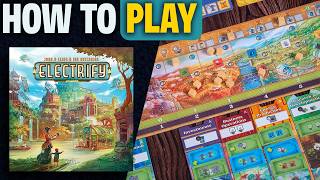
Electrify's heart is its rotating action selection mechanism, inspired by games like Ark Nova and Civilization: A New Dawn. Players select one of five energy sector tiles at the start of each round, which activate the actions printed on that tile and any industry cards stacked beneath it. If a player selects a sector no other player chose, that sector advances one column to the right, pushing other sectors along with it. This "innovation boost" makes sectors more powerful over time, but advancing also resets a sector to the leftmost column, creating a constant tension between strengthening actions for later or using them now. If multiple players select the same sector, they instead receive a "collaboration boost" and advance their research instead. The designers, John Declair and Ian Hutchinson, built this mechanic to reward patience and strategic positioning without punishing shared choices, making the action river accessible to players of different experience levels.
Energy Advancement and Grid Transmission
The second defining system is the energy transformation track running across each player's board. Players begin with six fossil fuel cubes in their "energy depot" (the lower section of their board). During the game, cards let them develop these cubes rightward, transforming fossil fuel into natural gas, biofuel, geothermal, hydroelectric, wind, and finally solar. Energy cubes at different development levels have different values for purchasing cards: rightmost (cleanest) cubes are worth the most currency. Players can also transmit cubes from the depot upward into the "grid" above, where they can fulfill demand cards or be discarded for research advancement. This transformation system creates elegant resource tension: do you spend your valuable solar cubes on purchases or save them for demands? Do you transmit them to the grid for scoring or keep them in the depot for buying power? Alderac Entertainment Group published this design with theme deeply woven into mechanics, making the "electrification" narrative feel integral rather than pasted-on.
The Electrify Experience
The Satisfying Feel of Engine Building
Reviewers across the board highlight the deeply satisfying experience of building and watching an engine activate. In early rounds, turns are short and simple. But as players add industry cards with arrow chains pointing between sectors, single activations cascade into multiple card triggers, producing cubes, advancing research, and transmitting energy in rapid succession. This gradual escalation mirrors the fantasy of an energy grid coming online. Players describe the moment when carefully planned card placements finally synergize as genuinely rewarding. The game delivers this satisfaction repeatedly across its 12-round arc, making each round feel like meaningful progress rather than repetitive turns.
The Meditative Puzzle of Solo Play
The solo experience in Electrify differs substantially from multiplayer. Players face scenario cards with specific victory point targets and bonus objectives tied to round deadlines. The mechanical change is subtle: instead of competing sectors based on player choices, a random token draw determines whether a sector advances (innovation) or the player gains research (collaboration). But the experience shifts from competitive to purely puzzle-like. Solo players report feeling immersed in optimizing their engine, with no downtime waiting for others. The game's simultaneous-play design in multiplayer translates to solo as well, creating a game that plays in about 60 minutes regardless of player count. Reviewers note that the solo mode works exceptionally well precisely because the game has so little built-in player interaction, making a bot-less solo experience viable and engaging.
What Makes Electrify Stand Out
Simultaneous Play Without Sacrificing Decision Depth
Many euro games sacrifice strategic depth for faster play, but Electrify achieves both. Once the round's sector selection is revealed, players execute remaining steps simultaneously and at their own pace, creating a game that runs remarkably fast for its mechanical complexity. You can play a full game in 60 to 75 minutes despite managing seven energy types, five rotating sectors, industry card chains, research tracks, and demand fulfillment. This speed comes from the simultaneous-play structure: players don't wait for neighbors to finish their turns. Reviewers find this pacing revelatory compared to traditional euro games, especially those who typically face long waits during multiplayer sessions. The game never grinds to a halt for one player's decision-making.
Replayability Through Scenario Depth and Card Variety
The game includes multiple solo scenarios of increasing difficulty, but broader replayability comes from the industry card pool itself. The base game includes introductory cards and advanced versions that unlock after a few plays. Reviewers emphasize that shuffling in advanced cards dramatically shifts viable strategies without breaking the design. Demand cards are tiered one through seven, with only one of each tier in any single game, meaning different card combinations appear in every session. The sector randomization at setup (determined by the lead player each game) adds another layer. Together, these systems ensure that no two games play identically. Players report that the game stays fresh through repeated plays, and they continually discover new card synergies and approaches.
Potential Drawbacks
Late-Game Fiddliness with Cube Management
As the game progresses, players accumulate significant numbers of cubes on their boards, particularly in the fossil fuel columns. In the endgame, managing the logistics of moving dozens of cubes between depots and the grid becomes tedious. One Stop Co-op Shop's reviewer noted that late-game turns can feel fiddly just dealing with the sheer volume of cubes, despite the game's inherent elegance elsewhere. This minor annoyance doesn't break the design but can slightly deflate the momentum of what was previously smooth, fast-flowing turns. Players with limited table space or those who prefer minimal physical token shuffling might find this frustrating in games running toward the 12-round finish.
Limited Meaningful Player Interaction in Multiplayer
Despite being a multiplayer game, Electrify functions almost entirely as simultaneous solitaire after the planning phase. The only player-vs-player interaction is the sector selection dial: choosing a sector no one else chose advances your sector, while matching someone else's choice only grants research. Reviewers note that in practice, the interaction diminishes significantly mid-game. As players focus on maximizing their own card synergies and engine strength, the sector selection becomes less about reading opponents and more about activating specific cards on their board. Some reviewers appreciated this, finding it refreshing to build their own engine without cutthroat competition. Others who enjoy tense euro-game interaction found it underwhelming, noting that demands don't force competition (every player can complete every demand) and there are no limited resources creating scarcity. For players seeking deep player interaction, this is a design trade-off rather than a flaw, but it's worth noting before purchasing.
If You Enjoy Electrify
Electrify shares DNA with several celebrated games. Ark Nova uses a similar action-river mechanic where selected actions slide backward and strengthen other actions, and both games reward long-term planning over short-term optimization. Space Base, also designed by John Declair, shares some mechanical touchstones and a "players building their own engines" philosophy. Civilization: A New Dawn similarly uses a moving-action-river system where position determines power. Players who love Seasons or other tableau-driven games will find Electrify's card-synergy puzzle familiar and satisfying. For solo enthusiasts, Rolling Heights and Terraforming Mars offer comparable depth and satisfying solo modes. If you're drawn to the thematic energy-production angle, Power Grid offers a heavier, more economic take on energy supply, though with very different mechanics. Those who appreciate the cascading activation chains in Electrify might explore Azul for simpler tile-chain satisfaction or Storyfold: Wildwoods for a different take on action selection and storytelling.
What Reviewers Are Saying
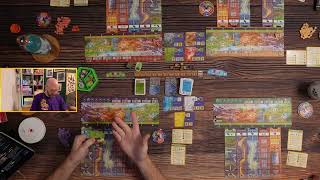
"You notice that little arrow? If at some point I had put this here, then what would happen is, hey, because I'm running investments, I'm also running both of these upgrades. And this little arrow says, hey, follow the arrow to the left. Run that as well. So, at the beginning of the game, you don't have much of this combo stuff, but later in the game, you can start creating huge activation chains where, hey, this could activate this, which could activate this, which could activate, and you could activate a ton of stuff. And late in the game, you get these huge super powerful turns."
— Rahdo Runs Through
"I think this is a cool new iteration on it. The idea that it's not just the one action getting better the further it goes, but that you're also customizing the things and having cards combo into each other. Now, I will note, I've never had it happen like this before, but now that I've done it, I kind of don't see why I wouldn't do it over and over again. Getting arrows in every single spot of a given column, if you can make it happen, is just kind of ridiculously good."
— One Stop Co-op Shop
"There are so many opportunities here. You can see the strategy. You can see it playing out. But you only get 12 times to do this. Electrify is a really cool smart game. And when you get someone that's got that kind of thinking that totally picks up what this game is doing from the start, it can be really, really fun."
— Tabletop Tolson