



Ricochet Robots Deep Dive
What the Community Thinks About Ricochet Robots
Reviewers mostly agree that Ricochet Robots is a small, clever puzzle game that is much more demanding than its box art suggests. Alex Randolph's design was first published in 1999, and several editions have followed, including newer ones from Z-Man Games that add minor changes to components or rules. Adam Porter of Adam in Wales - Board Game Design calls it "a mini masterpiece" and a classic, while being candid that it is not among the best games ever made. Adam Porter's reason for valuing it is that "there's nothing else like it," because it plays very differently from most games they own.
The strongest point of agreement is that the game is a concentration exercise more than a social one. Several reviewers describe players sitting in silence and staring at the board, working out a route before anyone declares a move count. Board Gaming Ramblings, the channel run by Cineal and Johannes, takes a more practical view in a video ranking their most-played games. They say the game is simple and fun, but they stopped playing it because one of them is consistently faster, which makes the game less enjoyable for everyone else. Adam Porter's own list-based videos place it among games that can be solved alone but gain their tension from the comparison with other players.
Where reviewers disagree is mostly about who the game suits. Adam says it is difficult in a way that takes time to absorb, and that players who are much faster may make the experience unpleasant for those who are slower. Ricochet Robots is therefore recommended for groups who enjoy quiet puzzling, and less so for players who want constant interaction.
Core Mechanics That Define Ricochet Robots
Race to Solve a Puzzle
The defining mechanic is a race to solve a fixed puzzle. A board is laid out with robots and targets, a target is drawn, and every player works to find the shortest sequence of moves that brings the required robot to its goal. Adam Porter explains in a mechanisms list video, Adam in Wales - Board Game Design, that the appeal comes from calculating the lowest number of moves and trying to beat the other players. Each robot slides in a straight line until it hits a wall or another robot, which means the solution is built from short, precise chains of movement. Reviewers say that declaring a number of moves and starting a timer turns the puzzle into a competitive act, even though no player can interact with another's robots.
Multiplayer Solitaire
Adam Porter also uses Ricochet Robots as a classic example of multiplayer solitaire, a design where every player works on the same puzzle independently. In a video on degrees of interaction in board games, Adam in Wales - Board Game Design notes that nobody can directly block another player's robots, so the game is played almost entirely in silence. The interaction lies in the timing: one player declares a move count and the other must beat it. Reviewers consider this a useful model for games that want competition without direct conflict, and they note that Dimension works on a similar principle, with each player solving a shared challenge and comparing scores.
The Ricochet Robots Experience
Silent Concentration and Tension
Reviewers describe the first minutes of play as a lesson in patience. Adam Porter says that when playing two-player, the two players "rub our chins" and sit quietly for several minutes while working out a solution. The tension builds because each player can tell when they are close to a solution and must decide whether to declare before the other player finishes. That pressure makes the silence feel charged rather than dull, and it is the feeling that reviewers return to most often when they describe the game.
Frustration That Turns to Laughter
The other dominant feeling is frustration, and reviewers frame it as the source of much of the enjoyment. Adam Porter explains that the interaction comes from the moment when a player is almost finished and the opponent declares first, which Adam Porter describes as the point where the frustration and laughter both arrive. In that video on interaction, Adam Porter argues that this is not a flaw but a central part of the experience, since the group shares the disappointment and the humor of watching a near solution disappear.
What Makes Ricochet Robots Stand Out
Simple Rules With Deep Puzzles
Reviewers consistently praise how little the game asks players to learn while still producing hard problems. Board Gaming Ramblings calls it "a puzzle game" that is "so simple" to teach, and they have played it thirty times in their own records. Adam Porter likewise calls the design "so clever" and says the experience is very different from most of the games they play. The rules fit on a page, but the solutions can take a long time to find, which is why the game keeps appearing in discussions of games that reward careful thought.
Works at Any Player Count
Because the game is a shared puzzle, it scales well to large groups. Adam Porter points out that the rules allow any number of players, and Adam Porter has heard of people playing it in conference halls with the board projected on a screen and hundreds of players trying to find the answer. Ramblings also notes that the game is usable at any table size, although its appeal shrinks when one player is much faster than the others. The result is a game that can be played with a couple of friends or in a large room, with the same basic rules in either case.
Potential Drawbacks
Predictable Winners
The most consistent criticism is that experienced players can dominate the game. Board Gaming Ramblings says they stopped playing because one of them "always wins," and that the game "is not that fun for the other players anymore." They describe themselves as good at it and admit that most of the people they play with do not stand a chance. Reviewers who value a balanced social game may find this unsatisfying, and it is a reason some groups choose to play with mixed levels of experience or to vary the puzzles.
A Theme That Sets the Wrong Expectation
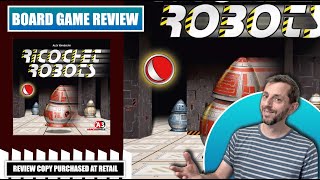
Adam Porter says the box is misleading because the artwork and the robots suggest a chaotic, sci-fi game similar to RoboRally. In Adam Porter's view, the game is in fact "a very slow thinking, a very serious game," which is not what the cover promises. Adam Porter thinks this mismatch has made the game seem less accessible than it is, and also notes that the amount of content in some newer editions may not justify the price, although Adam Porter has not personally seen the latest version. Buyers who expect a lively, action-packed game may be disappointed, while those who expect a quiet puzzle are more likely to be satisfied.
If You Enjoy Ricochet Robots
Players who enjoy Ricochet Robots's race to solve a puzzle will find similar satisfaction in Genius Square, where players race to place polyomino blocks into a grid. Adam Porter discusses that game in that mechanisms list, and the shared appeal is the moment when an answer becomes obvious and the opponent is still searching. Players who like the multiplayer solitaire structure will find the same idea in Dimension, where each player works on the same challenge and the scores are compared at the end. Those who want a deeper version of the original concept should look at Mutant Meeples, which Adam Porter describes as heavily based on Ricochet Robots while adding a number of new features. Finally, RoboRally shares the robot theme that many people associate with Ricochet Robots, but it plays very differently, so it is best recommended to players who want a different kind of robot game rather than a similar puzzle.
What Reviewers Are Saying
"It's really tense, it's really tense, because you know that that other player could declare at any time. And you can see when you're figuring it all out, you can see when you're getting close. You can be thinking right, I'm nearly there, I'm nearly there, I'm nearly there, I haven't quite got it, but I'm nearly there. And then your opponent declares, and all that thinking is wasted."
— Adam in Wales - Board Game Design
"Yes, but we stopped playing it because you always win. Yeah, but also it's not that fun for the other players anymore. You're also pretty good at it. I'm pretty good at it. But most player we play it with don't stand a chance."
— Board Gaming Ramblings
"The interaction comes in the frustration when you're almost there. You think you've almost got it and then the other player gets it before you can, and that's where the laughter sort of comes from."
— Adam in Wales - Board Game Design