


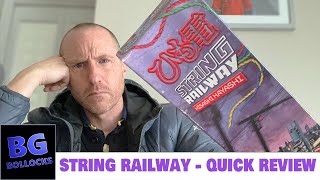

String Railway Deep Dive
What the Community Thinks About String Railway
String Railway stands out as a deliberately unconventional railway game that prioritizes charm and novelty over mechanical depth. Reviewers consistently note its unusual appeal, pitched squarely at two distinct audiences: players new to modern board games seeking accessible entry points, and experienced enthusiasts hunting for atypical designs that venture beyond the mainstream. The game has earned respect for its core concept and whimsical execution, though opinions diverge on whether its fiddly physical components and spatial disputes justify its design ambitions. Across the board, reviewers agree that String Railway rewards players with a distinctive play experience, though it demands tolerance for occasional frustrations inherent to its string-based design.
Core Mechanics That Define String Railway
Spatial String Placement
String Railway replaces the hexes, squares, and conventional tracks found in most railway games with an elegantly simple physical system. On your turn, you draw a station card and place it on the board, then choose one of your colored strings and position it to connect stations, earning victory points based on what your string touches. The board itself is defined entirely by strings: a large outer loop establishes the play area's boundary, while additional strings represent a mountain and river that block movement. This string-based spatial language means no two games have identical geometry unless players recreate exact configurations. Designer Hisashi Hayashi, who previously designed Trains and Trains Rising Sun, exploited the physical properties of strings to create a system where area control emerges not from claiming hexes but from positioning long arcs strategically within a shared space.
Area Control Through Connection
The mechanical depth emerges from managing overlapping strings and contested territory. Connecting new stations earns you victory points, but overlapping your string with an opponent's costs you points, creating a push-and-pull dynamic. Reviewers compared String Railway to Blokus and Sorro, games where you simultaneously try to maximize the space available to yourself while minimizing what remains for opponents. A station with a company limit restricts how many strings can connect to it, forcing players into contested junction points. In String Railway Cubed, the optional variant using movement tokens, this positional tension deepens: you move cargo between warehouses rather than simply scoring connection points, adding a logistical layer that transforms pure spatial blocking into economic maneuvering.
The String Railway Experience
Light, Filler-Adjacent Gameplay
String Railway delivers the experience of a quick aperitif game that can be taught in minutes and played in under thirty minutes. Reviewers emphasized its accessibility for casual players and newcomers, making it an appealing introduction to spatial strategy without the cognitive overhead of heavier abstracts. The decision space is deliberately constrained: you draw one station, choose which of your five strings to deploy, and position it to maximize points while blocking opponents. Because the core loop is so lean, the game serves best as a game-night opener, a filler between longer sessions, or a social bridge game for groups still building a shared collection. One reviewer noted it represents the ideal entry point for players tired of roll-and-move but not yet ready for economic games or heavy Eurogames.
Whimsical Physical Charm
The emotional resonance of String Railway rests entirely on its unconventional physicality. Using colored strings as the primary mechanism creates a tactile, almost craft-like atmosphere that stands apart from the cardboard-and-wood aesthetic of conventional board games. Reviewers used words like "DIY," "quirky," and "indie" to describe the visual and tactile experience of stretching strings across a board. This charm proves polarizing: players who embrace offbeat designs and appreciate the novelty of component substitution find it delightful. Those seeking crisp, standardized components and predictable rule enforcement find the string-based approach fiddly and frustrating. The game's unconventional appearance also makes it a conversation starter at game clubs, drawing curious onlookers who might not otherwise engage with a railway game.
What Makes String Railway Stand Out
A Radical Reimagining of Railway Mechanics
Most railway games ask players to claim routes on a map or build track networks from one city to another using conventional movement rules. String Railway discards that vocabulary entirely. Instead of calculating the shortest path or managing track-building engines, you are literally arranging physical strings to form territories and connections. This shift changes the spatial reasoning players must employ: rather than thinking about networks, you're thinking about Euclidean positioning in continuous space. A string can curve around a mountain, squeeze into a bottleneck at a marshalling yard, or greedily claim a wide arc to block opponents. This novelty, reducing railway strategy to pure spatial positioning using actual strings, is the game's defining feature and explains why it appeals both to players exhausted by conventional rails and those intrigued by mechanism innovation.
Scalable Setup for Variable Player Counts
The outer boundary string can be reconfigured into different shapes depending on player count: a square for four players, a triangle for three, and a line for two. This flexibility ensures that the play area scales meaningfully without requiring different rules or component sets. Reviewers noted that String Railway works better at three or four players, where the spatial competition intensifies and blocking becomes mutually consequential. At two players, the board remains spacious enough that conflicts feel less acute, reducing the pressure and tension that make area control games engaging. Nevertheless, the adaptability demonstrates forward-thinking design and ensures the game remains playable across the full range of player counts without deteriorating into either stalemate or chaos.
Potential Drawbacks
Physical Manipulation and Disputes
Because the entire game state depends on string positioning in continuous space, rather than discrete grid placement, physical movement becomes contested. Reviewers reported that stretching a string to connect a station can accidentally (or intentionally) displace neighboring strings or shift other stations. The question "Is your string actually touching that junction, or did you stretch it too far?" generates friction rather than fun for some groups. One reviewer noted the game invites accusations of cheating not through hidden information or rule-breaking, but through ambiguous string geometry. Another mentioned needing to play "judge" to rule on whether a tautly stretched string, when released, still touches its target. This design flaw means the game's success depends heavily on group culture and trust: groups accustomed to good-faith play enjoy it, while groups prone to sharp tactics find it frustrating.
Fiddly Components and Limited Agency
Reviewers criticized the component quality: the victory point tokens are single-sided and flimsy, making them difficult to flip and easy to miscount. The strings themselves, while evocative, tend to knot when stored, requiring careful organization before each play. The station card draw is random and heavily constrains your options: on most turns you will receive only one new station card, and if that card doesn't synergize with your spatial plans, you have limited workarounds. This restricted agency means bad card draws can feel particularly punishing in a game with so few meaningful decisions per turn. The combination of component frustration and limited mitigation paths makes String Railway feel slightly undercooked compared to polished competitors, even if that roughness contributes to its undeniable charm.
If You Enjoy String Railway
Players drawn to String Railway often gravitate toward abstract spatial games emphasizing positioning over economic systems. Try Blokus, which shares String Railway's emphasis on claiming area and blocking opponents but using cleaner components and faster turns. Sorro offers a similar spatial-control dynamic with a lighter rules overhead. For those charmed by String Railway's unconventional physicality and DIY aesthetic, String Railway Cubed, the official variant, deepens the experience without abandoning what makes the base game memorable. If you love games that play quickly but generate interesting spatial puzzles, Cock's On provides comparable engagement without the string-handling friction. Those seeking a railway game with more traditional mechanisms but comparable accessibility might explore lighter entries in the 18xx family or reimplementations like Cartagena, which also emphasizes movement and positioning over empire-building.
What Reviewers Are Saying
"I think this is this is going to be one that appeals to new Gamers or to people who have a whole lot of games but are kind of searching for that like weird thing like that thing that's just kind of on the outskirts a little bit."
— Allies or Enemies
"The way that the game tempts you into trying to block players into their area. And conversely, it's in your interests to try and fashion as much space as you possibly can. This sort of tactic reminds us of games like Blokus and Sorro, where you're trying to maximize the amount of space you've got whilst at the same time trying to minimize the amount of space that your opponents have."
— BoardGameBollocks
"You know how most railway games you put little tracks out. This one you're maneuvering the string. Such a cool concept and I thought it worked fine."
— Tom Vasel, The Dice Tower