

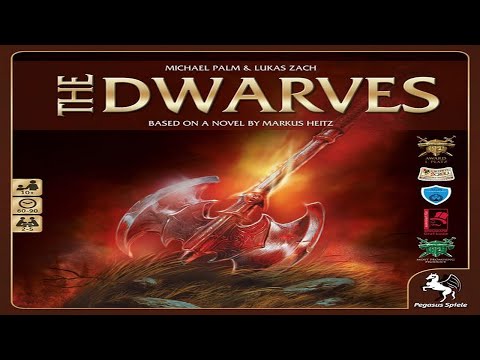
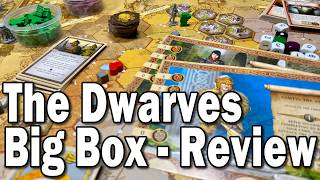

The Dwarves Deep Dive
What the Community Thinks About The Dwarves
Community reception of The Dwarves is mixed, with reviewers appreciating its core design but finding it ultimately forgettable. The Dungeon Dive praises the game as a solid fantasy cooperative experience that packs surprising depth into a compact box, earning it a place on the table if found at the right price. Board Games UnLocked's reviewers, however, conclude the game is simply average, describing it as neither particularly engaging nor frustrating, but failing to spark excitement about the Markus Heitz source material. The Dice Tower cuts even shorter, describing it as boring. The contrast reveals a key tension: players enjoy The Dwarves as a tactical puzzle in the moment, but few recall it fondly afterward or feel compelled to explore the novels that inspired it.
Core Mechanics That Define The Dwarves
Enemy Propagation and Gate Management
At its heart, The Dwarves is a threat-containment game where evil forces break through four gates and spread across the land of Girdlegard. At the start of each turn, players roll colored dice to determine which enemies (orcs, trolls, or dark elves) spawn at which gate. What makes this system unique is the way enemies move: they follow colored directional arrows printed on random hexagonal tiles that place them onto the board only after the land becomes corrupted. Once enemies occupy a single space, that land becomes Perished Land, triggering tile placements that create lanes of invasion converging toward the stronghold. According to Board Games UnLocked, this creates a strategic puzzle where players must anticipate spawn patterns and choose where to intercept enemies before they advance too far down the predetermined paths.
Dice-Driven Action Resolution
Every significant action in The Dwarves hinges on rolling dice: moving across terrain, fighting enemies, crafting items, and lobbying the dwarven council all require rolling a pool of six-sided dice and meeting target numbers depending on enemy difficulty. A dwarf's battle, crafting, and movement stats directly determine how many dice they roll. This creates a game where strategy exists primarily in positioning and decisions about risk versus reward, but where execution depends heavily on luck. Reviewers consistently note that a player can make reasonable tactical choices and still fail multiple turns in a row if the dice abandon them, adding narrative drama but making victory feel unreliable.
The The Dwarves Experience
Fast-Paced Tension That Escalates Unpredictably
Turns move quickly, with each dwarf taking just two actions per round. The Dungeon Dive praises the game's momentum, noting that the threat ramps up gradually as more enemies spawn and more threat cards are shuffled into the adventure deck. A doom track inches closer to the heroes' marker with each enemy that breaks through, creating a visible countdown to defeat. What makes this experience tense is not the complexity of any single decision, but the cascade of problems accumulating faster than the party can solve them. By mid-game, players juggle multiple quests, a spreading Perished Land, a hostile dwarven council, and the constant trickle of enemy spawns.
Cooperative Negotiation Against Random Chaos
The Dwarves demands that players talk constantly about what might happen next, because the game's spawning follows patterns players can learn to anticipate. The Dungeon Dive notes that players can begin to predict which gate will trigger next and position themselves accordingly. Yet because movement and combat are dice-driven, actual execution remains uncertain, forcing the group to debate whether to commit resources to an uncertain gamble or fall back. Board Games UnLocked found this tension unsatisfying, feeling that luck overwhelms strategic planning. The game can become a series of die rolls with limited agency, where cooperation amounts to discussing where to stand before hoping for favorable rolls.
What Makes The Dwarves Stand Out
The Dwarven Council Political System
The Dwarves includes a secondary layer of conflict that exists away from the main board: the dwarven council. As players take lobbying actions, they shift the council's favor, and a favorable council grants the party advantages for the round, while an unfavorable one brings penalties. The Dungeon Dive calls this political turmoil aspect "cool" and says it "adds a lot of tension" and "ebb and flow to the game." This creates a thematic backdrop of political intrigue that generates pressure alongside the combat threat, making the game about balancing both military and political fronts.
Thematic Integration of the Novel's Lore
The Dwarves is built from the first novel in Markus Heitz's Die Zwerge tetralogy, and this shows in every card and component. Adventure cards are layered with flavor text and art depicting characters and locations from the books. For players who have read the novels, reviewers note that this design choice can deepen investment in the dwarven names and their political stances, though Board Games UnLocked found the "difficult and tongue-twisting terminology and names" worked against them rather than for them. For those unfamiliar with the source material, the thematic effort still creates a sense of epic scope, even if the specific references land as decorative rather than meaningful.
Potential Drawbacks
Cumbersome Components That Slow the Game
The Dwarves comes with wooden meeples representing enemies. The Dungeon Dive expresses frustration with these pieces, noting they "are cumbersome and hard to use, falling over easily and blocking spaces." By mid-game there can be enough meeples scattered across the hex map to obscure location names and icons, turning what should be a fast-paced game into a slower one whenever a quest card requires traveling to a specific named location. Board Games UnLocked agrees that the expansion's meeples are "worse than the cubes from the base game," and that hex tokens "can cover up map spaces, making it difficult to find specific locations."
Dice-Driven Difficulty That Overwhelms Strategic Choice
Board Games UnLocked delivers the harshest critique on this point: the game "relies heavily on dice rolls, which can lead to frustrating losses due to bad luck," and could use "more built-in ways to mitigate luck, such as a currency system." Movement, combat, and quest resolution all depend on rolling high enough against a target number. The game's difficulty scaling comes from how many threat cards are seeded into the adventure deck, but none of that matters if a player rolls poorly several turns running. Reviewers note that this leaves players with reduced strategic agency; their role becomes discussing where to position themselves and then hoping for favorable rolls, which can make victory or defeat feel arbitrary regardless of planning quality.
If You Enjoy The Dwarves
Legends of Andor fans should recognize The Dwarves immediately: both are fantasy cooperative threat-management games with variable scenarios and escalating pressure, though Andor leans more into structured storytelling. Defenders of the Realm covers similar mechanical ground with more complex unit management, offering a deeper experience for those who want more strategic knobs to turn. Pandemic remains a touchstone for cooperative threat containment, and players who found Pandemic's tension satisfying may appreciate The Dwarves' faster pace and political subplot, though they will encounter more luck variance. Battlestar Galactica appeals to a similar audience drawn to tense cooperative pressure, though it trades combat for hidden-role betrayal.
What Reviewers Are Saying
"There is kind of a feeling of progression while you're playing the game, and I think that is pretty cool. The tension does ramp up in this game pretty quickly, and you do feel that fire, but I think it works."
— The Dungeon Dive
"It doesn't do anything totally. So it's a five, it's an average. It doesn't wow you. It doesn't entice me to read the book. It doesn't draw me into the world. The names are silly."
— Board Games UnLocked
"This is like based on some sort of IP, but it was so boring to me."
— The Dice Tower