/pic6430938.jpg)



































Votes for Women Deep Dive
What the Community Thinks About Votes for Women
Votes for Women has struck a chord with board gamers as a historically grounded, thematically ambitious game about the American women's suffrage movement. Reviewers celebrate it as a card-driven political game that manages to be both accessible and mechanically interesting, combining history lesson with engaging gameplay. The game stands out for treating its subject matter with both honesty and respect, while delivering a genuinely competitive experience where asymmetrical sides create meaningful tension.
Core Mechanics That Define Votes for Women
Card-Driven Action System
Every meaningful action in Votes for Women flows through cards. Players can play cards for their event text, use them to campaign by rolling dice, spend them to collect buttons (currency), or use them for lobbying actions targeting Congress. This multi-use card system gives each card flexibility, forcing constant tactical decisions about which action best serves your position right now. The sequencing of early, middle, and late-era cards ensures the game evolves naturally, with more powerful cards arriving as stakes rise.
Area Control and Cube Placement
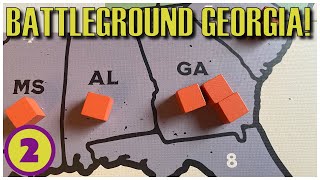
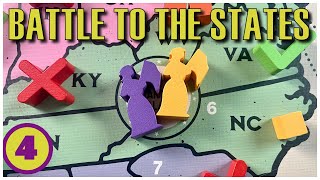
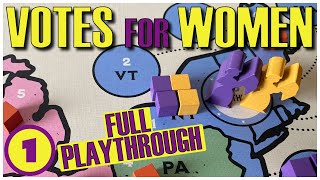
Support for the suffrage movement (or opposition to it) manifests as cubes placed on states across the map. Players must gather four cubes in a state to claim it during ratification, triggering votes that cement the state's position. This creates a tense push-pull dynamic: players race to control key states, only to have opponents remove cubes with well-timed cards. The two colors available to suffragists represent the historical diversity of the movement, while the single opposition color reflects the unified resistance the movement faced.
The Votes for Women Experience
Historical Immersion
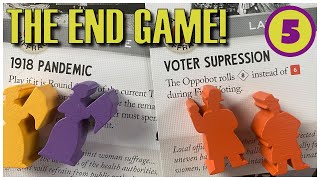
The game excels at putting you inside the 72-year struggle for women's suffrage. Cards are named after real figures like Frederick Douglass, Susan B. Anthony, and Ida B. Wells, with flavor text that educates and contextualizes each action. The inclusion of reproduced historical documents in the box, from newspaper clippings to court documents and specimen ballots, grounds the mechanical systems in genuine history. Players learning about events like the 1918 pandemic, the Civil War's impact on organizing, and Western states' leadership on voting rights encounter real history naturally woven into gameplay.
Political Maneuvering and High Tension
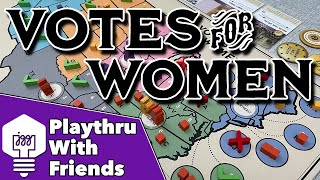
Votes for Women captures the feeling of political struggle: the constant negotiation of timing, the need to build support strategically, and the ever-present threat that opponents will dismantle your progress. The game forces players to decide when to push the 19th Amendment to the states for ratification, knowing that early submission gives the opposition more time to block it. This timing puzzle, combined with dice rolls that create uncertainty, produces memorable moments of triumph and heartbreak.
What Makes Votes for Women Stand Out
Honestly Complex Asymmetry
The game does not hide its historical asymmetry. Suffragists need 36 states to win while the opposition only needs 13 rejections, mirroring how constitutionally difficult it was to pass an amendment. Suffragists get more campaigners and buttons, reflecting their numerical advantage in the movement. Yet the opposition starts with a powerful first card and simpler objectives. This deliberate design sparks discussion: the game succeeds as history precisely because it makes winning as suffragists genuinely difficult, though some find this imbalance frustrating from a pure gameplay perspective.
Multiple Play Modes
Votes for Women offers genuinely different experiences across its modes. Competitive play pits suffragists against opposition directly. Solo and cooperative play replace the opposition with the Oppobot, a deck-driven AI that creates different strategic challenges. Two-player alliance modes let suffragists team up, or allow two opposition players to work together. These variations ensure the game stays fresh across replays and allows groups to choose the experience that speaks to them.
Potential Drawbacks
Dice Rolling and Variance
Like many political and war games, Votes for Women relies on dice rolls to determine how many cubes players can place or how many Congressional markers they can add. A strong roll can swing momentum; a weak one can leave you scrambling. Some players find this randomness frustrating, particularly when they lose a contested state by a single point or fail to lobby Congress despite careful planning. The game mitigates this with buttons that let you reroll, but buttons are precious and cannot always save you.
Balance Questions
While the historical imbalance is intentional, some find it makes opposition unsatisfying to play. The opposition player spends much of the game reacting, blocking, and trying to slow the suffragists down rather than pursuing a compelling positive agenda. Experienced players report that skilled suffragist play, combined with favorable card draws, can feel overwhelming to opposition. Others note that in competitive play, the first player to control key state cards often builds such momentum that comebacks feel unlikely.
If You Enjoy Votes for Women
Fans of Votes for Women often gravitate toward other historical card-driven games that emphasize political maneuvering. Twilight Struggle shares a similar arc of global conflict driven by card play, with the same tense back-and-forth dynamic. Paths of Glory offers deeper complexity and longer play for those who want more wargaming depth. 1960: The Making of the President shares the electoral focus with a tighter, more replayable design. Watergate captures political intrigue with elegant simplicity. For those who love the area control elements, Ticket to Ride provides a friendlier entry point. The digital implementation on Rally the Troops offers Votes for Women itself in a streamlined format that reduces fiddliness.
What Reviewers Are Saying
"Votes for Women takes the mechanical concepts of those games and streamlines them down to a really distilled format, where each round is just a card play and one of four easy to remember actions, making it reasonably easy to learn compared to how it looks."
— 3 Minute Board Games
"This is a card-driven game that depends on area territorial control and the history is so rich there were advances there were incursions there was pushing forward and there was breaking back."
— Beyond Solitaire
"The inclusion of multiple historical documents in the box is amazing and represents the best aspects of historic war gaming. There is so much depth to the war game with an ever-changing board state, dynamic reversals of fortune, and exciting card play that drives a game along at a fast pace."
— 3 Minute Board Games