







Witchbound Deep Dive
What the Community Thinks About Witchbound
Witchbound has resonated with players in strikingly different ways. Some reviewers find it a charming and engaging solo adventure with evocative storytelling and memorable characters, and anticipation for its release ran high among solo gamers watching their release calendars. Others appreciate the narrative promise but find the actual experience linear and harder to sustain, citing frustration with the specificity required to progress and difficulty maintaining motivation through a lengthy campaign. The game's appeal appears to depend significantly on how much players value exploration and reading over mechanical challenge.
Core Mechanics That Define Witchbound
The Discovery System and Point-and-Click Actions
Witchbound uses a streamlined action system built around looking and interacting with the world. Players use numbered codes to reference entries in the story book, combining basic actions with elements they discover in each scene. Reviewers have noted that this creates a detective-like flow where finding the right action to take on the right object drives the narrative forward. The system is elegant in its simplicity, but its reliance on precision means finding solutions can feel either satisfying or frustrating depending on tolerance for trial-and-error exploration.
The Amulet Binding and Familiar Mechanics
At the heart of Witchbound lies the binding mechanic, in which the protagonist Renie discovers an amulet that cannot be removed once worn. This creates a permanent commitment to the witch role and ties her to the island of Coven Cove. The game pairs this with a familiar character who becomes the player's companion. This relationship anchors the narrative and gives the solo experience a sense of companionship throughout the adventure.
The Witchbound Experience
Charming Art and Engaging Narrative
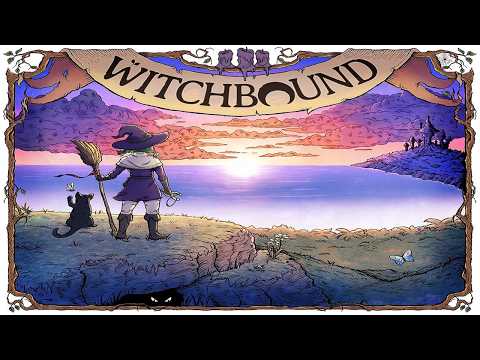
Reviewers consistently highlight the game's visual and narrative appeal. The old-school art style and story-driven approach create an immersive atmosphere, with players drawn to the personality and humor woven through the writing. The writing itself earns praise for its craft, making the dialogue feel genuine and the characters memorable, and reviewers described feeling excited just unboxing their copies.
The Challenge of Sustained Engagement
Where opinions diverge is in how well the game sustains that initial charm across its full 20 to 25 hour campaign. Some players find the exploration endlessly rewarding, while others describe hitting a motivation wall partway through. The game's central mechanic of finding very specific things to advance the story can feel clever when the solution is discovered and tedious when a player is searching. This variation in experience suggests that Witchbound works best for players who genuinely enjoy the process of exploration and reading rather than those seeking mechanical complexity.
What Makes Witchbound Stand Out
Minimal Components and Elegant Presentation
Witchbound ships with remarkably few components: books, dice, a handful of cards, and character sheets. This minimalism is intentional and refreshing, making the game quick to set up and easy to play. There is no fiddly board state or complex resource management to slow down the narrative flow.
The Solo-Only Design and Intimate Storytelling
Witchbound commits fully to the solo experience, removing any need to adapt for groups. This focus allows the narrative to speak directly to the player without compromise. The journey of a young person discovering they are now a witch, bound to an island, and forced to solve mysteries and help others, works as an intimate personal story that benefits from the solitary exploration of the world.
Potential Drawbacks
Linearity and the Specificity Problem
The game's strength, its story-driven exploration, becomes a drawback for players who encounter dead ends or unclear paths forward. Reviewers have noted that the game can be more linear than expected, and that finding the exact sequence of correct actions to progress can feel frustrating when the right interaction is not immediately obvious. This is a point-and-click adventure game at heart, complete with that genre's classic friction points.
Difficulty Sustaining Motivation Over Length
With a campaign stretching 20 to 25 hours, Witchbound demands sustained engagement. Some players reported losing motivation partway through, feeling that the story and mechanics did not maintain their grip as the game progressed. This suggests the game works best for players who are deeply invested in narrative and discovery and may disappoint those looking for escalating challenge or mechanical depth to keep them engaged across such a long play time.
If You Enjoy Witchbound
Players drawn to Witchbound often appreciate other story-driven solo games. Sleeping Gods and Earthborne Rangers share similar DNA, offering immersive worlds where narrative and exploration take center stage. If the writing and atmosphere are what captivate, games with old-school adventure sensibilities and strong narrative focus will likely resonate.
What Reviewers Are Saying
"and it seems really cute and cozy and fun and I'm so excited to do this."
— Watch Review
"I still find this one super charming in the art. The story is also cute. But in the amount I played, which was maybe a third through the game, I found first of all that it was more linear and more of sort of a frustrating point-and-click adventure game, at least for me, because I had to find very specific things and select very specific things with them to advance."
— One Stop Co-op Shop
"I couldn't really find much else in March other than Witchbound, which I'm excited about Witchbound."
— The Board Game Garden