
/pic7745916.png)
It is the beginning of the Meiji era. Once a sleepy fishing village, Yokohama has opened to foreign trade since the end of the Edo period and has now developed into one of Japan’s busiest trade centers. Goods such as copper and raw silk have gathered in Yokohama to be exported to foreign countries hungry for them. In addition, foreign technologies and cultural practices have integrated into the Japanese lifestyle as quickly as the modernization of the cityscape.
In this stand-alone game, you and your opponent compete to dominate the market. Roam the streets, strategically manage your assistants, and build a successful business empire while enlisting the aid of foreign agents. Each district in Yokohama offers unique benefits; exploit them wisely to outplay your opponent. Achieve coveted goals, master new technology, and chart your path to victory.
Yokohama Duel: A head-to-head battle for business supremacy awaits!
Part of the Yokohama family — see Yokohama for the combined view.


Images



- very strategic
- worker placement with interesting card mechanics
- lots of upgradeability
- smaller footprint and box size compared to the original
- requires tough choices due to limited resources
- strategic resource management and upgrades
- Yokohama
Mechanics (from transcript analysis)
- ascending card play — Worker cards must be placed in ascending order, affecting strategic planning.
- Resource Management — Players manage resources to fulfill orders and upgrade various components.
- upgrading — Opportunities to upgrade worker cards, add houses/shops, and acquire technology cards for special abilities.
- Worker Placement — Players use cards as workers, placing them on areas to gain resources, upgrades, and benefits.
Video topics + discussion points
Quotes (from this video)
- One of the biggest trends in the board game hobby over the last few years has been dual versions of board games.
- A two-player version of a game is often times easier to get to the table, you know, when you only have one other person you can you can get it played more often and sometimes these dual versions kind of distill a game down and make it a quicker experience as well and I like that too.
References (from this video)

Mechanics (from transcript analysis)
Video topics + discussion points
Quotes (from this video)
- If my score is higher than their cumulative score, then the studio, the channel, and the Murfs themselves belong to me.
- How well do these brothers know each other? If they don't, their souls are mine.
- I chose I play I chose my least favorite game on the planet, which is London.
- The point is I want Squishy Fruits. But we all had the right idea.
- I would say that he thinks C is the best letter for board games. The letter C.
- It's between C and T. T.
- Your souls belong to me.
References (from this video)
- Fantastic
- Looks much prettier than the original version
- New edition has a modern, clean look
- Could not keep it when moving
- Regretted calling it
- Yokohama during its transition from an agricultural to an industrial powerhouse
- Yokohama
Mechanics (from transcript analysis)
- Action Order — Workers must be played in ascending order of level, creating a timing puzzle.
- Worker Placement — Players deploy workers of levels 1, 2, 3, and 4 to a grid of actions.
Video topics + discussion points
Quotes (from this video)
- Planet Unknown is Planet Unknown in my top 10 of all time now.
- I'm generally not a fan of that, but the game is so good I'll allow it.
- I think Earth is near perfect as it is, but abundance for my wife makes the game even better.
- A musthave expansion for one of the 10 greatest games of all time, Earth Abundance.
References (from this video)
- New artwork and improved board design make it visually appealing and less busy.
- Smoother rules and overall smoother play compared to the original.
- Provides strategic tension and important decisions.
- Quick and accessible gameplay once learned.
- Variable elements like order cards and technology cards add replayability.
- Foreign trade and commerce, becoming the most successful merchant
- Yokohama
- Yokohama
Mechanics (from transcript analysis)
- action selection — Players select actions by playing their lowest power card to an available location and gaining rewards based on power level.
- Card Play — Power cards are played to take actions, and technology cards offer special abilities or scoring opportunities.
- Resource Management — Players gain and use resources like tea, silk, fish, and copper to complete orders and build structures.
- Set Collection — Players collect resources to fulfill orders and gain points.
- Worker Placement — Players place cards on locations on the board to take actions.
Video topics + discussion points
Quotes (from this video)
- It's a two-player action selection and resource management game that takes about 45 minutes to play.
- This is a brand new edition of the game. It's got new artwork, better and smoother rules, and better board design for overall smoother play.
- So, just from a graphic design of the layout of the board, like it it seems to make more sense. It's less busy.
- This has a very nice watercolor feel to a lot of it. Even just the components that I was looking at like it looks sharp.
- Definitely a game where you're sitting there thinking, I really need copper. I really need this, but I I need two of those things.
- So you do have those moments where you're sitting there trying to balance out that power card play because you always start with the lowest going to highest and so you're trying to find the best way of maximizing that and you only have 16 turns to do it.
References (from this video)

- Satisfying Euro feel in a short playtime.
- Multiple strategic paths to victory.
- Engaging player interaction and blocking opportunities.
- Familiarity for fans of the original Yokohama.
- Fast-paced gameplay.
- Some players might find it hard to catch up if opponents gain too much advantage.
- The base game's pathing mechanic is removed, which might be missed by some.
- Competition between port cities for trade and influence
- Hamburg and Altona historical ports
- Yokohama
Mechanics (from transcript analysis)
- Resource Management — Gathering and spending various resources like tea, fish, silk, and copper.
- Rondel — Players move a marker around a board with action spaces, with costs increasing for further movement.
- Set Collection — Collecting resources and contract cards to score points.
- Variable player powers — Workers can be upgraded and special cards provide unique abilities or modifiers.
- Worker Placement — Workers (cards) are placed on board locations to take actions.
Video topics + discussion points
Quotes (from this video)
- This is a family-friendly podcast about
- This is one of those things that I would love to have a a group where I just sit here weekly and play.
- As a board gamer, this is the system I want to play because it feels most like the board game.
- This is probably going to provide 40 plus hours of RPG content.
- This is not one of those fast playing games that you can wait for another game to finish.
- This is Rival Cities from Pegasus.
- If you have the word bouncy and cringe, how do you relate those at all?
- This is a straightforward tile lane game that accomplishes those very tasks that will get you the most points.
- It is a very simple light deduction game.
- Bert was saying is there's very much an economy of cards.
References (from this video)

- Great job condensing the original game
- Really fun
- Really recommend for worker placement fans
- Lose the meeple worker placement aspect
- Yokohama
Mechanics (from transcript analysis)
- Card placement — Used instead of meeples for actions.
- Card upgrading — Players can upgrade cards between rounds for better actions.
- Engine Building — Cited as an aspect of the game.
- Resource Management — Mentioned as part of the gameplay.
- Worker Placement — Mentioned as a core mechanic, although the meeples are replaced by cards in this version.
Video topics + discussion points
Quotes (from this video)
- Well this year, honestly, 2025, I feel like is the year of the two-player game.
- The gap between 10 and one on this list is smaller than any other video I'm about to put out.
- I just like honestly, if you caught me on a different day, I would arrange these in a different order, you know?
- This is maybe like the most chill game on this list.
- It's a genre of game that is getting more popular right now where you are making decisions on what cards to add to your deck, but then at some point, you're just flipping cards from your deck and doing whatever it says and you're not making choices at that point anymore.
- The production quality of Enthrall is insane.
- And this is another game with a lot of intrigue and faints and fakes, you know?
- This is a two player game where I'm like, 'Ooh, it Every time I play it, I want to play it again because I'm like, 'Ooh, I see something I could have done better.'
- Like I mentioned, the gap between 10 and one here is so small and they're all really great.
- It's a trend that I like because I just feel like they're easy to get to the table and they're bringing new people into the hobby that might not otherwise be in the hobby.
References (from this video)
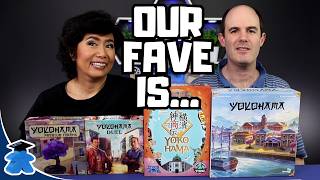
- Synapses release looks great on the table
- It is a reprint with different components
- Plays quickly once set up
- Not fully compatible with original Yokohama components (import goods)
- Does not feel as tight as other two-player games
- Players can specialize and avoid tight contests
- Lacks the mechanic from the original where opponents can plan around assistant placement
- Action selection is not as interesting as the original game's movement and color mechanics
- Automatically compared to the original Yokohama, making it feel less unique
- Japan, Yokohama
- Yokohama
Mechanics (from transcript analysis)
- Action Point Allowance — Players get four actions per round, using power cards to determine action strength.
- Engine Building — Players can build buildings to improve future actions and upgrade cards to become one power stronger.
- Set Collection — Foreign agents are gained by achieving specific goals like completing orders or acquiring technologies.
- Worker Placement — Players place workers on action spaces, with most spaces limited to one player.
Video topics + discussion points
Quotes (from this video)
- This is a Yokohama-tastic review. Um I love it.
- The core game is that every turn, you'll either place three of your assistants on different spaces, or place two on the same space, and then your president is going to go out walking.
- It is a great game. I can see why I would say that this is a classic because the mechanics is quite unique when you need to build up slowly your the strength for your actions.
- I don't know any other games that feels like this.
- This is a 2016 game. Games have gotten a lot more complicated since 2016.
- It is a pure reprint. If you do own the Tasty Minstrel orange version, you don't need to add the Synapses version.
- So, the engine building, it's still putting houses down. One of the few actions which is no longer in the game is the unlocking stuff action.
- However, it doesn't feel tight like many other duels that are out there on the market.
- I like that mechanics in the original Yokohama, and I kind of like miss that here in the duel.
References (from this video)
- compact footprint with deep two-player depth
- elegant pacing and clear decisions
- good bridge title for players of Rival Cities or base Yokohama
- less depth than the base Yokohama
- some may find the contract mechanics fleeting
- two-player economic competition in a compact box
- port/harbor economy in Yokohama
- tight, fast, competitive two-player euro
- Rival Cities
- Up or Down
Mechanics (from transcript analysis)
- card-based action selection — Players draft and execute actions to optimize resource gathering and scoring.
- resource trading / contracts — Turn in specific resources for contracts and points.
Video topics + discussion points
Quotes (from this video)
- “For $60, there's a lot of content in that Terra Antarctica box.”
- “This is the two-player euro of the year for me.”
- “This is a light, accessible deduction game that moves quickly.”
- “There are multiple victory conditions; you must block and chase objectives.”