

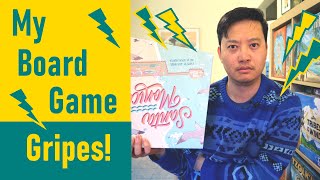


Sumatra Deep Dive
What the Community Thinks About Sumatra
Reviewers who have played Sumatra describe it as a thoughtful, well-made tile-taking game with a clear identity, but they disagree about where it belongs in a collection. All You Can Board, hosted by Carlo and Dillon, takes the most pointed stance. Its reviewers say they genuinely enjoy the game and like watching Reiner Knizia's ideas come out at the table, yet they recommend skipping it because so much of what it does overlaps with other Knizia titles they already own.
Board Game Sanctuary takes a more practical view. Rather than weighing the design itself, its host focuses on presentation, singling out the typeface and numerals as a barrier to a smooth game. Getting Games sits between the two positions. It calls the exploration theme neat and says the mechanics have plenty of appeal, while admitting that the reviewer had not worked through the rules in depth and did not yet understand how the research track's catch-up mechanic functions. Taken together, the verdict across these reviews lands on Sumatra being a solid game in its own right. The disagreement is about whether it earns a place next to the Knizia titles that came before it.
Core Mechanics That Define Sumatra
Compound Scoring
Reviewers' descriptions of scoring match the compound model closely. All You Can Board explains that tiles are sorted into a notebook, where different tile types go to different rows and each row scores on its own terms. Some rows reward pairing a number on one tile with a number on another and taking the higher value, while others grow with the number of tiles of a given kind that a player has collected. Because these categories are tallied separately, a player can concentrate on one strong row while still picking up points elsewhere. Getting Games adds that the scoring draws on a wide range of conditions, and that some villages require a certain number of GPS tokens, which ties the point system directly to the exploration theme. Reiner Knizia's habit of layering several independent scoring conditions onto one board is visible throughout, and the reviewers noted that many of its ideas echo Knizia's other designs.
The Shifting Research Track
The reviewers describe a board state that never settles, because the relative positions of players and the research marker constantly redraw who can do what. Whether a player is on the same space as the marker, ahead of it, or behind it determines which options are open that turn, so the practical geography of the game is always in motion even though the tiles themselves do not move. Getting Games describes a research marker on a track. A player who is slower than the marker must walk up to it and end the turn, a player who shares its space can research there, and a player who moves past it gains first claim on the next spot. The reviewer compared this to rubber banding, where pushing ahead and falling behind both carry consequences. The result is a moving target that players must react to rather than a fixed route they can plan from the start.
The Sumatra Experience
The Tension of the Moving Research Marker
Getting Games frames the research track as a contest in which some players push ahead while others straggle behind. Leaders gain first pick of the next location, and trailing players spend their turns catching up. That structure keeps every player aware of where they stand, because the same move that secures a good spot can also leave a player exposed. The reviewer said they did not yet fully understand how the catch-up effect balances the race, which suggests the tension is felt most strongly by players who have learned how the track resolves.
The Grueling Choice in the Tile Notebook
All You Can Board describes the selection phase as "really grueling decision-making," and the tension comes from timing. Tiles sit in locations, and players take them one at a time until someone decides to move on or take one more tile. The reviewers note that this choice affects what happens at the next location, since staying behind can give a player two picks in a row there. The satisfaction comes from finding a good sequence of picks that fills the right rows of the notebook, rather than from any single dramatic moment. All You Can Board identifies this kind of decision as a staple across many Knizia games, the kind of push-your-luck selection that rewards reading the table as much as reading the tiles.
What Makes Sumatra Stand Out
An Exploration Theme Carried Into the Mechanics
Getting Games highlights that the theme is more than decoration. Players are joining an expedition to explore Sumatra, from its volcanoes to its tropical rainforests, and the reviewer observed that the game leans into exploration significantly. Collecting GPS tokens, animals, and jewelry is part of what it takes to score villages, so the thematic items have a real role in the point system. The reviewer praised how the theme is wired into the scoring rather than attached to it afterward.
Knizia Decision Density in a Light Package
Getting Games argues that the simplicity of Knizia's mechanics, combined with the complexity of the decisions they create, is often very rewarding, and Sumatra fits that pattern. All You Can Board says that sitting down to play it is always a joy because it shows how different strategies emerge from a compact set of rules. The box advertises about 45 minutes, a length the reviewers found appealing for a game that does not feel heavy once it is underway. Players who enjoy Knizia's style will recognize the economy of rules and the richness of choices that the reviewers praised.
Potential Drawbacks
Legibility of the Font and Numerals
Board Game Sanctuary's most serious concern is readability. The host describes the typeface as stylish but hard to distinguish, and says the numbers that matter most to the game are difficult to read. When a player cannot tell a four from a nine, the flow of play suffers, and the reviewer argued that rules and game numbers should be easy to read at a glance after a long day. Anyone sensitive to visual clarity should plan to sort out the numerals early or bring a player aid.
Overlap With Other Knizia Games and Teaching Overhead
All You Can Board's objection is less about quality than about placement. The reviewers say they enjoy Sumatra but prefer Blue Lagoon and Lost Cities, and they would recommend those titles to a newcomer to Knizia before this one. The reviewers also found the rules harder to explain than the box suggests. One of them estimated a rules explanation of around fifteen minutes for a game listed at about 45 minutes, and said the how-to-play video made the game seem more complicated than it really is once you play it. For collectors with limited shelf space, that combination makes Sumatra a harder purchase to justify.
If You Enjoy Sumatra
Players who enjoy Sumatra's compound scoring will find a similar kind of satisfaction in Lost Cities, which All You Can Board names as one of the Knizia titles it prefers over Sumatra, making it a natural starting point for players who want the same designer's decision style in a leaner package. Readers who like the tile-laying side of Sumatra may also look at Blue Lagoon, which the same reviewers describe as a tile-laying game with a decent amount of player interaction. Eldorado shares Sumatra's expedition framing and racing-against-the-table tension, while Elysium offers a similar layered, multi-category scoring puzzle for players drawn to the notebook's compound scoring. Neither was compared directly against Sumatra in these reviews, so they read as adjacent recommendations for the same general appetite rather than head-to-head picks.
What Reviewers Are Saying
"and you're taking these tiles and putting them into your notebook different genre genres different types of tiles go to different rows in your notebook and each row scores differently"
— All You Can Board
"Sumatra whilst it uses this very stylish font it's very hard to distinguish what the letters are and in the game there are all these numbers that are really hard to see."
— Board Game Sanctuary
"so it seems like it's a competitive game where you have a bunch of researchers trying to out research each other with some people pushing ahead and some stragglers and you're kind of rubber banding as you're going down this route"
— Getting Games