
Monster Pit features tableau building, dice drafting, and hand management in a fully co-operative, fantasy adventure game. During the game, loyal Captains must rally their forces to defend the Citadel against the emerging threat of a creature from the deep. Think Gandalf rallying the forces of Minas Tirith in Return of the King.
This is not a tower defense game, but blends several mechanisms including dice drafting (there are custom dice and rolls can be mitigated), tableau building (the player boards are extra large to organize the various cards), and worker placement (in terms of the various buildings your Captain will visit).
Your Captain’s tableau will include soldiers, wizards, heroes, mounts, and wyverns. Some of these characters are for offensive purposes (attacking the Monster etc) and some for defensive purposes (building your resources including your dice pool). During the game player will also complete quests for the King, buy items from the Town Hall, ride a Mount, fight creatures in the streets of the Citadel, upgrade their Captain at the Armoury, visit the Dwarven Grotto for gold, and find helpful trinkets in the Fountain.
The game supports "true solo" (a solo player need only control one Captain), fully co-op multiplayer against the Monster, one vs one (one player controls the Captain, the other player controls the Monster), or one player (controlling the Monster) vs up to four Captains. All play modes feature long or short variants.
There are five monsters included in the game (Dragon, Enchantress, Behemoth, Vampire Queen, and Orc War Chief) both featuring "A" and "B" sides for greater challenge and variation. The game engine can be further adjusted with Difficulty Tokens.
—description from the publisher


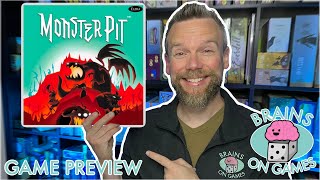
- Combines engine building, worker placement, and dice-driven combat
- Catacombs universe art style and recognizable wooden monster tokens
- High replayability and adjustable difficulty
- Cooperative play and shared goal-building for families
- Dense strategic planning and action budgeting that rewards experience
- Complex setup with many tokens, decks, and cards can be overwhelming for newcomers
- Resources are limited and can feel restrictive; randomness can dominate and require experienced players to manage
- Some sessions may feel chaotic due to many decks and cards and potential alpha-player dynamics
- Requires a relatively large play space and longer playtimes at higher player counts
- heroic fantasy dungeon defense against a monster
- Catacombs universe; fantasy dungeon city under siege
- Array
- Pandemic
- Catacombs
Mechanics (from transcript analysis)
Video topics + discussion points
Quotes (from this video)
- Monster pit is a game for between one and five players
- it's a game for between one and five players there are Solo rules there are Co-op rules and there are one versus many rules
- there are tons of monsters to choose from in this game they've all got their own little tokens
- I love the catacombs artwork
- this is a game that plays in 60 to 90 minutes
- cooperation that social skill of sitting around the table and working together
- this game combines engine building and worker placement which I love
References (from this video)

- Appealing artwork by Kawachi Moria.
- Fantasy theme.
- Cooperative gameplay.
- Complex for new gamers due to numerous village locations and rulebook clarity.
- Requires a large amount of table space.
- The rulebook needed some clarifications.
- Suggests trying before buying.
- Cooperative defense against a monster trying to reach the village.
- Fantasy Village
- Catacombs
Mechanics (from transcript analysis)
- cooperative play — Players work together to defeat a monster.
- Dice Rolling — Dice are rolled to gain resources or advance the monster.
- Tower Defense (loosely) — Players defend a village from a monster advancing along a path.
- Variable player powers — Players acquire character cards that provide different abilities and dice.
- Worker Placement — Workers are placed in village locations to take actions.
Video topics + discussion points
Quotes (from this video)
- This is a family-friendly podcast about
- This is one of those things that I would love to have a a group where I just sit here weekly and play.
- As a board gamer, this is the system I want to play because it feels most like the board game.
- This is probably going to provide 40 plus hours of RPG content.
- This is not one of those fast playing games that you can wait for another game to finish.
- This is Rival Cities from Pegasus.
- If you have the word bouncy and cringe, how do you relate those at all?
- This is a straightforward tile lane game that accomplishes those very tasks that will get you the most points.
- It is a very simple light deduction game.
- Bert was saying is there's very much an economy of cards.
References (from this video)

Mechanics (from transcript analysis)
Video topics + discussion points
Quotes (from this video)
- Monster pit can play in two modes a fully Cooperative mode where the monster is controlled by the game and a one versus mini mode where one player controls the monster
- The Citadel is a threat from a fearsome monster who has just emerged from the pit and is advancing on the gates
- we'll take you through the fully Cooperative rules first
- you'll be ready to play
References (from this video)
- cooperative defense against a monster
- The Citadel is a threat from a fearsome monster who has just emerged from the pit and is advancing on the gates
- captains of the Citadel work together to gain resources and launch attacks against the monster
Mechanics (from transcript analysis)
- alchemy stones and rerolls — Alchemy Stones allow rerolling all dice in a roll to re-roll outcomes
- Attack and Defense dice — Attack dice come from the captain and left side of Outpost; the monster defends with its own dice; outcomes determine hits and possible criticals
- Combat: Dice — Attack dice come from the captain and left side of Outpost; the monster defends with its own dice; outcomes determine hits and possible criticals
- district actions and building interactions — During the midday phase, captains move to districts and may perform actions at buildings, including exchanges of gold or items
- progress roll — In the morning phase, players form a dice pool by matching the dice to Outpost cards and roll to gain money and advance the monster
- quest and king's keep — Drawing a QUEST card from the King's Keep and resolving its quest reward is part of the progression
- tavern recruitment and deck management — At taverns, players recruit characters by paying gold, with an option to discard to reveal the next card
Video topics + discussion points
Quotes (from this video)
- Monster pit can play in two modes a fully Cooperative mode where the monster is controlled by the game and a one versus mini mode where one player controls the monster
- The Citadel is a threat from a fearsome monster who has just emerged from the pit and is advancing on the gates
- we'll take you through the fully Cooperative rules first
- you'll be ready to play
References (from this video)
- Two independent but linked modes that can be played separately or together
- Gothic art tone that echoes early Catacombs aesthetics
- Solitary play option and strong solo mode potential
- Strong cross-compatibility with Catacombs 3e and related titles
- Community-driven approach to stretch goals and content
- Brand confu sion risk with multiple Catacombs releases
- Niche dexterity focus may limit broader audience
- Crowdfunding reliance; logistics and retail market challenges
- defense of a citadel against subterranean threats; two-mode dungeon themed experience
- Gothic citadel above ground with underground catacombs
- two-mode, continuity-driven arc featuring the Catacomb Lord
- Hunt for the Ring
- War of the Ring
- Catacombs Cubes
- Catacombs 3e
- Catacombs and Castles
- Phantom Division
- Venom Division
Mechanics (from transcript analysis)
- Asymmetric play — cooperative town defense vs competitive dexterity arena
- compatibility-with-core — core Catacombs elements remain compatible with Catacombs 3e and other variants
- dexterity-dice system — dice-driven dexterity mechanics on the arena side
- overseer dashboard — dedicated player boards/dashboard to track catacomb lord and progress
- persistent elements across modes — hero upgrades and statuses carry over between modes
- Solo play support — the dexterity side supports solo play
- two-mode structure — town defense co-op/solo mode and an underground dexterity arena mode; halves can be played independently
Video topics + discussion points
Quotes (from this video)
- it's a standalone game with two modes
- two halves, you could just have an evening where you're playing the dice game and then an evening where you're playing the 1v all monster pit arena
- the dexterity mode on the other side of the playmat is a full-on competitive experience
- this is not a pre-order; we need your help to make this ambitious project
- we're looking to get catacombs and castles back into print
- fifty to sixty percent of our stretch goals were community driven