







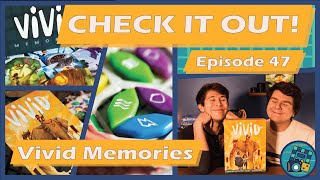



Vivid Memories Deep Dive
What the Community Thinks About Vivid Memories
Vivid Memories has generated consistently passionate reactions from reviewers, though the game divides opinion along a clear line: those who embrace its puzzly nature love it intensely, while those seeking a lighter experience find it punishing. The game's abstract design and demanding gameplay create polarized responses. Reviewers across channels agreed on the game's exceptional production quality and thoughtful theming, but disagree sharply on whether the gameplay rewards justify the mental strain. Several YouTube creators have named it among their top games of 2022, while others describe it as frustratingly unforgiving. The consensus centers on this paradox: Vivid Memories is beautiful, thematic, and brilliantly designed, yet it is not a game for every table.
Core Mechanics That Define Vivid Memories
Tile Placement and Fragment Management
The heart of Vivid Memories revolves around drafting colored acrylic fragments from a shared display and placing them onto your personal brain board, which is divided into hexagonal spaces. Players take turns choosing 1, 2 matching, or 3 different colored fragments from the ends of a row, then must place all their selected pieces into a single empty hex on their board. Reviewers highlight the satisfying physical experience of manipulating these tiles. The act of collecting and positioning fragments mirrors how memories accumulate in a child's mind, creating thematic resonance alongside mechanical depth. This drafting system creates constant tension: taking multiple pieces in one turn locks you into a specific spatial arrangement, while taking a single fragment grants a "rewire" action that lets you shuffle existing pieces to better strategic positions.
Threading and Connection Scoring
Beyond simple tile placement, Vivid Memories rewards players for creating "threads" of connected fragments. By tracing a path through adjacent hexes where each space contains at least one matching colored piece, players score points based on the thread's length multiplied by the number of empty core memory slots it connects to. This layered scoring system creates a compelling secondary goal: you must think not just about placing individual tiles but about building long-term connections that culminate in high-value scoring moments. Reviewers consistently praised how the threading mechanic forces players to plan multiple turns ahead and adapt as the shared tile supply shifts. The mechanic also drives replayability, as different color distributions and fragment draws create entirely different strategic challenges from one game to the next.
The Vivid Memories Experience
Mentally Demanding and Highly Puzzly
Vivid Memories creates a singular experience of brain-burning concentration. This is not a casual game where you can play on autopilot. Every fragment selection carries weight. Reviewers described intense mental engagement throughout each round, with gameplay that feels like solving a puzzle under time pressure. The game demands that players think multiple moves ahead, considering not just their own position but how their choices affect available options for opponents. One reviewer noted that despite the game's elegant presentation and forgiving learning curve during initial explanation, the actual strategic depth becomes apparent only after you begin playing. The initial ease of understanding the rules contrasts sharply with the difficulty of executing a cohesive strategy, creating a satisfying arc from confusion to mastery across multiple plays.
Rewarding Improvement and Punishing Mistakes
Reviewers consistently emphasized that Vivid Memories rewards repeated play and pattern recognition. Experienced players can achieve dramatically higher scores than newcomers, sometimes doubling or tripling their point totals. This creates both motivation and frustration: players want to improve but may feel outmatched early on. The game offers little comeback potential. If you fall behind in score through poor early decisions, the large point gaps can feel insurmountable by the endgame. This tightness and pacing became a sticking point for some reviewers, who found the punishing nature at odds with the game's charming theme. Others embraced this as evidence of the game's elegant design and strategic depth. The best experience comes when all players have played multiple times and understand the optimization potential locked within each turn.
What Makes Vivid Memories Stand Out
Stunning Artistic Direction and Tactile Quality
Every reviewer singled out the physical and visual design as exceptional. Illustrator Andrew Bosley's artwork brings the childhood-memory theme to life across every component. The dual-layer board itself resembles a brain, with its hexagonal spaces arranged to subtly evoke neural connections. The acrylic fragment tiles are described as particularly satisfying to handle, with their long diamond shape creating a tactile pleasure that reinforces the brain-themed fantasy. The production quality extends to the rulebook, which one reviewer called among the best they have encountered, with clear iconography and helpful sidebars. This is a game that simply feels premium to play: from unpacking the first time through the final scoring, the components reward attention and create an atmosphere that matches the game's elegant abstraction.
Unique Brain-Themed Concept Grounded in Genuine Mechanics
While many board games feature window dressing that barely connects to the ruleset, Vivid Memories uses its memory theme to reinforce every mechanical decision. The brain board layout, the core memory slots, the aspiration tile that fuels your personal victory point chase, and the notion of "threading" memories all create a cohesive design language that feels intentional rather than tacked-on. Reviewers appreciated that the theme genuinely informs strategy and flavor without becoming baggage. One creator observed that initially they assumed the memory theme was merely cosmetic, but after playing realized it shaped how they thought about tile placement and scoring. The game asks you to think like a child forming memories and building the neural pathways that define their personality, making the abstract puzzle feel personal and resonant.
Potential Drawbacks
Extremely Tight, Punishing Pacing with High Skill Floors
The game's greatest strength becomes a weakness for certain audiences. The combination of limited actions, difficult spatial decisions, and high variability in scoring means that a single poor choice early can cascade into defeat by endgame. Reviewers noted that if one player begins optimizing early and others are still learning, the resulting score gaps can grow so large that later players lose motivation. The limited actions available each round mean you must commit to a strategy; there is little flexibility if your plan becomes invalidated by another player's choices or unfortunate tile draws. Some players thrive on this pressure and describe it as rewarding; others find it exhausting and frustrating, particularly on their first play.
Abstract Design Can Obscure Strategic Intent
The brain theme and fragment mechanics, while thematically coherent, can feel opaque to players who prefer more transparent routes to victory. Unlike route-building games or engine builders where the path to high scores feels clear, Vivid Memories requires discovering through multiple plays that certain fragment colors are more valuable than others depending on the draft flow and how many of each color exist on the board. This opacity frustrated one reviewer who felt the learning curve was steeper than the packaging suggested. New players may struggle to understand why experienced players take certain actions, and that teaching burden can make early games less fun for the table. The abstract nature also means the game does not appeal as broadly as lighter tile-placement games despite its charming theme.
If You Enjoy Vivid Memories
Players who love Vivid Memories often draw comparisons to other abstract strategy games with beautiful production. If the brain-themed puzzly gameplay appeals to you, consider trying Azul or Splendor, which share the pattern-building and set-collection DNA but offer lighter, more forgiving gameplay curves. Azul in particular matches Vivid Memories' focus on creating colorful patterns, though with much lower stakes and less planning depth. For those who crave the puzzly depth without the abstraction, Mandala Stones offers similar spatial reasoning but with a slightly more streamlined decision space. If you loved mastering Vivid Memories across many plays, you may also enjoy games that reward deep strategic thinking and repeated plays, where experienced players notably outperform newcomers due to pattern recognition and optimization.
What Reviewers Are Saying
"It hurts my brain and I'm thankful for it."
— Kovray
"This game hurts my brain to a degree that is just unforgivable. I don't know if it's because of how the game is designed or if I'm just dumb. I think it's something about the combination of really easy drafting but then having limited actions to plan out these routes that are very difficult to achieve and patterns that are very difficult to achieve."
— Tabletop Tokki
"Vivid memories is just this amazing abstract strategy game that gives you a lot of Azul vibes except I'm terrible at it as well. I was second guessing this game and then I started playing and I was like wow, the theme is here, the connections are here, the colors are vibrant, everything just was amazing to me."
— Kovray