

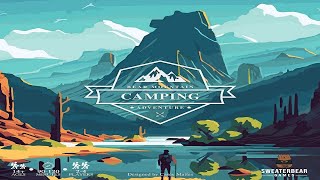



Bear Mountain Camping Adventure Deep Dive
What the Community Thinks About Bear Mountain Camping Adventure
Bear Mountain Camping Adventure has divided the board game community in genuine and substantive ways. Some reviewers find the production quality and thematic packaging compelling enough to recommend the game. Others view it as a tedious experience that overstays its welcome. Board Games UnLocked branded it a chore; The Board Game Garden and Watch It Played praised its camping aesthetic and mechanical innovation. This is not a case of different preferences for game weight or complexity, but a real disagreement about whether the core experience justifies the time investment.
Core Mechanics That Define Bear Mountain Camping Adventure
Double Deck Building
The game's defining mechanical innovation is its dual-deck system. Players build and manage two separate decks simultaneously, a green deck and a blue deck, each representing different camping activity types. Board Games UnLocked observed that few deck builders attempt this approach, and there is reason: managing card count, deck coherence, and resource flow across two independent decks creates cognitive overhead. The Board Game Garden, however, found merit in the system, noting that you can succeed by favoring one deck over the other, giving players genuine strategic choices about which deck to invest in. The two decks offer different cards and tokens, creating meaningful decisions about which activities to prioritize as you progress through the camping journey.
Track Advancement Through Resource Spending
Players move their camper along a path by spending accumulated activity tokens to meet the requirements of colored campsite zones. To advance from one zone to the next, you must spend specific combinations of resources (binoculars, canoes, bicycles, and similar camping equipment tokens). The further you progress on the trail toward Bear Mountain, the fewer cards you draw per turn, making resource efficiency increasingly critical. Watch It Played highlighted how location placement directly determines what cards enter your hand next turn, creating a feedback loop where progress decisions shape future options.
The Bear Mountain Camping Adventure Experience
The Appeal of Thematic Production
Reviewers consistently praised the game's aesthetic execution. The camping card art is minimalist but evocative, depicting real outdoor activities like kayaking, rock climbing, hiking, roasting s'mores, and fishing. The Board Game Garden described the art as super cool with an excellent aesthetic. The component quality is substantive: wooden resource tokens, storage trays that fit expansion modules inside the core box, and a physical camper piece that represents your gear capacity. Watch It Played's community coverage emphasized that the hiking theme and the satisfaction of collecting camping activities resonated with players who love outdoor recreation and board games that capture that spirit.
The Grind of Prolonged Play
A significant faction of reviewers found the experience exhausting. Board Games UnLocked was blunt: this game made them tired mid-play. The core loop (draw cards, play cards to generate tokens, spend tokens to move up a track) repeats across 50 to 90 minutes without sufficient variation to maintain engagement. Worse, according to critical reviewers, the win condition creates artificial prolonging: you need two of every single resource type (16 tokens total) plus a specific card from the deck to reach the final campsite. If you draw the winning card too early without resources, or accumulate resources without the winning card, you must continue playing. This felt less like elegant design and more like the game forcing players to stay seated.
What Makes Bear Mountain Camping Adventure Stand Out
Exceptional Production Quality and Organization
The physical game is impressively designed. Board Games UnLocked, despite disliking the gameplay, gave the production two points on its score specifically for this reason. The storage solution is exceptional for a camping-themed game: token trays separate resources efficiently, and the box inserts accommodate the game's expansions. The wooden upgrade tokens and the overall component palette create a tactile, premium feel uncommon in deck builders. The art direction is cohesive and thematic, with each location and activity card reinforcing the camping adventure fantasy.
Dual-Deck Novelty and Strategic Asymmetry
While controversial, the two-deck system remains distinctive. Most deck builders ask you to refine a single deck toward coherence and power. Bear Mountain splits your focus, allowing you to create two distinct engines or favor one over the other. The Board Game Garden appreciated this novelty, noting that the premise of managing two separate card pools was interesting mechanically, even if execution proved divisive. For players who enjoy the juggling act of resource management and simultaneous deck cultivation, this mechanic provides puzzle-like satisfaction.
Potential Drawbacks
Tedious Core Loop Without Meaningful Decisions
The gameplay loop simplifies quickly: identify which colored zone you need to reach, calculate the resource symbols required, and play cards to generate those tokens. After a few turns, players stop reading card text and instead scan for icons. Board Games UnLocked described eventually ignoring the camping activity titles entirely and just counting symbols. The two-deck management, which sounds complex, resolves into muscle memory: green cards go here, blue cards go there. Without sufficient variation in available cards, location effects, or strategic pivots, the loop becomes rote by mid-game.
Length Poorly Calibrated to Depth
The 50-to-90-minute runtime is a persistent frustration. Board Games UnLocked played the game multiple times and it never lasted under an hour. For a game whose core mechanic amounts to spending three tokens of any color to get a wildcard token, or playing cards to move a marker up a track, the length feels bloated. Expensive expansions (weather, rough terrain, pets) do little to address this fundamental pacing problem. Watch It Played noted that the game has a lot of fun expansion modules, but the base experience's length relative to its mechanical depth leaves many players feeling the game has artificially extended itself rather than earned its runtime through engaging systems.
If You Enjoy Bear Mountain Camping Adventure
For players who appreciate the dual-deck mechanic and outdoor theme, similar games offer comparable experiences. Mythwind shares a resource-management fantasy but with different mechanical implementation. Parks similarly captures the joy of outdoor recreation through card play and represents a more streamlined approach to the camping fantasy. Earthborne Rangers offers variable player powers and environmental narrative alongside deck building, satisfying the need for progression without excessive downtime. Seven Citadel and Seventh Continent appeal to players who enjoy exploration and token management within longer play sessions. Point Salad provides lighter deck-building satisfaction for players who want the theme without the time commitment.
What Reviewers Are Saying
"This game is bogged down already by the overall design of this game, but by having to manage two decks, this game would have been at least somewhat quicker if all you did was manage one deck of what activities you're doing."
— Board Games UnLocked
"The art and aesthetic of this game is super cool, and there are a ton of different variants for this game, which I think is awesome. But overall it is a fairly simple game where basically you are doing double deck building, which is really cool. I really liked the premise of that."
— The Board Game Garden
"The further you go, where you land your piece determines what your hand draw is for the next turn. So the further you get up, the better your cards better be to have enough symbols on them because you aren't going to be drawing as many. This one looks interesting."
— Watch It Played