





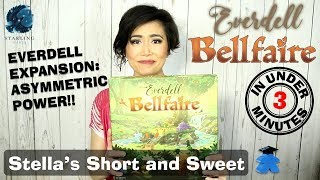
Everdell: Bellfaire Deep Dive
What the Community Thinks About Everdell: Bellfaire
Everdell: Bellfaire arrives as a celebration of 100 years in Everdell's world, and reviewers greet it as a thoughtfully modular expansion that enriches the tableau-building experience without overwhelming the base game. The expansion is praised for its restraint and accessibility, offering a menu of components that players can mix and match to shape their own version of the game. Reviewers consistently highlight the expansion's ability to make Everdell more resource-friendly and playable at higher player counts, though some note that Bellfaire stays purposefully light in its mechanical innovations compared to other expansions. The overall consensus positions Bellfaire as an elegant, well-crafted addition that rewards its fans with thematic depth and organizational tools, even as some components feel more optional than transformative.
Core Mechanics That Define Everdell: Bellfaire
The Market: Open Trading and Resource Exchange
The market is Bellfaire's primary mechanical anchor, providing an additional worker placement location where you can gain goods and exchange resources for different types or convert them for points. The market tile has a two-phase design: first you gain cards and resources from one side, then the tile flips to reveal a trade option where you give resources and cards to gain coins and resources of your choice. Reviewers emphasize that the market solves a real problem in the base game, especially at higher player counts, by offering an open area for resource generation when the contested main board becomes tight. The market is flexible enough that many players land there, but not so powerful that it dominates strategy.
Asymmetric Player Powers: Unique Critter Abilities
Bellfaire assigns each critter species a special ability, giving players immediate individual flavor from the moment they choose their meeples. Reviewers love this thematic layer because it moves species selection from pure aesthetic choice into genuine strategic differentiation. The otter can use wood as any other resource; the hedgehog gains berries and can substitute two berries for any other resource when building; other species unlock forest locations or enable alternative actions. These powers are not overwhelming but substantial enough that they feel meaningful. The asymmetry encourages players to build strategies around their chosen critter's strengths, adding another dimension to tableau planning without requiring deep rules learning.
The Everdell: Bellfaire Experience
Accessible Expansion that Eases Resource Scarcity
Bellfaire feels like a gentle enhancement rather than a complexity spike. The market location and asymmetric player powers both work to make resources less punishing to acquire, which reviewers note creates a more forgiving rhythm than the base game. This is particularly valued by players learning Everdell or introducing it to others, because the expansion opens up more viable paths to success without removing the care required to build a strong tableau. The expansion doesn't force you to use all of its components; you can add just the player powers, or just the market, or layer in the flower festival. This modular design means Bellfaire can deepen the game for groups who want more without overwhelming those who prefer the base experience.
Thematic Celebration Grounded in Charming Lore
The expansion frames itself as Everdell's 100-year anniversary festival, and the rulebook backs this with a playful historical timeline documenting major events each year. Reviewers find this lore delightful: a plague strikes, the king and queen marry, they die childless forcing an election, postal pigeons go on strike, a tornado hits. This whimsical worldbuilding transforms Bellfaire from a mechanics patch into a celebration of the Everdell universe, making the festival feel earned and lived-in. The asymmetric player powers are tied directly to critter themes (the otter's resourcefulness, the pig farmer's abundance), and new critters like cardinals and toads fit seamlessly into the art and flavor. Reviewers consistently praise how the expansion respects and extends the base game's beautiful, immersive atmosphere.
What Makes Everdell: Bellfaire Stand Out
Player Boards: Organization for Table Control
Bellfaire includes double-sided player boards that let you organize your resources, workers, and tableau in one contained L-shaped space. Reviewers note these are not mechanically necessary but practically invaluable, especially in four- and six-player games where table space becomes precious. More importantly, the player boards enable Bellfaire to scale Everdell up to six players in a way that works: without them, the base game becomes unwieldy and players spend turns reaching across the table to grab pieces. The boards are described as a small quality-of-life upgrade that makes higher player counts genuinely enjoyable rather than merely possible.
Modular Design Philosophy: Pick Your Own Complexity
Bellfaire is held up as an exemplary modular expansion because it doesn't force all its components into every game. Players can choose to include just the player powers (asymmetry without extra locations), or add the market (resource trading), or layer in the flower festival and garland awards (public endgame goals). This approach means the same box can serve a casual group playing base Everdell with just powers, or a seasoned group stacking Bellfaire with Pearlbrook and Spire Crest. Reviewers strongly prefer this philosophy over expansions that demand all-or-nothing adoption, because it gives players sovereignty over their game's pacing and depth. Bellfaire doesn't feel like mandatory add-ons; it feels like a toolbox of options.
Potential Drawbacks
Flower Festival Remains Thematically Underutilized
The flower festival element, while charming, doesn't command much strategic attention in practice. Reviewers note that the flower festival cards and garland awards feel light compared to the player powers and market, and several players admit they forgot to prioritize the festival during their games. The expansion celebrates 100 years thematically, but the festival cards don't generate enough mechanical pull to make flowers feel like a core strategic axis. Some reviewers had hoped for more festival-specific cards or activities to justify the thematic setup. The garland awards do encourage interaction and majority scoring, but the flower festival itself stays decorative rather than essential, which feels like a missed opportunity for deeper thematic integration.
Best Played Selectively, Not All Components at Once
While the modular design is praised, reviewers caution that not all combinations work equally well. The asymmetric player powers and market work seamlessly together, but layering Bellfaire with Pearlbrook requires careful consideration because the frog ambassador from Pearlbrook creates a pull toward water-based locations while Bellfaire pushes resources toward the market. At higher player counts, adding multiple expansions can strain table space and turn length, even with the player boards. Reviewers suggest Bellfaire shines brightest as a targeted add-on rather than a foundation for maximum expansion stacking, and some groups will find the extra layer unnecessary if they're already happy with the base game or have committed to other expansions as their primary enhancement.
If You Enjoy Everdell: Bellfaire
If Bellfaire resonates with you, you might also appreciate Everdell: Spire Crest, which adds an expedition system with discovery cards, weather challenges, and big critter mounts. Spire Crest is more strategic and demanding than Bellfaire, introducing delayed rewards and resource planning, so it appeals if you want Everdell to be crunchier. Everdell: Pearlbrook expands the world with a river and pearl resources, adding wonders (high-cost endgame monuments), frog ambassadors, and a river board that integrates smoothly with the base game. Pearlbrook is resource-heavy and rewards long-term planning, making it ideal if you want a full-featured side system. Both Spire Crest and Pearlbrook can layer with Bellfaire, though many reviewers find Bellfaire works best as a standalone module that complements either of them without needing to run all three.
What Reviewers Are Saying
"The market allows you to gain goods, so it's another space where you can go and gain those goods. There is often a good and some goods and some cards, which is quite nice. Then you move the token to the other side of the market, which then becomes the trade side: you need to give in those resources in order to exchange for a different type of resource and then get some points."
— Get into games
"I really like the idea of instead of just picking your people just because oh hey I want to be the mice today, the mice you actually will have a special unique ability tied to the meeples of your choice. It gives that person something special and also helps kind of give them something to strive for."
— Board Games UnLocked
"I really like everyday based game and these expansion modules bring more bits and pieces that you can do, which is very nice. The asymmetric play power is my favorite because it kind of sets some of your strategies at the start. The more generic event card are easier to complete, because otherwise it is hard to have a very specific card to achieve it."
— Meeple University