




Everdell: Mistwood Deep Dive
What the Community Thinks About Everdell: Mistwood
Everdell: Mistwood has sparked genuine enthusiasm among solo and casual multiplayer fans, though reviewers emphasize this expansion fundamentally changes how the game feels. The expansion is universally appreciated for transforming the solo experience, replacing the somewhat unpredictable Rugard solo opponent with a more engaged, rule-respecting rival. Reviewers consistently note that Mistwood appeals to players seeking a more challenging and interactive solo mode. While some acknowledge it adds complexity and table space, the near-unanimous sentiment is that Mistwood elevates the base game's replayability, particularly for solitary play. The expansion is not necessary for enjoying Everdell, but reviewers who have adopted it tend to view it as indispensable once experienced.
Core Mechanics That Define Everdell: Mistwood
Night Weave: The Spider Opponent
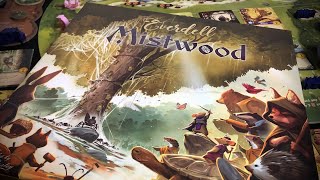
The centerpiece of Mistwood is Night Weave, a solo and competitive opponent designed by Rob Bell and Chrissy Pesque. Night Weave is a sophisticated player character represented as a large purple spider with her own workers, called spiderlings. Unlike Rugard (the base game's solo opponent), Night Weave follows the same rules as human players: she can hold a maximum of 15 cards in her city, must organize them in the standard grid, and must actually earn special and basic events to score them rather than receiving unearned bonuses. This mechanical consistency means players face a genuinely adversarial presence. Night Weave takes turns drawing activity cards that dictate her actions each season: placing spiderlings, placing herself in the meadow, or performing other actions. Her spiderlings accumulate throughout the game and can be placed on the board to block valuable card locations, creating tension during play. When Night Weave occupies a space in the meadow, adjacent cards gain a web token, making them cost one additional berry to purchase. This mechanic directly pressures player strategy and prevents the feeling of competing against a random system.
Variability Layers: Difficulty, Personalities, and Plots
Starling Games designed Mistwood with multiple layers of difficulty to suit different player preferences and replays. The difficulty system ranges from Tame through Tricky, Troubles, Tormenting, and finally Terrifying, each changing how aggressively Night Weave scores bonus points. Beyond difficulty, Mistwood includes Personality cards, such as Night Weave the Noteworthy or Night Weave the Nefarious, each granting her ongoing special abilities that alter her strategic approach throughout the game. There are also optional Plots cards (33 of them) that trigger at season's end and introduce one-time or seasonal effects, adding yet another layer of unpredictability. Alternatively, players can use Plans cards for long-term twists. This modularity means no two games play identically, and solo players can calibrate the challenge to their skill level or mood. The expansion also introduces new Farm cards with choice mechanics (marked by a sun symbol), allowing players to select one of two benefits when activating those cards, further enriching decision-making in both solo and multiplayer contexts.
The Everdell: Mistwood Experience
Tension of Active Opposition
The expansion creates a palpable sense of playing against a thinking opponent rather than managing a predictable system. Night Weave places workers on the same locations players covet, blocks meadow spaces with her spider tokens, and competes directly for basic events. Reviewers describe this as deeply different from the base game's Rugard, where players could optimize around a non-responsive AI. With Night Weave, each turn becomes a negotiation: take the card you want before she does, or build toward a different strategy. This interactive tension elevates what might otherwise feel like a puzzle-solving experience into genuine gameplay. The meanness of Night Weave is frequently mentioned, and reviewers appreciate it not as frustration but as engaging opposition.
Rich Replayability Through Modular Design
The combination of five difficulty levels, eight Personality cards, and 33 Plots cards creates extraordinary variability. Reviewers highlight that the expansion transforms solo Everdell from a one-note experience into a game worth returning to repeatedly, each time facing a subtly or radically different opponent. A Personality might emphasize gathering resources, blocking the meadow, or prioritizing specific card types, while Plots introduce seasonal disruptions that force adaptation. This modularity means players never feel stuck in a single dominant strategy, keeping the expansion fresh across dozens of plays.
What Makes Everdell: Mistwood Stand Out
Night Weave as a Legitimate Player
The most praised aspect of this expansion is that Night Weave respects the game's rules in a way Rugard never did. Reviewers emphasize how Rugard could accumulate cards beyond the 15-card limit, hold unlimited workers, and score events without actually earning them, making the opposition feel arbitrary. Night Weave is constrained by the same mechanics as human players. She must place cards in the standard grid formation, cannot exceed 15 card slots without using construction cards, and only scores basic and special events if her city contains the required card combinations. This philosophical shift transforms solo play from managing a rng system to playing against a competent but bound rival. One reviewer stated they will never return to playing Everdell solo without this expansion because Night Weave delivers the sense of playing against someone.
Sophisticated Solo Module Without Bloat
Reviewers praise Mistwood for how densely it packs strategic options into digestible mechanics. The system is not prohibitively complex (though the iconography requires initial learning) but offers genuine strategic depth. The Night Weave boards clearly display which action she'll take each season, removing hidden information and keeping the game transparent. Personalities and Plots are straightforward to track. The expansion avoids overwhelming players with fiddly bookkeeping while still delivering rich tactical decisions. Starling Games made the deliberate choice to ensure players can distinguish between difficulty tiers without adding unnecessary chrome.
Potential Drawbacks
Night Weave is Genuinely Difficult and Can Be Punishing
Night Weave is consistently described as a challenging opponent, and reviewers note she is not the expansion for players seeking a relaxing, forgiving solo experience. At higher difficulty levels (Troubles and above), Night Weave can accumulate workers faster than players expect, block key meadow positions, and score efficiently, creating legitimate pressure to optimize play. Reviewers who favor calm, exploratory Everdell experiences may find Mistwood shifts the tone toward puzzle-solving and tactical play. The expansion works best for solitary players who actively enjoy competition and challenge.
Table Space and Initial Learning Curve
The expansion introduces Night Weave's lair board and spiderweb tokens, expanding the physical footprint of the game. For players with limited table space, setting up Mistwood requires deliberate arrangement. Additionally, the iconography on Night Weave's activity cards (which vary by season and determine her actions) can be confusing on a first play, requiring careful reading of the rules. Reviewers note this friction fades quickly as patterns become familiar, but new players teaching the expansion to others should budget extra time for the learning phase. Some reviewers also mention that integrating it with other big-box expansions like New Leaf requires a larger die (12-sided instead of 8-sided), adding a small component requirement.
If You Enjoy Everdell: Mistwood
Players drawn to Mistwood typically have a strong preference for solo gaming and seek competitive challenge from their opponents. The base game Everdell remains the ideal starting point and foundation for this expansion; Mistwood requires the full base game to play. For those who want to further enrich their solo experience, Starling Games' other Everdell expansions (Bellfaire, Pearl Brook, Spire Crest, and New Leaf) all layer additional modules into the core experience, though Mistwood stands apart in how fundamentally it reimagines solo play. Players who appreciate other sophisticated solo systems, like those in heavier euros, often find Mistwood's Night Weave system uniquely rewarding: it combines elegant rules with genuine opposition.
What Reviewers Are Saying
I will never play Everdell without the Mistwood expansion again because it just makes me feel like I'm playing an actual opponent.
— Where There's A Wilz, There's a Play
There's layer upon layer upon layer of variability, so much to do for the solo mode.
— Box of the Lights
She blocks the meadow, she blocks your town, she comes into your open spaces of your town.
— Get into Games