










Shadow Moon Syndicates Deep Dive
What the Community Thinks About Shadow Moon Syndicates
Shadow Moon Syndicates arrives as a card-driven area control game that puts players in the shoes of crime syndicate bosses competing for control of a space station. The criminal theme carries through mechanically and thematically, creating a cohesive experience where players manipulate agent cards to establish influence across various districts while disrupting their opponents' plans. Reviewers consistently praise the game's ability to deliver tactical depth without sacrificing accessibility, and many highlight how the interplay between card drafting, area control, and hand management creates moments of genuine tension around the table.
The game has resonated particularly well with players who enjoy competitive, interactive experiences. Unlike more solitary Euro-games, Shadow Moon Syndicates thrives on player-to-player conflict, with reviewers noting that the board state is in constant flux as opponents push, pull, and eliminate each other's influence. For groups that embrace this kind of confrontational gameplay, the experience lands as one that encourages repeated plays and keeps players engaged throughout.
Core Mechanics That Define Shadow Moon Syndicates
Card Play and the Agent Stack System
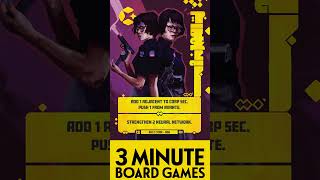
The heart of Shadow Moon Syndicates revolves around its elegant card play system. Each turn, players deploy agent cards from their hand to build what's called an agent stack. What makes this system distinctive is the dual-ability structure on every card: an above-the-line effect that always activates, and a below-the-line effect that only triggers under specific conditions. This happens when a card is the first in your stack, when it matches the faction of the card already in your stack, or when you play a card face-down. Reviewers highlight how this creates meaningful decision-making, as players must consider not just what a card does immediately, but whether it sets up their next card's bonus action.
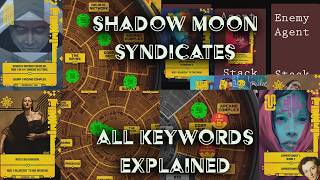
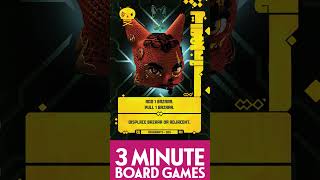
The keyword system on these cards drives most interaction with the board. Keywords like push, pull, transfer, eliminate, strengthen, and usurp give players fine-grained control over influence placement and movement. Reviewers note that while there are roughly 15 different keywords to learn, most become intuitive after a few hands of play. The reference card provided helps during the learning phase, and many reviewers appreciate how Arkus Games prioritized accessibility by including extensive rules examples and clear wording in both the rulebook and player guides.
Area Majority and Operation Tokens
Shadow Moon Syndicates uses area control as its scoring mechanism, but with a twist: players spend their influence to claim operation tokens that deliver immediate points. The board contains 15 districts, and to claim an operation token straddling two of them, a player must control at least one district with sufficient influence. Rather than sitting back once they claim control, players have incentive to cash in and move on, which keeps the board dynamic and prevents any single player from dominating indefinitely. Reviewers mention that this mechanism creates strategic tension, as there's always a trade-off between building majority for passive control points and actively spending influence to claim valuable operation tokens.
Each round, players also score credits for any district they control (one credit per district, three for the central Spire). This layered scoring from both operations and area control means that players can pursue multiple paths to victory. Reviewers appreciate that no single strategy dominates, allowing for diverse playstyles even within the same game group.
The Shadow Moon Syndicates Experience
High-Energy Table Interaction and Disruption
What reviewers consistently emphasize about Shadow Moon Syndicates is its confrontational nature. This is emphatically not a game where players quietly build their own engine. Instead, much of every turn is spent interfering with opponents' plans through card effects that manipulate, burn, or displace their influence. Several reviewers describe this as a "take that" game, and they mean it as high praise: the interaction isn't random cruelty but deliberate tactical choices. Since all players can see the board state evolving, there's room for skilled play and reading the table. Reviewers note that experienced players can anticipate threats and position themselves defensively, or they can go on the offensive if they sense an opening.
The three-round structure means the game doesn't overstay its welcome. Reviewers mention that with experienced players, a full game takes 45 minutes to an hour, keeping the energy high and the pace snappy. The final round plays differently than the first two (no card market, smaller hand size) and delivers a decisive moment where all the cards players carefully curated come into play. This structure prevents the game from becoming repetitive or allowing luck to override strategy.
Faction Variety and Replayability
The game ships with 10 distinct factions, but only 6 or 7 are used in any given game depending on player count. Each faction has a central mechanic that defines its playstyle: some excel at direct damage, others at card manipulation, still others at board control or economy manipulation. Reviewers appreciate that this variability means no two games feel identical, and groups that own the expansion gain even more combinatorial options. The designer notes that the game is designed as a "forever game" that players will want to bring back repeatedly because of this faction mix-and-match system.
Reviewers also highlight that the factions aren't imbalanced; instead, they're distinct enough that different groups might favor different combinations. One playthrough might favor aggressive factions that clash head-to-head, while another might feature more manipulative, subtler syndicates. This flexibility in the game's personality appeals to players who like variety in their rotations.
What Makes Shadow Moon Syndicates Stand Out
Accessible Complexity
Shadow Moon Syndicates occupies an interesting space: it has genuine strategic depth with roughly 15 distinct keyword actions, a layered scoring system, and meaningful decisions every turn, yet reviewers consistently note it's easier to teach than comparable games. Arkus Games prioritized legible rules with large fonts, extensive examples, clear hierarchies, and helpful reference cards. The baseline rules are straightforward: deploy a card, resolve its effects, optionally claim an operation or adjust your hand. From there, the keywords add texture without overwhelming new players. Reviewers who teach games professionally appreciate that after explaining the core flow once, newer players can play through their first hand confidently.
The criminal syndicate theme also reinforces the mechanics rather than existing separately. Every action on a card makes sense narratively: a faction that recruits new members might have an "interfere" ability that places rival gang members into your stack. A faction that controls smuggling might excel at moving influence. This thematic coherence helps new players reason about card effects even before they've memorized keywords.
Component Quality and Production
Reviewers comment on the quality of Arkus Games' production. The stackable influence tokens have a premium feel and integrate well with the board. The card art is distinctive and varied, with each faction having its own visual identity. The rulebook itself is beautifully laid out and illustrated. The cover art in particular draws attention; reviewers mention it evokes a "Pulp Fiction in space" vibe that stands out on shelves. These production choices signal respect for the players and contribute to the overall experience, making the game feel like a premium product rather than a commodity.
Potential Drawbacks
High Player Interactivity Isn't for Everyone
The same confrontational energy that appeals to many players is also why Shadow Moon Syndicates won't work for all tables. This is explicitly a game where you disrupt opponents, where your carefully laid plans can unravel thanks to a well-timed card play, and where kingmaking and player elimination are real possibilities. Players who prefer cooperative games, puzzle-like optimization challenges, or games that let them pursue a solitary strategy won't find satisfaction here. Reviewers acknowledge this directly, noting that the game's appeal comes precisely from its refusal to be gentle or forgiving.
Additionally, the game's flavor includes criminal activities and mature themes. While no reviewer objects to this, and Arkus Games clearly leans into the crime-syndicate theme intentionally, groups with young children or squeamish sensibilities should be aware of the setting.
Learning Curve for Keywords and Interactions
While reviewers generally praise the accessibility of Shadow Moon Syndicates, there is a genuine learning curve. The 15 keywords and their interactions require familiarity before players can play at full speed. The agent stack system, while elegant, introduces timing complexity that newer players need to internalize. In your first game, referencing the rules and keyword card frequently is normal, and some rules questions will arise. Reviewers note that this is manageable and that play accelerates quickly, but it's not a game you can teach in three minutes and play immediately at full depth. Groups wanting a lighter experience or a game that plays smoothly on first meeting might prefer something simpler.
If You Enjoy Shadow Moon Syndicates
Players who love Shadow Moon Syndicates tend to enjoy other games that prioritize table interaction and tactical play. Red Dust Rebellion offers a different flavor of confrontational play with an asymmetric wargaming lens. Circadians: Chaos Order and Circadians: First Dawn share some of the faction-based asymmetry and area control DNA. For a lighter take on hand management and area control, Twilight Imperium (if you can stomach the length) offers grand-scale interaction. Players enjoying the criminal theme might look to games with similar flavor, though the board game space has few games that nail the crime-syndicate feel as well as Shadow Moon Syndicates does. The game also works exceptionally well for groups that like to play the same game repeatedly, as the faction mix ensures variety across plays.
What Reviewers Are Saying
"This is a very heavy PVP game, this is a very take that game. A lot of what you're doing when you're playing cards, sure you're adding influence out onto the board into different areas and you are wanting to move your influence and hedge up your positions and protect yourself, but a lot of what you're doing is also messing with your opponents, you're pushing them out, you're eliminating their influence tokens, you're messing with their stacks so their combos aren't set up the way they wanted them to be set up."
— Watch Review
"If you like area control triggered by simple card play with lots of tactics and strategy then Shadow Moon Syndicate is for you. This right here is the shadow Moon and you'll see that it's divided up into all of these different districts where we're going to be placing these influence tokens trying to control those locations for a variety of different reasons, ultimately to fulfill objective cards but also to complete all of these operation tokens."
— MLE University
"It is what I consider a forever game. I've designed it in such a way that you should be able to play through a round of the game in 45 minutes to an hour or so, once you're good at it, and then afterwards immediately go and want to play again. You should be either wanting to prove you can do it again or angry that you lost out and want to go again."
— 3 Minute Board Games