






Crossing Oceans Deep Dive
What the Community Thinks About Crossing Oceans
Crossing Oceans represents Mac Gerdts' refinement of the designer's earlier design Transatlantic, intended as a smoother, more focused successor to an already divisive game. Community reaction has been mixed: reviewers appreciate its accessibility and flow, but find the strategic experience less compelling than hoped. The game sits in an awkward middle ground, where the thematic elegance of its ocean liner components and historical depth cannot quite compensate for what many describe as monotonous, repetitive gameplay. For fans of Concordia (Gerdts' widely celebrated earlier work), Crossing Oceans feels like a step backward in terms of strategic variety and meaningful decision-making, despite being mechanically tighter and faster to teach.
Core Mechanics That Define Crossing Oceans
The Rondel Action System
At its heart, Crossing Oceans uses a rondel for action selection. Each player has a marker they advance clockwise around a circular track with eight action spaces. On your first turn you can go anywhere, but subsequently you move one to three spaces forward, or pay a contract to leap further ahead. You cannot return to the same space twice in a round, creating a loose but disciplined flow. Rio Grande Games presents a clean, colorful design where each action space is color-coded and easy to read. Reviewers note that this rondel is decidedly simpler and more constrained than Mac Gerdts' Concordia, which uses a deck-building system allowing players to accumulate cards and chain actions in surprising ways. The Crossing Oceans rondel, by contrast, feels straightforward and tactical without the depth of long-term planning and flexibility Concordia offers.
Resource Management and Ship Specialization
The economic engine revolves around earning money and converting it into ships. Players acquire ships from a rotating market, then place them on different regions of a double-sided game board. Each ship has a color flag, and at game end, scoring is almost entirely determined by how many flags of each color you own and how many matching flag tokens you have collected throughout the game. This creates a powerful incentive to specialize: focus on one or two ship colors, use trading house actions to score points whenever that color is activated, and ignore the rest. Reviewers consistently report that this ultra-specialization is the dominant strategy. One player chooses red ships, another black, another blue, and there is almost no reason to deviate. The system includes a small multi-color flag token to encourage variety, but it scores far fewer points than focusing narrowly. The result is that once the optimal path reveals itself, the game becomes about executing that same plan as efficiently as possible, which reviewers describe as the game's most significant strategic flaw.
The Crossing Oceans Experience
Smooth, Frictionless Turns with Minimal Downtime
Crossing Oceans excels at keeping the game moving. Reviewers praise the tight turn structure and the way actions resolve quickly. With two or three players, your turn comes around constantly; with four, there is still minimal waiting. The rulebook, published by Rio Grande Games, is remarkably concise for a Mac Gerdts design, fitting six pages while still providing clarity. Once players grasp the eight actions and the ship/contract choice, turns flow without hesitation. The box claims 75 minutes but reviewers found it typically runs 80 to 110 minutes, which for a strategy game with resource management is genuinely efficient. No one reports boredom while waiting: everyone is engaged. The problem is not downtime; it is the repetitiveness of what happens when it is your turn.
The Repetition Trap
Despite the smooth mechanics, reviewers use words like "repetitive" and "boring" to describe the long-term experience. Turn after turn involves the same motions: advance on the rondel, take an action, earn money, buy more ships of your chosen color, place trading houses, collect flag tokens. There is little variation in what each action does, and the board interaction (via region actions) is minimal once players settle into their chosen specialization. One reviewer captured this precisely: they are not bored during play, but they feel no excitement or engagement. The game lacks the puzzle-like satisfaction of optimizing a Concordia hand or the emergent storytelling of kingdom-building games. It simply is a competent vehicle for executing a predetermined strategy without elaboration or surprise.
What Makes Crossing Oceans Stand Out
The Thematic Passion and Historical Accuracy
Crossing Oceans is unmistakably a passion project. The game includes real ocean liner ships with historical details provided in an accompanying booklet. The board has two sides: a clean, modern game board with easy-to-read symbols and colors, and a historical map showing the actual routes and geography of the golden age of ocean liners. The components are beautifully produced; the paper money, while printed with identical serial numbers, still evokes the weight and texture of real currency. The blue ribbon action is a direct reference to the Blue Riband, a real award given to ships with the fastest transatlantic crossings. This level of thematic integration is rare in pure Euro games and shows Mac Gerdts' love for the subject matter. Reviewers consistently note that the theme does not mechanically interfere with the game, serving as elegant window dressing, but it also fails to elevate the experience because the core mechanics themselves lack the narrative or tension that would make the theme feel essential.
Board Tightness and the Ship Replacement Mechanic
Each region on the board has a limited number of spaces for ships (some hold two, others three or four). When a region fills up, the oldest ship in that region is bumped out and returns to its owner. Reviewers point out that this creates a satisfying tension: you are constantly jockeying to keep your ships on the board or replace older vessels with newer, better ones. On one turn a player might feel threatened as their ships are pushed out, forcing them to recalculate. On the next, they seize the opportunity to place a ship that forces an opponent to decide whether to replace it or use an action elsewhere. This spatial puzzle is one of the few moments where the game feels like a puzzle worth solving, though it is relatively shallow. The mechanic encourages some interaction and reminds players that board presence matters, even if the ultimate scoring is almost entirely dependent on flag token accumulation rather than ship positioning.
Potential Drawbacks
The Specialization Stranglehold and Lack of Strategic Variety
The most damning criticism from reviewers is that Crossing Oceans collapses into a one-trick-pony game. Everyone specializes in one or two colors because that is the overwhelming dominant strategy. Attempts to "balance" by pursuing multiple colors result in fewer points across the board compared to going all-in on one. There are published variants attempting to address this (Mac Gerdts released an updated version with tweaked trading-house costs within a month of release), but the fact that a variant was needed so quickly signals that the base game has a fundamental strategic imbalance. The consequence is that every game follows a similar shape: players identify which colors are being targeted and either fight for one or settle into a different color with minimal conflict. The rondel provides only a loose constraint on timing; it does not force players into conflict or create the kind of dynamic re-evaluation that happens in Concordia. For players who loved the multi-use card system and evolving hand in Concordia, Crossing Oceans will feel like a step back.
Limited Interaction and Muted Player Conflict
Despite having a region-activation action that triggers every player's ships in a chosen region, the interaction is less pronounced than reviewers expected. Once players have settled into their color specializations, activating a region is often just a mechanical payout rather than a meaningful decision point. You are not weighing whether to activate a region your opponent dominates or one where you have the advantage. Instead, everyone benefits from the payout, and you move on. Reviewers describe the game as "okay" in terms of conflict and kingmaking: the threat of bumping someone's ship off the board is the closest the game comes to direct conflict, but it lacks the tough choices and player tension that make resource-management games memorable. The game is fundamentally non-confrontational, which some players may prefer, but it means that even at higher player counts where region interactions matter more, the game still feels like four parallel solitaire games of token collection rather than a shared economic struggle.
If You Enjoy Crossing Oceans
If Crossing Oceans' elegant design and smooth flow appeal to you, Rio Grande Games' Concordia is the clear next step: it shares the same designer and is widely regarded as a masterpiece of the rondel and resource-management genre. Concordia pushes every element further: the multi-use card system creates genuine dilemmas, the provinces you develop matter more than commodities you collect, and the interaction between players is more textured. If you have already played Concordia and want something lighter or faster, Transatlantic (the original 2017 Gerdts design) is worth investigating despite the mixed reviews; some players actually prefer its ship-scoring mechanism and trading-house dynamics, even if the overall package feels less polished than Crossing Oceans. For those drawn to the ocean-liner theme and historical accuracy, the production quality and thematic depth are unmatched in the genre, making Crossing Oceans a worthwhile table centerpiece even if the gameplay does not sustain long-term engagement.
What Reviewers Are Saying
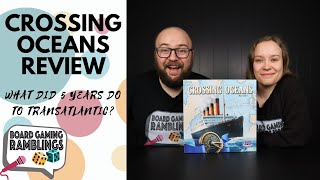
"I'm not bored while I'm playing it, but I'm not having a great time. I'm not being excited. I think it's nice that the turns go by so quickly."
— Board Gaming Ramblings
"There's almost nothing to suggest why I shouldn't just specialize in one here and then get as many ships of that that I can afford. So yeah, I've found that everyone goes into specialization."
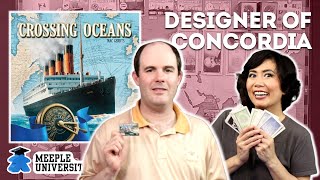
— Meeple University
"I'm really excited to see what he was doing for five years making this game better, and for me sadly it was not better. It's not a game I ever need to play again."
— Board Gaming Ramblings