







Happy Mochi Deep Dive
What the Community Thinks About Happy Mochi
Happy Mochi has emerged as a delightful surprise for board gamers seeking a quick, accessible shedding game with surprising depth. Reviewers consistently praise the game's charming aesthetic and clever mechanical simplicity. It strikes a balance between being easy to teach and rewarding to play repeatedly, making it a standout option for anyone looking for a game that works with groups of varying experience levels.
Core Mechanics That Define Happy Mochi
Two-Digit Number Play
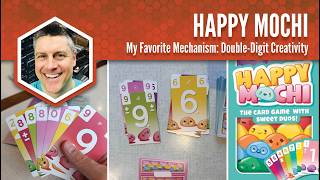
At the heart of Happy Mochi lies a clever twist on traditional card shedding. Players don't discard single cards; instead, they must play pairs of adjacent cards from their hand as two-digit numbers. This adjacency restriction forces meaningful decisions at every turn. Since the cards in a player's hand never change order, players must work within that constraint while trying to form numbers that satisfy the current requirements on the table. Drawing additional cards anywhere into the hand is the key way to unlock new numeric combinations and find escape routes when stuck.
Climbing and Comparison
Once a two-digit number is played, the next player faces restrictions. A plus or minus indicator next to the number dictates direction: players must play higher or lower two-digit numbers than what was just laid down. This creates the classic ladder-climbing tension found in games like Scout and The Mind, but with a distinctly numerical twist. The game escalates naturally as each play sets new thresholds for the next player, tightening constraints until someone cannot respond and must draw cards to refresh their options.
The Happy Mochi Experience
Accessible Charm
The game radiates a lighthearted, whimsical energy that transcends its rulebook. The adorable mochi-themed card art and colorful box design create an inviting aesthetic that puts players at ease. Reviewers highlight that this is emphatically a nice game, not a mean-spirited one. The experience feels inclusive rather than cutthroat, welcoming players of all ages and experience levels into a brief, shared adventure.
Surprisingly Thinky Decisions
Despite the simplicity of its premise, Happy Mochi offers more strategic depth than first appearances suggest. When to play cards, which number combination to create, and whether to use a powerful pair immediately or save it for a critical moment all matter. Choosing whether to make life difficult for the next player by playing the same color adds a layer of tactical consideration. These decisions accumulate into a satisfying puzzle that rewards careful play without ever becoming oppressive.
What Makes Happy Mochi Stand Out
The Color Restriction Twist
One elegant mechanism elevates Happy Mochi from merely competent to genuinely clever. When both cards on the table happen to be the same color, the next player must not only play higher or lower but also match that color with their next two-card pair. This optional constraint appears and disappears naturally based on card luck, meaning players must stay alert and adaptable. It makes the game harder for following players while adding just enough unpredictability to keep each round fresh.
The Happy Mochi Wild Card
When a player holds a pair in their hand, they can play it as a wild card on any pile, ignoring all number and color restrictions. This pair is accompanied by the satisfying declaration of the game's name. These moments break stalemates and reset the board, offering relief when the table becomes too constrained. They appear rarely enough to feel impactful while remaining common enough to shape play throughout the game.
Potential Drawbacks
Very Light Strategy
Happy Mochi is fundamentally a game of limited depth. This is by design, but players seeking a game with multiple strategies or long-term planning may find it too straightforward. The fourteen hands played across a typical game move quickly, leaving little time to develop complex plans or recover from early bad luck. It's a game of tactical adaptation rather than strategic masterclass.
Luck-Driven Outcome
The cards you draw and the order they arrive remain significantly influenced by chance. A player can make all the right decisions yet still fail to draw the numbers they need at critical moments. Some may draw new cards early and find themselves with terrible hand orderings they can never escape. This is part of the charm for a casual game, but less satisfying for players who want outcomes driven purely by skill.
If You Enjoy Happy Mochi
Players drawn to Happy Mochi's accessible shedding mechanics and clever number-play will find a welcoming home in games like Scout, which shares the hand-order restriction and scaling difficulty, and The Game or The Mind, which offer similar cooperative number-line challenges with different themes. Those who love the quick pace and family-friendly charm might also explore Hanabi for more cerebral cooperative play, though be warned: it lacks the lightness and social ease that make Happy Mochi such a joy to teach and play in rapid succession.
What Reviewers Are Saying
"This is a super cute little card game. Um, and it is a shedding game where you are trying to get rid of all the cards from your hand, but there is a card in the middle that flips over back and forth and it's going to determine whether you have to follow higher or lower as you are going around in the game putting out cards."
— The Dice Tower
"So, in this simple little card game, there's a surprisingly high number of decisions that I really enjoyed and yeah, I I just had I had a lot of fun playing it."
— Stonemaier Games
"I think this is a really solid family weight game into games like the mind, the the the game, not Hannabi. That will ruin people's lives. So, don't play Hannabi. But, uh that is Happy Mochi."
— The Dice Tower