












Priorities Deep Dive
What the Community Thinks About Priorities
Reviewers across multiple platforms consistently celebrate Priorities as a standout social game that achieves something many party games struggle with: genuine insight into how the people around the table think. Rather than just laughing at random prompts, players gain real perspective on each other's values and priorities. The game is praised for being straightforward to teach, easy to play, and remarkably effective at sparking genuine connection. Several reviewers note they initially discovered Priorities through other media—like the game show Paranoia Room on Dropout—but were immediately compelled to buy their own copy after one play session. There is broad agreement that this is the kind of game people reach for when they want to build camaraderie and learn something authentic about the people they're playing with.
Core Mechanics That Define Priorities
The Ranking Mechanism
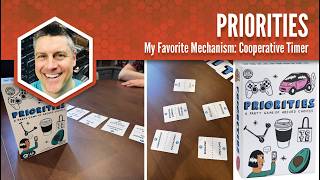
At the heart of Priorities lies a deceptively simple but powerful mechanic. One player draws five cards—objects, concepts, or scenarios from everyday life—and secretly ranks them from most valued to least valued based on their own preferences and personality. The other players then work together to guess that ranking. The beauty of this mechanic is that it forces players to think deeply about how someone else's mind works. As Positively Bored Gaming's Mitchell observed after playing, the game requires knowing not just a person's likes and dislikes, but understanding how they actually think and reason about trade-offs. A phrase like "noisy kids" might mean different things to different people. For someone with children, noisy kids means their family is home, something joyful. For someone on an airplane, it means frustration. The game thrives on these interpretive moments.
The Letter-Spelling Timer Mechanism
What distinguishes Priorities from other guessing games—like So Clover, Just One, Telestrations, or Echo—is its organic timer. Every card in the game has a letter on its back that spells the word "PRIORITIES." When players guess correctly, they flip that card over and keep the letter. When they guess wrong, the game gets the letter. The first to spell the complete word wins. Jamie from Stonemaier Games praised this mechanism as a clever solution to a real problem: many similar games lack any built-in pressure or sense of stakes. Without some kind of timer or win condition, they can feel like unstructured activities. Priorities embeds pressure into its design in a way that feels natural rather than artificial, pushing players to make decisions without feeling punitive.
The Priorities Experience
A Conduit for Laughter and Revelation
Playing Priorities is less about winning and more about the moments of discovery. Reviewers consistently describe the game as generating hilarious debates. One reviewer noted: "This is a game you walk away from making fun of your friends' choices." The example given was unforgettable: "I can't believe Kyle ranked Taylor Swift above Baby Yoda." These moments stick with people. They become the stories friends retell for months. The game excels at surfacing unexpected preferences and creating memory-making moments, not because the game itself is wacky or arbitrary, but because it reveals genuine truths about how people think.
Building Genuine Connection
Beyond the laughter, reviewers highlight a deeper experience. After playing one session, a team from Shelf Side Plays noted they had achieved a 70% success rate and observed that they "learned a lot" about the person being ranked. This isn't accidental. The game is explicitly designed to deepen relationships. Jamie from Stonemaier Games selected Priorities to represent the TV show Friends—not because it's flashy or competitive, but because it captures the essence of how friends know each other through small, telling details and repeated conversations about preferences and values.
What Makes Priorities Stand Out
A Genuine Predictor of Compatibility
Unlike pure party games that rely on gags or speed, Priorities depends on actual knowledge. The more you know someone, the better you do. This makes repeated play with the same group especially rewarding. Over time, players develop sharper mental models of how each person thinks. They notice patterns in what matters to whom. The game rewards attentiveness and emotional intelligence in a way that feels earned rather than arbitrary.
Accessibility Without Sacrifice
Priorities is famously easy to teach. There are no complex rules, no ambiguous card text, no learning curve. Yet despite this simplicity, the game generates sophisticated social dynamics. Players with diverse gaming backgrounds sit down together and immediately understand what they're doing. A newcomer to board games and a veteran play on equal footing. This accessibility makes Priorities a natural choice for mixed groups, family gatherings, or introducing non-gamers to modern board games.
Potential Drawbacks
Requires Actual Social Investment
Priorities is not a game for players who want to zone out or play mechanically. It demands engagement and genuine thought about the people at the table. If your group isn't interested in learning about each other's preferences or debating the merits of different options, the game loses its magic. Some players may find the requirement to make deep, interpretive judgments about others' preferences uncomfortable or exhausting.
Quality Depends on Card Mix and Group Chemistry
The game's strength lies in how cards prompt discussion. If the card draw skews too absurd or too neutral, the discussions can feel forced. And like any social game, Priorities lives or dies by the chemistry of the group. A table of people who already know each other extremely well, or conversely, a group of complete strangers with no shared context, may find less to discuss than an established friend group playing together.
If You Enjoy Priorities
Players who appreciate Priorities's focus on honest social interaction and light discussion will find similar satisfaction in Wavelength, which also emphasizes reading how others think through careful communication. Those who enjoy the guessing element should explore So Clover or Just One, both of which share the mechanic of players working together to deduce a person's perspective. For a different flavor of party game that still values observation and discussion, Telestrations offers wordless creativity and laughter. Echo provides another cooperative guessing experience. But for building genuine connection through ranking and preference revelation, Priorities stands alone.
What Reviewers Are Saying
"You have to know the person and their likes and dislikes. You also have to know how the person's mind works and what their take on that question or those words is going to be."
— Positively Bored Gaming
"I actually like this more than Wavelength."
— Shelf Side Plays
"This is a game you walk away from making fun of your friends' choices... like I can't believe Kyle ranked Taylor Swift above Baby Yoda."
— Watch Review