











































Enchanted Ivy Deep Dive
What the Community Thinks About Enchanted Ivy
Enchanted Ivy has arrived as a surprising gem in an increasingly crowded field of cozy tile games from publisher AllPlay. Alex Ra from BoardGameCo called it "exactly the kind of optimization puzzle that I like," while also ranking it among his most-played games of the year with 13 plays, calling it easily his favorite AllPlay title. Jenna from The Board Game Garden expressed similar enthusiasm after previewing a prototype, noting she really enjoyed the gameplay of it. The solo gaming community sees Enchanted Ivy as something special, though it does face the inevitable comparison to established titles like Calico and Cascadia. Broadly, reviewers credit the game's charming theme and unusual artwork for lifting it above other entries in the tile-laying genre, though one reviewer cautiously noted the crowded space and acknowledged being uncertain whether another such game was needed.
Core Mechanics That Define Enchanted Ivy
Tile Placement
Enchanted Ivy is fundamentally a tile placement game where players build an inn by placing guest cards and room tiles according to placement rules and spatial constraints. Each turn, a player draws two cards and one guest from a scenario-specific bag, then places one guest and two cards onto their growing layout. The placement is not free-form; each guest has preferences and requirements that shape where they can or must be positioned. Reviewers like Alex Ra broke down the mechanics during gameplay: the Washer wants gaps between herself and other guests, the Alchemist wants white or blue flowers in her column, and the Fire Breather scores for empty diagonal spaces. This creates a puzzle where the core challenge is orchestrating placement to satisfy multiple guest preferences simultaneously while working toward a pre-defined goal shape.
Pattern Building
Woven through the tile placement is a pattern-building system centered on ivy connectivity. Ivy cards form connected paths across the layout, and score depends on consolidating these paths into as few separate groups as possible. Fewer, larger connected patches of ivy earn more points than scattered, fragmented groupings. This creates a secondary optimization layer: while placing guests to satisfy their individual scoring rules, a player is also trying to trace unbroken ivy paths that knit the guests together. One reviewer noted spending multiple plays learning to connect ivy in a circle back to where it started, a symbolic payoff that also yields significant points. The pattern builds gradually as tiles interlock, rewarding players who think several turns ahead about connectivity.
The Enchanted Ivy Experience
Satisfying Puzzle Mastery Through Iteration
Reviewers consistently highlighted a key emotional arc: each scenario teaches something new through repeated plays. Alex Ra described getting all four goals in one scenario only after six plays, noting that players start to get better at optimizing as they learn which guest wants what and start to chart out the pathway and learn from mistakes. Jenna from The Board Game Garden mirrored this, saying players must play scenarios multiple times to get a sense or feel for what they're doing and then iterate to perfection. What makes this feel earned rather than punishing is that plays remain quick. A single game can finish in 10 to 20 minutes, so the repetition is not a grind but rather a series of small experiments. One reviewer captured the moment perfectly: it is so satisfying when finally engineering that perfect score, because a player really feels they've earned it, having planned around all the things that are going to come out.
Charming, Whimsical Atmosphere
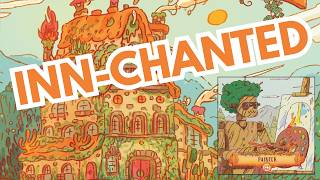
Reviewers consistently praised the game's presentation as a standout feature. The theme of running a magical inn with eccentric guests brings warmth to what might otherwise feel like a dry optimization exercise. One reviewer described the guests as very whimsical, eccentric, and all the different characters seeming very fun. Alex Ra called the presentation very cute, with cute artwork forming a great package. The combination of quick playtime, puzzle depth, and cozy aesthetic means Enchanted Ivy feels less like grinding a math problem and more like spending an evening managing a delightfully odd bed-and-breakfast.
What Makes Enchanted Ivy Stand Out
Scenario-Driven Depth Without Campaign Fatigue
Unlike many puzzle games, Enchanted Ivy structures its replay value around distinct scenarios with unique goal sets rather than an endless campaign. This matters because it creates natural stopping points. Each scenario gives a specific shape to build, particular guests to work with, and two distinct goals to chase. Alex Ra, a passionate advocate for scenario-driven design, explained that games like Calico and Cascadia keep him coming back precisely because each scenario is a fresh puzzle. Enchanted Ivy follows this formula, offering players a defined series of challenges to master rather than a single, endless optimization treadmill. The prototype includes four scenarios; the final game is expected to have more, and reviewers already want additional content because they can see themselves playing through each one multiple times.
Meaningful Decision-Making in a Small, Quick Package
For a game that plays in 10 to 20 minutes, Enchanted Ivy packs remarkable decision density. Tiles cannot simply be placed randomly; each placement cascades forward, blocking or enabling future positioning. One reviewer described the tension of weighing whether a spot is good because of how it works toward or against later placements. Even a solo player must think several moves ahead, weighing multiple guest requirements and ivy paths simultaneously. The brevity means a session finishes feeling like meaningful choices were made, not that the game was over before a player could engage with it. Another reviewer emphasized how the game's challenge never scaled down just because it was solo; getting all the goals in a single game remains hard-won and genuinely satisfying.
Potential Drawbacks
Luck and Card Draw Can Derail Careful Planning
As with similar tile-placement games, Enchanted Ivy's card and guest draws are random, and a bad sequence can make certain goals unachievable no matter how well a player plays. Alex Ra acknowledged this directly: luck is definitely a factor, and the order that cards and guests come out absolutely plays a part in how likely a player is to optimize around the scenario goals, even when playing the best game possible. This is by design; part of the puzzle is adapting to what the bag and draw provide, but players seeking purely skill-based puzzles with no luck component may find it frustrating to nail a perfect strategy only to be blocked by an unlucky draw.
A Crowded Genre May Leave Some Players Unconvinced
Enchanted Ivy enters a market already populated with respected tile-placement games: Calico, Cascadia, and other similar titles fill similar design space. One reviewer voiced honest skepticism, noting that light to medium-weight tile-laying games have become a really crowded genre and expressing uncertainty about needing another one. While Enchanted Ivy's charming theme and artwork help it stand out, players who already have deep roots in Calico or Cascadia may wonder whether they have room for another puzzle game with similar strategic DNA. For those players, the question is not whether Enchanted Ivy is good; reviewers agree it is, but whether its particular flavor justifies shelf space in an already-full collection.
If You Enjoy Enchanted Ivy
If Enchanted Ivy resonates with a player, reviewers recommend exploring Calico and Cascadia as natural companions. Alex Ra explicitly named these as the games that gave him the same optimization-puzzle feel, noting that having specific scenarios layered around a core system is what keeps him diving back into a game. Reviewers also mentioned Ugly Griffin Inn by Button Shy as a similar solo puzzle, with one reviewer noting Enchanted Ivy feels like someone took Ugly Griffin Inn and made it significantly better. That said, Alex Ra also warned that completionist-minded players should be aware that finishing all scenarios of puzzle games like this can create a long cooling-off period before diving back in; he took about two years between completing Calico's scenarios and returning to replay them.
What Reviewers Are Saying
"I really enjoy this game. This is exactly the kind of optimization puzzle that I like. It has you trying to get to a certain level of score here while making it very hard to do so."
— Alex Ra, BoardGameCo
"It is just a puzzly game of placing these different guests in your inn in order to fulfill their specific objectives. And then you're also trying to connect the ivy on the outside and it's just so good."
— Jenna, The Board Game Garden
"It is so satisfying. You've planned around all the things that are going to come out, and you eventually get that perfect score. If you are a solo player in any capacity, Enchanted Ivy is a game you should be checking out."
— Alex Ra, BoardGameCo