







CATAN: New Energies Deep Dive
What the Community Thinks About CATAN: New Energies
CATAN: New Energies, a standalone game for three or four players designed by Klaus and Benjamin Teuber and published by Catan Studio, splits reviewers more sharply than most entries in the CATAN family. Rolling Dice and Taking Names is the clearest fan: one host says that when base CATAN comes up, New Energies is what comes off the shelf instead, and calls the changes an improvement. Meeple University's three hosts land in the middle, with one enjoying the shift in strategy, one calling it a bit of an unnecessary bolt-on, and one preferring the new version for its extra flexibility. The critics are blunt. 3 Minute Board Games describes it as CATAN with additional steps and later named it the fourth worst game of its awards year, while BoardGameCo listed it among the most disappointing games of 2025, calling it a worse version of CATAN that felt fiddly and non-intuitive. Earlier coverage from Watch It Played's news roundup and Jon Gets Games was curious rather than judgmental, with the Jon Gets Games host recalling that CATAN was a gateway into the hobby.
Core Mechanics That Define CATAN: New Energies
Power Plants and Energy
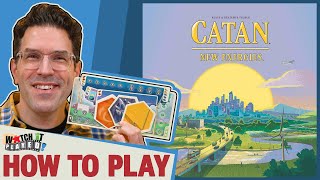
The familiar building and trading remain, but two new card types sit on top of them. Meeple University explains that cities no longer produce two of a resource; they produce one resource plus a science card, which is the main way to get science outside of trading and a few development cards. Science pays for power plants: a fossil fuel plant costs one science and a renewable plant costs three. According to Watch It Played's rules teach, a town has one slot for a plant and a city has slots for up to three. When a plant's hex produces, the owner gains energy, stored on the player board. Meeple University highlights that energy trades with the bank at two to one for any resource, and 3 Minute Board Games lists its other uses: removing a fossil plant, clearing a blocker, buying development cards, or building a warehouse that raises the discard threshold on a seven to ten cards.
The Event Bag and Environmental Footprint
Towns, cities and fossil plants raise a player's environmental footprint, while renewable plants lower it, and a global track sums everyone's total. At the start of each turn, tokens are drawn from an event bag and placed around the edge of the island; when a section fills, its event resolves. 3 Minute Board Games summarizes the pattern: brown events are normally bad for polluters and green ones are good for non-polluters. The bag begins full of brown tokens, and each renewable plant built adds a green one. Rolling Dice and Taking Names explains that as the global footprint climbs, players draw two and then three tokens per turn instead of one, which speeds the game toward its end. Hazard tokens from events stop a hex or settlement from producing once, and the environmental inspector takes the robber's place.
The CATAN: New Energies Experience
A Race Against the Clock
The event bag doubles as a timer. A player who reaches 10 points still wins immediately, but if a token must be drawn from an empty bag, the game ends and the winner is whoever has the most renewable plants minus fossil plants, with victory points only breaking ties. Watch It Played notes that if nobody has a positive total, every player loses. Rolling Dice and Taking Names loves this built-in clock. Meeple University shows how it bites: one host was sitting on eight or nine points, playing as dirty as possible, when the bag emptied and the result dropped to last place. The hosts estimate that a table of heavy polluters could see the game end in eight or nine turns.
Balancing Growth Against Pollution
Meeple University frames the theme as doing everything CATAN normally asks while balancing the negative against the positive, and the hosts describe a genuine strategic fork. Cheap fossil plants generate energy and flexible resources that push toward 10 points, but they empty the bag faster; renewable plants are slow and expensive but protect against the alternate ending. One host praises the resulting shift in the meta, since no one can rush blindly without checking whether the finish line is actually reachable, and building dirty early before spending energy to clean up later is one way to stay nimble.
What Makes CATAN: New Energies Stand Out
Ian O'Toole's Redesign
Even the harshest critic praises the look. 3 Minute Board Games calls Ian O'Toole's art the best thing about the game, almost worth buying just to upgrade an existing copy of CATAN. Meeple University loves the modern aesthetic and points out thematic touches throughout: processed resources such as steel beams and natural fiber, wooden dice, and a box with labeled compartments that, as far as the hosts understand, contains no plastic.
Answers to Old CATAN Frustrations
Several changes target long-standing complaints. Rolling Dice and Taking Names names CATAN's two biggest problems as players refusing to trade and bad dice rolls, and likes that energy can be turned in for resources. Meeple University compares the energy exchange to an old mini expansion that gave coins on unproductive rolls, and celebrates that the Monopoly development card is gone, while knights return as cleanups that can also clear hazards or evict the inspector.
Potential Drawbacks
More Work, Fewer Turns
3 Minute Board Games makes the sharpest mechanical case against the game. It expects players to build almost twice as much as regular CATAN, yet each player will likely get only 12 to 14 turns. Events slow each turn, block resources and create more dead turns, and because events punish whoever pollutes most, players become hesitant to grow at all. The review argues the 10-point victory might as well not exist and doubts anyone can build nine renewable plants before the bag runs out. Length is no cure either: Rolling Dice and Taking Names estimates about two hours for a good CATAN player.
Fiddly and Non-Intuitive
BoardGameCo found the game more fiddly and less intuitive than CATAN, singling out the possibility that the whole table loses. Replaying it on Board Game Arena to give it another chance did not change that verdict. One of Meeple University's hosts shares a milder form of the concern, feeling the original was elegant enough and choosing to stick with it.
If You Enjoy CATAN: New Energies
For players drawn to the emissions theme, 3 Minute Board Games points to Energy Empire as a better emissions-based game, and recommends the original CATAN to anyone not collecting every version. Rolling Dice and Taking Names places New Energies alongside CATAN: Cities & Knights, which one host treats as the way to play CATAN; the other host now reaches for New Energies instead when a game of CATAN is on the table, which suggests players who want more depth than the base game could look at either.
What Reviewers Are Saying
"Catan new energies expects you to build almost twice as much as normal Catan does. The problem is each player will likely only get 12 to 14 turns. Events will punish the first player to get higher emissions than anyone else and actively make you hesitant to grow."
— 3 Minute Board Games
"It felt more fiddly. It felt non-intuitive. The whole way you could have all the players lose the game. The whole thing was very weirdly done."
— Alex, BoardGameCo
"The theme is all about doing what you normally want to do but balancing the amount of negative that you put in versus the positive."
— Meeple University