









Foodfighters Deep Dive
What the Community Thinks About Foodfighters
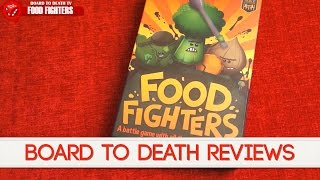
Foodfighters, Kids Table Board Gaming's light two-player dice battler, draws reviewers in with a premise built for laughs: teams of foods clashing in an all-out food fight. Board to Death TV came away impressed by how much polish the small box delivers for the price, while Neon Gorilla frames the design around a different strength entirely, how easily it scales across ages and skill levels. Across both perspectives, Foodfighters earns credit less for depth and more for hitting exactly what a quick, approachable card-and-dice game is supposed to do.
Core Mechanics That Define Foodfighters
Dice-Driven Tactical Combat
Foodfighters resolves its battles through dice rolls layered onto a tactical card-and-gear system. Board to Death TV describes the factions as fairly balanced thanks to their unique power cards, but notes that the dice can swing a game lopsided through pure luck, hitting rolls that convert directly into currency or damage. That volatility is treated as expected rather than a flaw, since a dice-driven tactical card game inherently trades some balance for accessibility and excitement. Players roll to attack, roll to earn resources, and manage gear and positioning around the outcomes.
Positional Placement and Targeting
Beyond the dice, Neon Gorilla highlights how placement decisions shape whether a fighter can be reached by an opponent's attacks. Even in the game's simplest mode, where younger players roll dice and attack directly, there's an underlying strategic layer: deciding where to place fighters so opponents can't easily get to the ones that matter most for winning. This dual-depth design, simple enough for a young child to grasp, layered enough for an adult to plan around, is central to how reviewers describe the game's appeal.
The Foodfighters Experience
Scalable From Preschoolers to Strategists
The defining experiential trait reviewers single out is scalability. Neon Gorilla describes testing the game across an enormous range of players, down to a four-year-old simply rolling dice and attacking, up through players who treat fighter placement as a real strategic puzzle. The same box delivers either experience without needing different rules, which the reviewer treats as the single most important quality a Kids Table Board Gaming design can have.
A Lighthearted, Expandable Food Fight
With vinyl stickers that let players mix and match food types onto their fighters, broccoli, chicken, and onion all on one team, Foodfighters leans into customization as part of the fun. "Where There's A Wilz, There's a Play" calls this sticker system genuinely cool, since it lets players build whatever meal-themed team they want and swap in expansion content the same way. The result is a game that feels replayable through silly recombination rather than through mechanical complexity.
What Makes Foodfighters Stand Out
Premium Components at a Budget Price
Board to Death TV calls out the components specifically: thick cardboard standees for the fighters instead of thin cards, and robust wooden pieces instead of cardboard tokens. At roughly $20 US, that level of component quality is described as pretty impressive for the price point, a detail reviewers don't expect from a light, young-skewing card game.
An Accessible Entry Point for Young Players
Because the core loop, roll dice, attack, knock out an opponent, is simple enough for a four-year-old, Foodfighters functions as a genuine on-ramp to tactical gaming for families. Kids Table Board Gaming's design philosophy of scalability is reflected directly in how the game plays: the youngest players can jump in immediately, while the placement and gear decisions give older players and parents something to actually think about.
Potential Drawbacks
Artwork That Could Use More Character
Board to Death TV notes the artwork is fine but could have used more characteristic detail for the different food types depicted. It's a minor aesthetic critique rather than a functional one, but it's the one area where reviewers feel the presentation doesn't quite match the component quality elsewhere in the box.
Dice Luck Can Outweigh Strategy
The same dice-driven combat that makes Foodfighters accessible to young players is also what makes outcomes lopsided when the rolls don't cooperate. Board to Death TV is clear that this luck factor is baked into the design rather than a balance failure, but players looking for a tighter, more skill-driven card battler should go in expecting randomness to occasionally override careful positioning.
If You Enjoy Foodfighters
Fans of the dice-driven tactical combat should look at King of Tokyo, which delivers a similarly approachable, luck-forward battle system wrapped in a silly theme. For the family-scalable, quick-session appeal, Sushi Go! offers the same ease of teaching to young players while still rewarding a bit of planning. Players drawn to the sticker-based customization will enjoy Stickers!-style cooperative deckbuilders that lean on physical customization as part of the fun.
What Reviewers Are Saying
"What really impressed me were the nice quality components. Thick cardboard for the fighters instead of cards and thick robust wooden pieces instead of tokens. And with a price point of $29 Canadian, which is equivalent to about $2.99 American. No, but seriously, it's about $20 US. And that's pretty impressive."
— Board to Death TV
"The game is so scalable that you can play it with a four-year-old cuz you're rolling dice and just attacking your opponent. And if you get a one symbol on the d, the die, you've you've attack you su excuse me successfully attacked your opponent and you knock them out. Um, but I could be playing with strategy because I need to think about where am I going to place my uh my fighters so that you can't get to the ones that you need in order to win it."
— Neon Gorilla
"The cool thing about this game is it comes with these little vinyl stickers that you can put on here so you can mix and match these and you could actually have like broccoli and chicken and onion on one team and then you just put the stickers on which is how you play with the food fight with the expansions."
— Where There's A Wilz, There's a Play