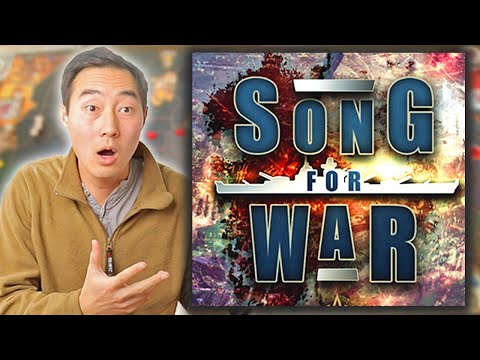

Song for War: Mediterranean Theater box art

Song for War: Mediterranean Theater

Game ID: GID0452468
Game Info
Year
2025
Players
2-4
Age
14+
Playtime
270 min
Collection
Ratings
Creator Score
Mechanic profile
Not enough video data yet
Vibe profile
Not enough video data yet
Description

WWII tabletop wargame where players control German Italian US or British forces to control the Mediterranean with combined land sea and air units

Description

WWII tabletop wargame where players control German Italian US or British forces to control the Mediterranean with combined land sea and air units

Ask a Rules Question
All mentions
Browse transcript mentions, sentiments, pros/cons, mechanics, topics, quotes, and references.
Total mentions: 10
This page: 10
Sentiment: pos 8 · mix 2 · neu 0 · neg 0
Mentions per page
Showing 1–10 of 10
Video AIKsi5fATnY Zilla Blitz Playthrough at 0:02 sentiment: positive
video_pk 86606 · mention_pk 224641
Zilla Blitz - Song for War: Mediterranean Theater video thumbnail
Click to watch at 0:02 · YouTube ↗
Overall sentiment (raw)
positive
Pros
  • Gorgeous maps
  • Engaging combat system with detailed steps
  • Fast-paced feel with momentum
  • Tactical depth through unit interactions and damage types
  • Heroic defensive stand by the British despite initial setbacks
Cons
  • Gameplay rule error identified by the host regarding units not in an active battle space.
  • Cruiser hit cost the Italians dearly.
  • Axis armor was significantly weakened before reaching Tobruk.
Thematic elements
  • World War II
  • Mediterranean theater
Comparison games
none
Mechanics (from transcript analysis)
  • Air Superiority — Clearing the airspace by engaging enemy fighters and anti-aircraft units is a key tactical objective before ground assaults.
  • Combat System — A detailed sequence of seven battle steps is explained, involving different unit types and damage levels (white, gray, black).
  • Combined Operations — The plan involves using air support (bombers, fighters) to soften ground defenses before a ground assault with armor and infantry.
  • Damage Levels and Armor — Units have different armor levels (white, gray, black) and damage types (white, gray, black) that interact, affecting combat outcomes.
  • Dice Rolling — Combat and anti-aircraft effectiveness are determined by dice rolls, with specific target numbers and damage types (white, gray, black).
  • Special Dice Rolls — Rolling a 12 on certain dice indicates double damage or the attacker choosing the target, adding a critical hit element.
  • Transport Units — Light transports are used to move infantry and artillery, enabling them to participate in battles in new locations within the same turn.
  • unit movement — Units have specific movement ranges and can be transported by light transports, allowing for same-turn deployment and participation in battles.
Video topics + discussion points
No key topics recorded for this video.
Quotes (from this video)
  • The sequence of play is the heart of Song for War Mediterranean Theater and it's basically these two columns on the right hand side here we have movement steps and then battle steps.
  • The game has kind of a sweeping fast-paced feel to it with a lot of momentum.
  • Tobruk holds.
References (from this video)
No references stored for this video.
Video WheXbUX6n9g Zilla Blitz Top List at 10:36 sentiment: positive
video_pk 86357 · mention_pk 223120
Zilla Blitz - Song for War: Mediterranean Theater video thumbnail
Click to watch at 10:36 · YouTube ↗
Overall sentiment (raw)
positive
Pros
  • Allows for creativity at operational and strategic levels
  • Sandbox of Mediterranean combat
  • Accessible game of WWII combat
  • Feels like a game made for the reviewer
Cons
  • Not for players seeking strict historical representation
  • Currently only in prototype form, awaiting Kickstarter
Thematic elements
  • Strategic and operational level war game
  • World War II, Mediterranean Theater
Comparison games
none
Mechanics (from transcript analysis)
Mechanics unknown.
Video topics + discussion points
No key topics recorded for this video.
Quotes (from this video)
  • these are the games that I played in 2024 they could have been released in 1978 the games that I enjoyed over the past year.
  • I Define War Games somewhat broadly so some of these games are more conflict simulation than they are necessarily tanks battering against each other.
  • this is I think the best educational game I've played in the past two years.
  • I think that's where a lot of the richness of alliances and deception and kind of the tabl talk would really really level up this game.
  • the mechanics the rules and how to get those two things to work together just all clicked and the game transformed and that magic of the coin experience it was like this epiphany.
  • it's got a nice mix between complexity and accessibility so not as hard as like an advanced squad leader or perhaps a lock and load tactical combat system but but still got a lot of meat to it and good decision making.
  • this game is both simple it matches it molds in Euro Concepts hand management so you're managing your deck of cards messing up your opponent's cards and yet it's got this tactical accessibility and subtlety of depth that gives it really The Best of Both Worlds.
  • this might have been one might very well have been my most singularly enjoyed wargaming experience over the past year.
  • it's a gritty complex tactical combat system that takes a while to play into but there's just so much there and yet once you get it down the gameplay seems to really really flow.
  • the map is one of the most stunning maps in all of War Games.
  • an absolutely beautiful spectacular gameplay experience.
References (from this video)
No references stored for this video.
Video U64ty_5faPc Shelfside Review at 0:15 sentiment: mixed
video_pk 86039 · mention_pk 221810
Shelfside - Song for War: Mediterranean Theater video thumbnail
Click to watch at 0:15 · YouTube ↗
Overall sentiment (raw)
mixed
Pros
  • Insanely thematic World War II gameplay
  • Movement sequence feels intuitive and well-structured
  • Strong combined-arms feel with air/sea/land integration
  • Board visuals and components are visually striking
  • Hidden Fleet mechanic adds tense mind games
  • Sea transports create meaningful long-range movement and strategy
  • Reinforcement and NS cards add strategic choices
Cons
  • Prototype components with quality/design issues
  • Double-sided pieces can flip and unpredictably change stats
  • Insufficient board space leads to stacking and congestion
  • Pieces look similar (e.g., cruisers vs battleships) causing confusion
  • No combat values printed directly on pieces
  • Objective tokens small and inconsistently shaped (Benghazi token particularly small)
  • Rulebook formatting inconsistent and hard to read; edge-case references scattered
  • Reinforcement phase is clunky with heavy calculation and setup
  • Shipping lanes mechanic is visually hard to discern and feels like overhead with modest payoff
  • NS cards sometimes feel out of place and can disrupt core mechanics
  • Setup feels bloated with many components
Thematic elements
  • Combined arms warfare with air/sea/land integration and area control
  • Mediterranean theater, 1943
  • historical, scenario-based strategic warfare with layered reinforcement and hidden fleets
Comparison games
  • Axis & Allies (1941)
  • Quarter Master General: World War II
  • Atlantic Chase
  • Normandy
  • Undaunted North Africa
  • Warhammer
Mechanics (from transcript analysis)
  • Combat: Damage Based — Artillery, battleships, and cruisers have ranges and can contribute to combat without occupying the same space; terrain interacts with range effects.
  • Dice-based combat with unit-specific dice — Units roll different dice (gray/white/black) reflecting strength; each unit can roll at least one die per combat step with special abilities and ranges.
  • Hidden Fleet — Hidden fleet mechanics add tension by keeping some enemy fleets concealed, enabling ambushes and mind games.
  • Multi-stage round and phase order — Each round has four stages (movement/battle, victory check, NS card draw, reinforcement) that structure play and rhythm.
  • NS card-driven upgrades — NS cards allow occasional unit upgrades and faction-specific bonuses, adding a layer of strategic deck-building to reinforcement.
  • Range and bombardment mechanics — Artillery, battleships, and cruisers have ranges and can contribute to combat without occupying the same space; terrain interacts with range effects.
  • Reinforcement phase and NS cards — End-of-round reinforcement phase with National Support (NS) cards that provide bonuses; players draw and purchase NS cards to influence production and deployment.
  • Sea transports and multi-phase movement — Sea transports move across multiple phases and can carry and reposition units, enabling amphibious and extended maneuvers.
  • Sequential movement system — Air, sea, and land phases moved in sequence, with turns felt snappy despite many units.
  • Shipping lanes and production penalties — Control of shipping lanes can penalize opponent production, introducing strategic decisions around supply lines and lane control.
  • Variable Phase Order — Each round has four stages (movement/battle, victory check, NS card draw, reinforcement) that structure play and rhythm.
Video topics + discussion points
No key topics recorded for this video.
Quotes (from this video)
  • insanely thematic World War II gameplay
  • The sequence of play works really well
  • hidden Fleet mechanic which we didn't explain at all
  • this is basically babby's first war game
  • I would give Song for War an 8 out of 10
  • the reinforcement phase... is pretty darn clunky
References (from this video)
No references stored for this video.
Video AAQUihfo5pg Shelfside Discussion at 8:46 sentiment: positive
video_pk 85721 · mention_pk 220339
Shelfside - Song for War: Mediterranean Theater video thumbnail
Click to watch at 8:46 · YouTube ↗
Overall sentiment (raw)
positive
Pros
  • Thematic focus on WWII battles and tactical feel
Cons
  • Promotional content may bias perception
Thematic elements
  • Array
  • World War II theater
  • Tense, tactical combat emphasis
Comparison games
  • Twilight Imperium
  • Monopoly
Mechanics (from transcript analysis)
  • Sequential Movement — The game uses sequential movement across theaters to resolve combat.
Video topics + discussion points
No key topics recorded for this video.
Quotes (from this video)
  • I hate this game.
  • You're dead before me.
  • Your game's a tree.
  • I'll be backstabbing you because you're dead before me.
  • This game called Gaia Project.
  • Monopoly. All right?
  • That John Company second edition, it absolutely positively gets reviewed.
  • Song for War really captures the feeling of a combined arms game.
References (from this video)
No references stored for this video.
Video CTe0QDWvhlc Zilla Blitz Other at 20:17 sentiment: positive
video_pk 85640 · mention_pk 219997
Zilla Blitz - Song for War: Mediterranean Theater video thumbnail
Click to watch at 20:17 · YouTube ↗
Overall sentiment (raw)
positive
Pros
  • Fun game
  • Beautiful art and map
  • High quality production
Cons
none
Thematic elements
  • Mediterranean Theater
  • World War II
Comparison games
none
Mechanics (from transcript analysis)
  • Multiplayer — Playable for two to four players.
  • Operational strategic level — An operational strategic level game.
Video topics + discussion points
No key topics recorded for this video.
Quotes (from this video)
  • It's checking off a lot of boxes for me and that it's solitire, individual man, campaign, strong narrative elements, events.
  • I love to see new games, new companies popping up and see newcomers into the field. It only helps us have more creativity, more innovation, and more people pushing the edge of the design envelope.
  • This is a new and interesting direction for them.
  • This is a lot of fun. I think it's going to spin great narratives.
  • My understanding of World War I combat of course listening to him went up through the roof.
  • And this game focuses on the reconnaissance at Verdon as the part of the combat.
  • Warfare traditionally was a situation especially as you go farther back in time where you didn't have anywhere close to full information and getting that information and what you did with that information and analyzing that information and making decisions on incomplete information was such a huge part of warfare that really hasn't been captured in a lot of our modern wargaming experience.
References (from this video)
No references stored for this video.
Video tf82yICHdZ8 Zilla Blitz Top List at 20:25 sentiment: positive
video_pk 83249 · mention_pk 209397
Zilla Blitz - Song for War: Mediterranean Theater video thumbnail
Click to watch at 20:25 · YouTube ↗
Overall sentiment (raw)
Extremely positive
Pros
  • Sandbox experience of Mediterranean combat
  • Strategic level gameplay
  • High replayability with many directions to take
  • Works well with 4 players in a cooperative setting
  • Variety in unit building
  • Creative and fun
  • More depth than Axis and Allies
  • Full wargame experience
Cons
  • First Kickstarter failed, second one succeeded after modifications.
Thematic elements
  • Mediterranean Combat
  • World War II
Comparison games
  • Axis and Allies
Mechanics (from transcript analysis)
  • cooperative play — two to four player game. Four players works great because you've got two side, two axis sides, two allied sides, and you're going to be trying to work together to best accomplish your goals.
  • sandbox gameplay — Think of a sandbox of Mediterranean combat.
  • Strategic Wargame — strategic level combat in World War II.
  • Unit Customization/Building — you've got different types of units that you can build, special units that you can build that are going to show up in some games that aren't going to show up in others.
Video topics + discussion points
No key topics recorded for this video.
Quotes (from this video)
  • This looks like it could be a fastplaying, light, fun game about flying B7 flying fortresses in World War II.
  • This looks like it takes a game that is incredibly highly regarded in its earlier editions, rethinks it, reimagines it, adds a lot of gameplay, redesigns it, and publishes as publishes it as a designer edition.
  • It is so creative and since the last time I've looked at it, I've noticed they've added bot logic cards and its soliter rating is a full high.
  • I think what is almost an ideal balance between
  • This could be the greatest game ever if it works, right? Who knows? But I can't wait to try it. Lightning Strikes from Compass Games.
  • I think this could be one of the best war games of all time.
  • My number one most anticipated game for 2026. specific chase.
  • Pacific Chase air naval combat in World War II.
  • My number one game for 2026, Pacific Chase from GMT Games.
  • So, there we have it. my top 30 most anticipated war games for 2026.
References (from this video)
No references stored for this video.
Video hUXDwfjMC2k Zilla Blitz Discussion at 9:04 sentiment: positive
video_pk 38326 · mention_pk 115387
Zilla Blitz - Song for War: Mediterranean Theater video thumbnail
Click to watch at 9:04 · YouTube ↗
Overall sentiment (raw)
positive
Pros
  • replayability
  • thematic depth in Med theater
Cons
none
Thematic elements
  • sandbox, multiplayer live play
  • Mediterranean WWII theater
  • group-focused, highly strategic
Comparison games
  • Fields of Fire Deluxe
  • Dunkirk campaigns
Mechanics (from transcript analysis)
  • 4-player live on board — coordination across a larger group
  • sandbox-style play — open-ended strategic play with many hypotheticals
Video topics + discussion points
No key topics recorded for this video.
Quotes (from this video)
  • this sounds like a lot of fun
  • this is going to be marvelous
  • I can't wait to get a group of people over to play the whole Mediterranean theater
  • this looks really, really good
References (from this video)
No references stored for this video.
Video hI_wUNwQfRI Zilla Blitz Review at 0:02 sentiment: positive
video_pk 36335 · mention_pk 108886
Zilla Blitz - Song for War: Mediterranean Theater video thumbnail
Click to watch at 0:02 · YouTube ↗
Overall sentiment (raw)
positive
Pros
  • Creative sandbox that allows varied, ahistorical play
  • Compelling two-level strategic/operational planning
  • Excellent map and production value
  • Strong player aids and rule design that aid learning
  • High replayability in larger scenarios due to unit cards and national support tokens
Cons
  • Dice luck can undermine perfect planning
  • Steep learning curve for units, sequence of play, and some rules
  • Desire for even smaller, quick-start scenarios
Thematic elements
  • ahistorical sandbox warfare allowing players to deviate from real history
  • Mediterranean Theater, World War II
  • hypothetical/loosely historical
Comparison games
  • Axis & Allies
Mechanics (from transcript analysis)
  • asymmetrical factions and multi-player modes — Allies vs Axis with 2- or 4-player configurations and one-to-one or mixed side control
  • Combat: Dice — Combat uses dice, introducing luck and variability to planned operations
  • Dice-driven combat — Combat uses dice, introducing luck and variability to planned operations
  • Multi-Use Cards — National support tokens and upgrade/unit cards grant diverse options each turn
  • national support cards and unique units — National support tokens and upgrade/unit cards grant diverse options each turn
  • scenario-based replayability — Four scenarios with larger strategic scope and smaller rapid-play variants
  • two-level gameplay — Strategic (large-scale, map-wide) decisions and operational (short-term, sequence-based) planning
Video topics + discussion points
No key topics recorded for this video.
Quotes (from this video)
  • Yes unequivocally I do like it
  • Sandbox of gameplay
  • Loosely tied to history
  • not Axis and Allies clone
  • the map is absolutely fabulous
  • I would say a three and a half out of 10 [complexity]
  • replayability especially in those larger scenarios
References (from this video)
No references stored for this video.
Video 18W1no9Ti14 Invictor Rex Discussion at 0:00 sentiment: mixed
video_pk 31171 · mention_pk 91913
Invictor Rex - Song for War: Mediterranean Theater video thumbnail
Click to watch at 0:00 · YouTube ↗
Overall sentiment (raw)
mixed
Pros
  • deep, multi-layered gameplay with strong asymmetry
  • highly thematic maps and sturdy components
  • relatively fast combat resolution for a complex, multi-domain system
  • high replayability through multiple scenarios and card-based asymmetry
  • fog-of-war flavor created by hidden fleets and hidden deployment
Cons
  • solo play and hidden fleet mechanics can be difficult to simulate convincingly
  • prototype components may still evolve before final production
  • considerable learning curve due to substantial unit stats, upgrade rules, and sequence complexity
  • not a strict historical simulator; focuses on gameplay and scenario design
Thematic elements
  • combined arms warfare with asymmetry, supply dynamics, and hidden information
  • Mediterranean theater, World War II, strategic operational level
  • historical inspiration with a strong emphasis on gameplay over strict simulation
Comparison games
  • Axis & Allies
Mechanics (from transcript analysis)
  • Asymmetrical deck — A deck of cards unique to each side that introduces asymmetric events, units, and capabilities, boosting replayability
  • Hidden Deployment — Secret or partially hidden unit deployment and reconnaissance that drive strategic planning and risk assessment
  • Hidden Victory Points — Victory point tiles track strategic objectives; changing VP tiles can trigger automatic wins and guide aggression
  • Multi-domain combat — Air, sea, and land units interact with distinct stats, armor, and hit powers to resolve engagements
  • National support tokens — A currency-like mechanic that upgrades units or unlocks nation-specific abilities, injecting asymmetry and strategic choice
  • Objective-based victory points — Victory point tiles track strategic objectives; changing VP tiles can trigger automatic wins and guide aggression
  • Supply lines and mobile hubs — Dynamic supply network mechanics reflecting the North African campaign with supply hubs that shift in value and influence
Video topics + discussion points
No key topics recorded for this video.
Quotes (from this video)
  • it's coming back to Kickstarter in early 2025
  • maps are absolutely stellar
  • I wouldn't call this a historical simulation
  • the action really cranks up fast
  • I'd probably give this game a six
References (from this video)
No references stored for this video.
Video 7yR9B2fi45k Zilla Blitz Interview at 0:00 sentiment: positive
video_pk 28612 · mention_pk 83887
Zilla Blitz - Song for War: Mediterranean Theater video thumbnail
Click to watch at 0:00 · YouTube ↗
Overall sentiment (raw)
positive
Pros
  • deep decision space and high replayability
  • fast-starting, action-oriented play from turn one
  • strong collaborative gameplay that mirrors wartime teamwork
  • asymmetrical units with unique abilities and counterplay
  • multiple scenarios plus short quick-play offerings for shorter sessions
  • hidden fleets and fog of war add meaningful tension
Cons
  • long play times for the full theater-scale experience
  • high component count and setup requirements
  • steep learning curve due to many rules nuances and upgrade options
  • balancing cards and upgrades to avoid overpowered combinations
Thematic elements
  • collaborative, multi-national grand strategy with alternate-history potential
  • World War II Mediterranean theater (Gibraltar through Greece, North Africa to Italy, Balkans auxiliary routes)
  • historical sandbox with hypothetical, player-driven outcomes
Comparison games
  • Twilight Imperium
  • War of the Ring
  • Conquest of the Empire
  • Fortress America
  • Axis & Allies
  • Access and Allies
Mechanics (from transcript analysis)
  • card-driven actions (strategy cards) — a national support phase with cards to upgrade units, trigger events, or shift strategic momentum.
  • cooperative play with teaming — Allied players coordinate with each other (and Axis players) to achieve shared objectives.
  • fog of war & hidden fleets — informational uncertainty and hidden fleets create tension and strategic decision points.
  • Hidden Deployment — informational uncertainty and hidden fleets create tension and strategic decision points.
  • real-time resupply — units can be resupplied and redeployed across the map as play progresses.
  • Scenario / Mission / Campaign Game — four distinct scenarios with varying maps, times, and objectives.
  • scenario-based design — four distinct scenarios with varying maps, times, and objectives.
  • Tech Trees — each unit has unique upgrade paths and tech options that influence capabilities and strategy.
  • unit upgrades / technology tree — each unit has unique upgrade paths and tech options that influence capabilities and strategy.
  • unit-based movement — movement is unit-centric rather than nation-centric, with three to four-step planning ahead.
Video topics + discussion points
No key topics recorded for this video.
Quotes (from this video)
  • this game kind of favors aggression
  • it's fast-paced
  • this game is deep but it's not necessarily complex
  • the action start right away
  • open-ended sandbox in terms of how you want to prosecute sort of you know the war
  • there's a ton of depth and replayability
  • collaborative sort of conspiring nature that's going on about how you want to work together
References (from this video)
No references stored for this video.
Transcript Navigation
Top
Showing 1–10 of 10
Game Deep Dive