





Under Our Sun Deep Dive
What the Community Thinks About Under Our Sun
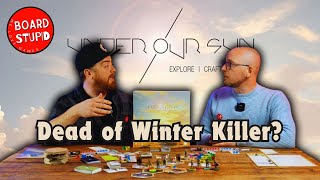
Under Our Sun has made a remarkable first impression on board game reviewers at Board Stupid, who have played it extensively across multiple sessions at major conventions and at home. The game presents itself as a survival adventure in a post-apocalyptic world where resources are scarce, danger is constant, and trust among teammates is never guaranteed. What reviewers consistently emphasize is not just the mechanical competence of the design, but its relentless thematic cohesion. Every system, from action points to weather effects, reinforces the sensation of being a desperate survivor in a hostile environment. The game is frequently compared to Dead of Winter, Robinson Crusoe, and This War of Mine, though reviewers argue Under Our Sun distinguishes itself through a more tightly designed economy and a crafting system that sits at the absolute core of survival strategy.
Core Mechanics That Define Under Our Sun
Action Points and Resource Economy
At its mechanical heart, Under Our Sun employs an action point system that controls every meaningful decision players can make. Each round, players receive up to six action points to spend across morning, afternoon, and night phases. Moving between tiles costs action points based on terrain. Drinking water costs one action point. Eating food costs one action point. Trading with allies costs one action point. Attacking enemies costs one action point. This rigid economy creates constant tension, as players must weigh survival needs against mission objectives. Reviewers note that this "old school" action point approach feels surprisingly fresh because everything flows naturally from the survival theme. You are not spending points on abstract activities; you are rationing energy as a starving person would. Thirst and hunger are not flavor text; they are mechanical governors on your capacity to act. Sleep becomes mandatory or you lose action points the next day. The elegance lies in how the system teaches through consequence rather than rulebook. First-time players often fail to prioritize correctly and run out of energy before completing goals, but this creates memorable lessons rather than frustration.
Crafting as Non-Optional Survival
Perhaps the most innovative aspect of Under Our Sun is how it treats crafting as a central pillar rather than an optional subsystem. Board Stupid reviewers emphasized repeatedly that this is genuinely different from games like Nemesis, where crafting can be safely ignored, or Fallout, where it feels decorative. In Under Our Sun, if you do not craft properly, you will not survive. The game provides a detailed crafting menu listing dozens of possible items, each requiring specific combinations of materials gathered from exploration. You can craft medical kits, rope for faster movement, antibiotics, weapons, ammunition, and crucially, sunscreen to protect against the brutal weather. The eight types of resource cubes (water, food, iron, wood, plastic, and others) must be actively converted into survival tools. Reviewers describe the crafting system as "a cheat sheet for surviving the apocalyptic wasteland." The innovation is psychological: rather than checking boxes on a predetermined path, you must make genuine strategic decisions about which items to prioritize. Water? Food? Weapons? Shelter? Each choice has consequences that ripple across future turns. This creates a planning layer absent from many survival games, elevating the experience beyond simple resource collection.
The Under Our Sun Experience
Post-Apocalyptic Tension as Mechanical Expression
Under Our Sun uses game systems to create an atmosphere of relentless scarcity and danger. The sun itself is a mechanical antagonist: each morning and afternoon, players draw a weather card that determines conditions for that phase. A mild day offers no penalty. A heat wave forces all players to drink extra water, straining already-limited supplies. A sandstorm reduces action points available to everyone. A solar storm deals direct damage to all characters. This weather system reinforces the game's central narrative without needing cutscenes or flavor text. You feel the sun threatening you because it mechanically threatens you. Night brings an entirely different danger. After sunset, every action becomes perilous. Drawing from the night deck when players explore or act is always bad and sometimes catastrophic. Enemies are more dangerous at night. Panic attacks strike without warning. Tents can catch fire. Most critically, players must spend precious action points sleeping, or they start the next day exhausted and limited. The genius of this design is that panic and caution feel earned by the game state, not imposed by arbitrary rules. You are not paranoid because the rulebook says to be; you are paranoid because every night something terrible happens.
Traitor Suspicion and Semi-Cooperative Doubt
The optional traitor element amplifies tension by introducing social gameplay to the survival struggle. At the start of a game, players can draw traitor cards. Some games, everyone is cooperative. Other games, one or more players hold a secret agenda that conflicts with the team's goals. The traitor might need to sabotage the mission, steal resources, or eliminate specific characters. Because players never know if a traitor is present, suspicion becomes a form of psychological warfare. When one player hoards water, is it selfish survival instinct or traitor sabotage? When someone suggests exploring a dangerous tile, are they advancing the mission or setting allies up to die? Board Stupid reviewers emphasize that this mechanic "changes everything" not by changing the rules, but by inverting trust assumptions. Even in fully cooperative games, players begin second-guessing decisions because they remember traitor-mode exists. However, reviewers strongly caution that traitor mode should only be attempted after several cooperative plays. The game is already difficult at maximum cooperation; adding hidden goals creates a complexity ceiling that requires genuine mastery to navigate.
What Makes Under Our Sun Stand Out
Phenomenal Thematic Integration
Board Stupid reviewers return repeatedly to one observation: Under Our Sun is phenomenally thematic without being thematic for theme's sake. Designer Max described spending eight years developing the game, dreaming about how it should feel. That investment shows in how every subsystem reinforce the core fantasy. The modular hexagonal board means exploration always feels different. The crafting menu connects directly to survival needs. Combat uses custom dice with color-coded strengths. Karma dice allow small mitigation but cannot eliminate risk. The night deck's creatures are actual mutants born of radiation, not generic obstacles. Weather effects are named and specific (sandstorm, heat, solar flare, mild chill). This cohesion creates a unified experience where mechanics and story are inseparable. You are not playing a game that happens to have a post-apocalyptic setting; you are playing a game whose entire purpose is to simulate desperate survival.
Modular Replayability Despite Limited Scenarios
The base game includes seven scenarios, which might seem limiting. However, reviewers note that scenario replayability is exceptional because the modular board and random tile placement ensure each game feels genuinely different. Even with identical mission goals, the tiles you discover, enemies you encounter, resources you find, and weather patterns you face will vary dramatically. An expansion of scenario cards is already planned, allowing indefinite growth of the mission library. This modular approach proves more elegant than infinite procedural generation, giving each scenario intentional design while maintaining high variation.
Potential Drawbacks
Learning Curve and Rule Interactions
Under Our Sun is positioned at the advanced end of complexity, approaching expert territory. The core action point and crafting systems are clean, but numerous special rules govern specific scenarios, tile interactions, and edge cases. Reviewers report that the first few plays require frequent rulebook consultation. The designers themselves acknowledged this by preparing a version 2.0 rulebook with expanded FAQs addressing scenario-specific interactions. This is not a flaw per se, but it means the game requires patient teaching and table acceptance of occasional rules arbitration. Groups that enjoy crunchier, highly simulated systems will embrace this; casual players may find it burdensome.
Suboptimal at Higher Player Counts
While the game supports two to four players (up to six with expansions), reviewers strongly prefer two-player cooperative sessions. At four players, downtime between turns becomes noticeable, reducing engagement. The simultaneous resolution systems help mitigate this, but the game's tense, intimate feel works best with fewer people making joint decisions. If playing with four, reviewers suggest ensuring your group thrives on tactical discussion and does not mind extended deliberation.
If You Enjoy Under Our Sun
Under Our Sun appeals directly to fans of survival games where resources matter and failure is possible. Dead of Winter fans will recognize the exploration and semi-cooperative structure, though Under Our Sun streamlines setup and execution significantly. Robinson Crusoe players will appreciate the modular board and action economy. Those who love This War of Mine or Fallout Board Game will find kindred thematic spirit, though Under Our Sun leans more mechanical than narrative-driven. Nemesis enthusiasts should note that while both feature dangerous enemies and asymmetric threats, Under Our Sun is considerably more forgiving and accessible. For players seeking a cooperative adventure game that punishes poor planning but rewards smart crafting and teamwork, Under Our Sun delivers a tightly designed, thematically coherent experience from indie designers who spent years perfecting their vision.
What Reviewers Are Saying
"This mechanic does not change anything in a game, but it changes everything in the game because all your decision then suddenly are doubted by the group, because might have a traiter amongst you, but then you might not, so and that that sort of sense of unease and uncertainty always makes you question what people are doing."
— Max (Designer), Board Stupid
"It's the first game that I feel, or at least that I play, where the crafting element is at the center of the entire system, and it's not just uh something added or something oh cool I can do that. No no, this is you need to do it."
— Matt, Board Stupid
"It's the new dead of winter to me, is the, it's that kind of game. It's that game. It's that um has that exploration element as well. And uh the crisis management and and all that kind of things, uh, with the uh you can have the traitor mode."
— Board Stupid