







The Finest Fish Deep Dive
What the Community Thinks About The Finest Fish
The Finest Fish has earned consistent admiration from board game reviewers for being a rare blend of accessibility, visual beauty, and elegant mechanical design. Reviewers unanimously celebrate the game's streamlined approach to pattern-building gameplay without sacrificing depth or visual satisfaction. The consensus across Board Game Sanctuary, Stonemaier Games, and Getting Games points to a game that succeeds precisely because it knows what it is: a pattern-placement experience that respects the player's time while delivering a gorgeous table presence. Some reviewers note their immediate visceral reaction to the game's components, with Getting Games remarking that the carefully crafted aesthetic alone would draw players in at any game night. The accessibility mixed with genuine satisfaction creates a rare sweet spot that appeals to both casual family players and experienced hobbyists looking for something fresh.
Core Mechanics That Define The Finest Fish
Resource Management Through Scale Drafting
At the heart of The Finest Fish lies a elegantly constrained resource management system. Players acquire scales through drafting piles of three, with each choice directly impacting their ability to complete patterns or purchase objectives. Board Game Sanctuary emphasizes that this system creates meaningful tension: players can spend scales to buy objective cards that score three points each, but doing so means fewer scales available for placement on their fish. The scarcity ensures that every allocation forecloses other strategic options, creating the kind of decision-making that elevates a simple mechanic into something engaging. This constraint feels organic to the theme rather than arbitrary, as players genuinely deliberate between completing their current patterns or investing in future scoring opportunities.
Pattern Placement and Collaborative Market
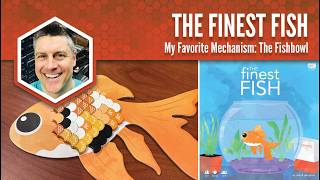
The second pillar of The Finest Fish involves placing those acquired scales onto a dual-layered goldfish board in patterns that match secret objective cards. Players arrange colorful scales using adjacency rules, with points awarded for completed patterns and for contiguous groups of three or more same-colored scales. What distinguishes this from similar tile-placement games is the fishbowl trading mechanic described by Board Game Sanctuary. When players take scales, they can swap one with whatever sits in the shared fishbowl, creating a dynamic where rejected scales become opportunities for opponents. This elegant secondary market ensures that no resource is truly wasted and that player interaction extends beyond simple turn sequencing into genuine economic strategy.
The The Finest Fish Experience
Streamlined Elegance
Reviewers consistently return to a single phrase about The Finest Fish: streamlined yet satisfying. Stonemaier Games articulates this observation most directly, noting that among the nature-themed games played at Geekway to the West, The Finest Fish felt "the most streamlined of all these games that I played, but also I thought the most satisfying mechanically and visually." What makes this observation significant is that streamlined does not mean shallow. Players manage resources, plan patterns, and adapt to the cards available, but none of this requires extensive calculation or alpha analysis. The game respects the table's time while delivering genuine decision-making, which creates a cadence that feels satisfying rather than rushed.
Visual Satisfaction and Tactile Pleasure
The second defining experience is the sheer visual and tactile satisfaction of building a goldfish. The wooden scale tokens in various colors slot onto a recessed dual-layer board, and as players contribute their work across multiple rounds, each fish transforms into a unique composition of colors and patterns. Board Game Sanctuary describes the component quality with appreciation, noting that the thick wooden scales offer genuine tactile feedback that card-based alternatives cannot match. Getting Games takes this further, articulating that the aesthetic appeal alone creates a stopping power at the table, where onlookers would pause mid-conversation to ask how the game works simply by observing the beautiful fish taking shape. This visual narrative arc, where an empty board gradually transforms into a finished work, provides intrinsic satisfaction beyond the scoring track.
What Makes The Finest Fish Stand Out
Remarkable Component Quality and Presentation
The Finest Fish's most obvious differentiator is the quality and thematic integration of its components. Last Night Games invested in thick wooden scale tokens with varied colors and patterns that catch light beautifully on the table. The dual-layered board creates physical recesses where scales naturally nestle, preventing the fiddly sliding that can plague other placement games. The presentation immediately signals that this is a game designed with care, and reviewers note that this attention extends to the entire package: the ruleset is digestible, the component organization is logical, and the overall experience feels polished. While Board Game Sanctuary notes a minor quibble about scale size, the consensus celebrates the tactile and visual integration as something that enhances rather than distracts from gameplay.
Accessibility Without Compromise
The Finest Fish achieves something increasingly rare: genuine accessibility for new players without reducing depth for experienced ones. The core rules can be taught in minutes, yet the decision space remains meaningful across plays. Reviewers from diverse backgrounds all highlight the game's ease of teaching as a strength, with the Unknown Channel reviewer specifically praising that "it is easy to teach, easy to get to the table. There's pattern building, it looks cool, it's really fun, and the presentation is amazing." This combination of quick teachability and genuine strategic depth creates a game that functions equally well at a casual game night or among players seeking lighter competition. The pattern-completion objectives add replayability without requiring expansions or complex variants to unlock different experiences.
Potential Drawbacks
Component Scale and Physical Manipulation
Board Game Sanctuary raises one practical concern that deserves attention: the scale tokens, while beautiful and chunky, occasionally present fiddly placement challenges. Fingers large enough to handle the scales confidently can sometimes struggle with precise positioning in the recessed board, particularly when trying to achieve adjacent placements in tight areas. This is not a deal-breaker for most players, but it represents a minor friction point that occasionally interrupts the otherwise smooth flow of turns. Players with fine motor considerations or those seeking absolutely frictionless component interaction might occasionally wish for slightly more generous spacing or larger tokens, though the trade-off against the game's elegant overall footprint is intentional on the designer's part.
Limited Strategic Depth for Experienced Strategists
While The Finest Fish excels at accessibility, some players who prioritize heavy strategic analysis may find themselves through with the decision-making space after a few plays. The game's elegance comes partly from its focus on elegant constraints rather than layered systemic complexity. Reviewers do not position this as a negative, but rather note that the game is designed for different goals than deep Euro-style play. The satisfaction comes from beautiful execution and pattern completion rather than elaborate resource conversion chains or devastating combos. Players seeking those experiences are better served by more ambitious designs, though The Finest Fish's streamlined nature is intentional and arguably successful rather than a limitation.
If You Enjoy The Finest Fish
The Finest Fish draws natural comparisons to pattern-building games that reward careful placement and visual composition. Reviewers frequently mention Sagrada when discussing pattern mechanics, and players who found satisfaction in arranging colored glass pieces will find familiar pleasure in The Finest Fish's scale placement. Getting Games notes that the game occupies the middle space among nature-themed tableau games like Habitats and Shallow Sea, offering better visual payoff than many and more streamlined gameplay than some. The comparison games mentioned in community discussion include Panda Royale from the same publisher, Last Night Games, which shares the accessible-but-satisfying philosophy, alongside lighter spatial-reasoning games like Cascadia for those seeking similar puzzle satisfaction. Players drawn to Sagrada's blend of pattern completion and resource scarcity, or to games where the visual end-state matters as much as the scoring track, will find The Finest Fish delivers that exact experience with its own elegant voice.
What Reviewers Are Saying
"I like this game because it is easy to teach, easy to get to the table. There's pattern building, it looks cool, it's really fun, and the presentation is amazing."
— Watch Review
"The really cool part of this game is that you can actually take scales off your fish to spend them, you can then place scales into this fishbowl which other players can then use on their turn so there is that kind of like cool trading system that happens here."
— Board Game Sanctuary
"It was the most streamlined of all these games that I played, but also I thought the most satisfying mechanically and visually. And it just ends up looking really beautiful, like a beautiful goldfish with different scales."
— Stonemaier Games