















Satchel Quest Deep Dive
What the Community Thinks About Satchel Quest
Satchel Quest has emerged as one of the most anticipated games among content creators and reviewers across multiple channels and platforms. The consensus centers on its fresh take on bag-building mechanics, combining the pull-of-the-bag excitement with genuine spatial puzzle-solving. Reviewers consistently praise how the game manages to feel both accessible and intellectually engaging, offering something genuinely new to a beloved mechanic rather than recycling familiar ground. The game appears poised to appeal to both bag-building enthusiasts and players who want more agency within randomness.
Core Mechanics That Define Satchel Quest
Bag Building with Double-Sided Tokens
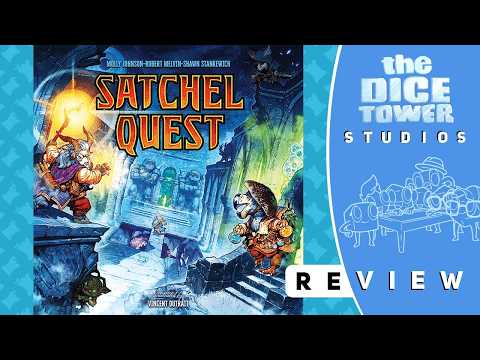
At its heart, Satchel Quest centers on the bag-building mechanic that has delighted players in games like Quacks of Quedlinburg. Players accumulate tokens into their personal bags and draw them over the course of five rounds. The crucial innovation is that every token is double-sided. When you draw a token during the dungeon phase, you immediately make a decision about which side to play. This simple addition fundamentally transforms the experience from pure luck into a skill-based puzzle. Rather than hoping for the right chip, players face a meaningful choice every single time they draw. As one reviewer noted about this mechanic, "by pulling out chips, you inherently always have a decision, which is a really neat take on that." The designer team of Molly Johnson, Robert Melvin, and Sean Senovich have used this mechanism to add genuine agency within the randomness of the bag pull.
Spatial Dungeon Puzzle
The second defining mechanic is the spatial puzzle of arranging those tokens into a dungeon grid. As you descend through dungeon depths, you place your drawn tokens into rows of the dungeon map. Each placement matters because monsters, treasures, and other features respond to adjacency and positioning. You need weapons to attack monsters in the correct attack patterns, shields and armor to defend from different threat ranges, and you must manage potions and artifacts. The puzzle becomes: given what you pulled, how should you arrange it? Do you push your luck to get the perfect arrangement, or do you settle for what you can build? Reviewers emphasized that this elevates Satchel Quest beyond a simple bag-and-hope experience into something with real spatial decision-making.
The Satchel Quest Experience
Puzzle Over Chance
While many bag-building games center on the tension of pushing your luck, Satchel Quest leans harder into the satisfaction of solving a spatial puzzle. Yes, there is randomness in what tokens you draw, but once drawn, the puzzle is yours to solve. Reviewers describe it as combining the thrill of dungeon crawling with the craft of carefully arranging pieces. The experience feels methodical and thoughtful rather than purely dependent on fortune. You are not passively hoping the bag works out; you are actively shaping your luck through placement decisions.
Progression and Growth
The game unfolds across five rounds, and each round offers chances to grow stronger. Heroes level up by spending experience, unlocking new skills that offer powerful effects. The feeling is one of gradual empowerment, where early rounds teach the basics and later rounds reward smart skill selections. Players describe wanting to return to the game to try different skill paths and see how asymmetric heroes tackle the same challenges differently.
What Makes Satchel Quest Stand Out
Accessible Depth for Bag-Building Fans
Reviewers note that Satchel Quest takes a beloved mechanic and adds genuine innovation without overcomplicating it. One enthusiast on Grant's Gamerecks described it as potentially "the next step beyond Quacks," acknowledging the established great game while positioning Satchel Quest as evolution rather than repetition. The game appears to hit a sweet spot: bag building is present and satisfying, but the addition of the spatial puzzle gives players a reason to care about the outcome beyond dumb luck.
Beautiful Presentation and Asymmetry
Multiple reviewers commented on the striking artwork from Vincent Duty, describing it as among the first things that drew them to the game. Beyond aesthetics, reviewers were equally enthusiastic about the asymmetric hero design and multiple adventure paths. These elements promise significant replayability. Different heroes have different starting satchels and skill trees, and the game ships with four standard adventure paths to choose from. The design team's pedigree (Molly Johnson, Robert Melvin, and Sean Senovich, all previously associated with well-regarded games) gives players confidence that this variety is meaningful rather than shallow.
Potential Drawbacks
Spatial Puzzle Complexity
The dungeon grid spatial puzzle, while praised as innovative, may not be for everyone. Reviewers noted that the puzzle layer adds decision space, which some players love and others find overwhelming. Those accustomed to more streamlined bag builders where you simply pull and resolve might find the placement phase requires more table time and consideration. Teach time appears to be moderate, and reviewers recommend the included adventure paths which gradually introduce rules, but newcomers should expect to think carefully about placement.
Roguelike Difficulty and Scaling
The game is described as roguelike bag building, meaning difficulty escalates as you descend deeper. While reviewers appreciate this scaling, they also acknowledge that bad luck with token draws combined with spatial mistakes can create challenging situations where progress stalls. The game promises solo and multiplayer variants, so difficulty tuning across these modes would be worth trying before committing to a particular path.
If You Enjoy Satchel Quest
If Satchel Quest resonates with you, consider exploring Quacks of Quedlinburg for the pure bag-building experience, Wonderlands War for another innovative take on randomness-meets-agency, and Nana for a streamlined card game that also rewards tight decision-making. Each offers a different flavor of the "meaningful choice within randomness" promise that makes Satchel Quest compelling.
What Reviewers Are Saying
"I love bag building. I just love those exciting moments in games where I've done all the planning I can do, but at some point I just got to pull it. Hope it works out for me. I love that tension, that unknown, that excitement. And Satchel Quest is a bag building game, but maybe more of a puzzly one than we have seen before because it's kind of a dungeon crawl game, but you are pulling tokens from your bag. They are double-sided. You're going to decide how to play them, and you're going to add them into a grid, your dungeon grid in front of you."
— Grant Lyon
"The chips are double-sided. And so by pulling out chips, you inherently always have a decision, which I think is a really neat take on that. You get some agency, but it still gives you the randomness."
— Rahdo Runs Through
"This is players take on the role of adventures in a roguelike bag puzzle game. So, a bag building game, but a puzzle game. And with this design team, I am just really excited about this. And it's going to be good. It better be good or else I'll be so disappointed if it's not good. It sounds like it has all the, you know, all the ingredients to be pretty, pretty darn cool."
— Ryan and Bethany Board Game Reviews