




Mountains out of Molehills Deep Dive
What the Community Thinks About Mountains out of Molehills
Mountains out of Molehills has earned consistent praise from reviewers for delivering a light yet engaging experience that punches above its weight class. The game's primary appeal lies in its charming presentation and clever mechanical balance. Watch It Played's coverage showcases the game's accessibility, while kovray emphasizes its versatility across player counts, noting that it scales beautifully from intimate two-player matches to chaotic four-player affairs. Meeple University highlights the game as a standout in a relatively underserved genre, and Meeple Mountain praises its thoughtful design philosophy. Where reviewers diverge is on player count preference. Some find the tighter 2-player board restrictive, while others appreciate how higher player counts amplify the strategic chaos. The consensus, however, is universal: Mountains out of Molehills is an intentional, well-balanced experience that respects the player's time and delivers laughs alongside genuine strategic moments.
Core Mechanics That Define Mountains out of Molehills
Card Drafting and Action Programming
Each round begins with drafting. Players take turns selecting movement cards from a common pool until everyone has four cards. The clever twist comes next, in the planning phase: players must secretly arrange these cards in the order they will resolve them, then lock in their sequence. They cannot change or even look at the order once set. This creates the heart of the game's tension. When resolution begins, players reveal cards one at a time and move their moles accordingly. Because moles cannot see underground, a detail the theme delightfully leans into, players are planning blind, hoping your neighbors will not interfere with your path. If another mole blocks you, you stop. If you hit the edge of the board, you stop. If you trigger a rock placed by an opponent, you spin in a random direction. This unpredictability transforms a game that could be purely tactical into one where adaptation and humor coexist. The Op, the publisher, has crafted card variety to ensure each draft feels fresh, from simple movement cards to rocks and special topple abilities.
Area Control Through Tower Dominance
As moles move through the underground spaces, they push dirt upward, building molehills on the surface. When multiple pieces stack in a single location, they form towers. Control of each tower is determined by who placed the piece at the very bottom. This means a tower can be stolen from you if another mole builds atop it, since only the bottom piece matters for scoring. At the end of each round, you score one victory point for every piece in each tower you control. This creates a constantly shifting landscape of power. Early towers you thought were secure can be claimed by opponents who strategically place pieces beneath your original placement. It also opens up defensive play: if an opponent is building toward a huge, high-value tower, you can often topple it (intentionally or through the natural flow of play), scattering their pieces and potentially losing them off the board entirely. The mechanic rewards both bold conquest and careful disruption.
The Mountains out of Molehills Experience
Playful Chaos and Delightful Disruption
The game thrives on the collision between careful planning and inevitable chaos. Every round, at least one player's best-laid plans will crumble because another mole wandered into their path or a rock redirected them entirely. Rather than feeling punishing, these moments land as comedic beats at the table. The theme reinforces this perfectly: moles cannot see well underground, so of course their plans go awry. Reviewers repeatedly mention laughter and fun emerging from these disruptions. The rock mechanic is a case in point. When you play a rock card, you place an obstacle on the board that will spin any mole who hits it in a random direction. The resulting chaos can be delightful or devastating depending on whose mole gets spun, but it always generates table conversation. This is a game designed to entertain as much as to strategize.
Satisfying Territory Control and Come-from-Behind Victories
Beneath the chaos lies a satisfying economic game of territory and timing. Claiming towers and growing them into mountains gives genuine satisfaction. The toppling mechanic, while chaotic, also rewards planning. If you can predict where pieces will fall when a tower tips, you can sometimes gain control of multiple towers in a single cascade. The increasing height limits across six rounds also create a natural come-back mechanic for players who fall behind early. Rounds one through three cap towers at two, three, and three pieces respectively. Rounds four through six allow four, four, and five pieces. This gradual increase means that small mountains you started controlling can become valuable lategame assets, and it gives trailing players more opportunities to catch up. This scaling keeps the game competitive throughout, preventing any single player from running away with the victory.
What Makes Mountains out of Molehills Stand Out
Delightful Theme Execution and Charming Component Design
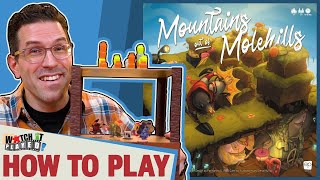
Mountains out of Molehills could be a forgettable card-and-cube game, but instead it is infused with personality from opening the box. The four moles are named Loma, Clay, Sandy, and Pete, each with a short backstory printed in the rulebook. Sandy works with rough terrain, Pete is an inventor with robotic equipment strapped to his back. This is not idle window dressing; reviewers noticed it immediately and appreciated how these touches made the game feel like an intentional design rather than a formula. The 3D board is the real star of the show. The molehill pieces stack up from an underground board (the bottom of the game box) to an above-ground board placed on top, creating a literal three-dimensional landscape. This visual spectacle draws observers in. Multiple reviewers noted that just seeing the game set up at a table is enough to make passersby curious. The Op has weaponized the box itself as part of the play experience, using it as the underground layer rather than packaging it separately. This is thoughtful design that says the publisher cares about how the game feels to own and play.
Precise Mechanical Balance and Elegant Scaling
The game scales gracefully across player counts, with the board literally changing size depending on how many people are playing. A 4-by-4 grid for two players, a 5-by-5 for three, and a 6-by-6 for four ensures the playing space remains relevant to the group. The card economy is designed so that each draft and shuffle feels different. Because cards are shuffled and dealt randomly each round rather than cycling through a fixed deck, every game develops its own card economy. One round might have an abundance of movement cards; another might flood the table with obstacles. This prevents the game from becoming rote. The mountains also scale by round. Starting at a maximum height of two, allowing just one layer of stacking, the limit increases each round until round six tops out at five pieces. This serves as an elegant tutorial, letting new players experience smaller, cleaner towers before engaging with the complex cascades of lategame topples. It also ensures that scoring remains challenging throughout the game, keeping competition tight.
Potential Drawbacks
Frustration When Plans Collide with Other Players
The programming mechanic's strength is also its weakness for some players. If you are someone who becomes frustrated when plans fail, Mountains out of Molehills will trigger that frustration regularly. You may spend the planning phase crafting what you believe is the perfect sequence of moves, only to have another mole wander into your space or a rock redirect you entirely. Your turn resolves with far fewer molehills placed than you intended. Reviewers were candid: if you do not enjoy that chaos, or if you expect your strategy to survive contact with other players' moves, this game may not land for you. The lighthearted chaos is baked into the design and cannot be toggled off.
Board Legibility and Two-Player Restrictions
The boards are visually appealing but the grid lines demarcating spaces are deliberately muted to match the earthy tones. This creates a beautiful aesthetic but can make it hard to count spaces or determine exactly where a piece was placed. At two players especially, this legibility issue surfaces regularly because the smaller board demands more precision. Additionally, the two-player experience suffers from restricted board space and a smaller card pool, which can lead to rounds where everyone is just bumping into walls and struggling to move. Reviewers strongly preferred the game at three or four players, where the board opens up and the chaos becomes delightful rather than restrictive. The game is playable and fun at two, but it is not where it shines.
If You Enjoy Mountains out of Molehills
Holly, from Floyd Games, shares Mountains out of Molehills' love of 3D construction and spatial play, though Holly leans heavier toward puzzle-solving. Colt Express, the seminal programming game, shares the chaotic planning mechanic and rewards clever card play; some reviewers felt Mountains out of Molehills offers a lighter, more accessible spin on that formula. Spinderella, Cartographers, and Village Green all offer area control or spatial strategy without the programming element, for players who want control without the chaos. Express and Manifest offer pick-up-and-delivery and card-drafting mechanics in different settings. If you are drawn to the 3D production, the cute theme, and the light-to-medium strategic weight, Mountains out of Molehills may be your gateway to lightweight programming games or an excellent addition to a collection of games that prioritize player interaction over rules complexity.
What Reviewers Are Saying
"Overall I actually thought this was a great game, it's very cute, it's very, um, it's got a pretty big table presence. You can get a little frustrated when you're building those mountains because all of a sudden you're like oh no I've lost control of all of my mountains or my biggest mountain has toppled."
— kovray
"From an artistic perspective, I really liked the way that The Op designed and utilized the box, from the art on the outside of the bottom lid to the way that the inserts are designed to allow these columns to insert. Everything about this was intentional and said here is an experience we want you to have."
— Meeple Mountain
"I think programming games a lot of the time they thrive on the chaos and they always work well at higher play count. Indeed, for that reason, I think there's a good amount of chaos when you get up to four. Certainly it plays very well."
— Meeple University