







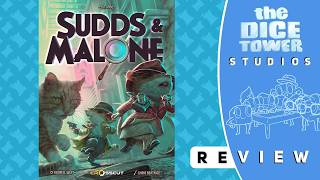

Sudds & Malone Deep Dive
What the Community Thinks About Sudds & Malone
Sudds & Malone has struck a chord with reviewers who appreciate medium-weight Euro-style games with personality. Reviewers consistently praise the game's mechanical elegance and its distinctive aesthetic. The Dice Tower team calls it "a really cool thing" with solid dice drafting mechanics, while Meeple University celebrates the cute theme paired with noir atmosphere as genuinely charming. Even reviewers who note mechanical quirks or thematic tensions recommend the game for players who enjoy strategic puzzles wrapped in a detective fantasy. The Discriminating Gamer praises the "interesting choices" within the game design, and Tantrum House highlights the unique blend of mechanisms that sets it apart from straightforward Euro games.
Core Mechanics That Define Sudds & Malone
Dice Drafting
At the heart of Sudds & Malone sits a clever dice drafting system. Each round, a shared pool of dice is rolled once, including black, white, gray, and individual player-colored dice. Players take turns selecting one die at a time, with a crucial constraint: each player can claim at most one die of each color per round, plus one die of their own color. This limitation forces real timing decisions. As one reviewer notes, "You might take your die early just to hold out, or you need that number and decide to take it now so you can plan around knowing that die won't be available later." This creates tension between optimizing your current options and preventing opponents from claiming the dice they need. The streamlined drafting pool keeps the mechanic tight and fast.
Action Selection and Engine Building
Each die you draft corresponds to one of six actions available on your player board, and here is where Sudds & Malone reveals its depth. Every action can be upgraded over the course of the game by spending in-game currency, making your character progressively more powerful. The Discriminating Gamer emphasizes this: "I really like the player board, how depending on the action you take can be improved during the game, and you're never going to be able to improve everything in one game." This forces meaningful strategic choices game to game about which skills to develop. The Dice Tower team celebrates this progression: "I am watching my game get better as I go. This game has that through and through, and that is great." The actions include investigating the city (collecting evidence), moving up the calendar track, removing flimflam obstacles, closing cases for points, and generating currency through various means. Players feel the satisfaction of becoming more efficient as their board evolves.
The Sudds & Malone Experience
Grimy Charm Wrapped in Cute Characters
Reviewers consistently describe an unusual aesthetic tension that somehow works. Players are anthropomorphic mice detectives solving crimes in 1938 New York, confronting cigarettes, alcohol, bullets, and murder. Yet the artwork renders the whole setting in a charmingly adorable way. Meeple University captures this perfectly: "It has the noir feeling just with this subtle cuteness underneath, which I quite like." Rather than clashing jarring against each other, the cute animal styling and dark detective theme create a whimsical noir atmosphere. The Discriminating Gamer notes that while the theme seems at odds with itself, it remains "fun and appropriate." This contradiction becomes the game's strongest thematic hook: tiny mouse detectives chasing down shadowy criminals feels inherently fun precisely because it stays committed to both tones.
Investigative Tension and Mystery
Though Sudds & Malone is not a heavy deduction game, it weaves mystery throughout the experience. Four of nine possible suspects (rats, moles, and frogs) are hidden at the start, and as you collect clues through investigation, you gradually narrow down who is guilty. Tantrum House explains the dynamic: "There is a push and pull between gathering more info and committing to your decision. Go too early and you might be wrong, and wait too long and someone else might beat you to getting more points." This timing tension extends beyond the mechanical puzzle. Every player is chasing the same hidden information but scoring based on how efficiently they deduce it. This keeps the game engaging even for players who would never enjoy a pure logic puzzle.
What Makes Sudds & Malone Stand Out
A Compelling Blend of Engine Building and Deduction
Reviewers note that Sudds & Malone does something uncommon: it pairs satisfying engine building with a deduction element, creating a game that appeals to both optimization-minded players and those seeking mystery and discovery. Tantrum House frames it precisely: "With the blend of the mechanisms, the dice drafting and the action selections feels familiar, but paired with that deduction gives the game something unique. You are not just optimizing actions, you are always thinking about how each move gets you closer to the solution or how to get those hunch cards for scoring points." Meeple University emphasizes the same idea: the engine building part pairs with something else, where you see clues and realize "oh that means that this is not the suspect." This layering prevents the game from feeling like a mere optimization puzzle or a light mystery; it becomes both simultaneously.
Elegant Production and Thematic Art
Reviewers praise the game's physical presentation. The deluxe component kit offers silk-screened wooden resources including whiskey glasses, rotary phones, and notepads that reinforce the 1940s setting. Even without the upgrade kit, the cardboard tokens punch nicely and feel substantial. The art by Chris Beatrice delivers consistent, charming character work across the player boards and cards. The Discriminating Gamer says simply: "I absolutely love this artwork," and notes that it "brings the theme of the whole detective, and everything else just really together." The game board is well-organized and clearly laid out, making the various action spaces and calendar track easy to navigate even on first play.
Potential Drawbacks
Fourth Player Brings Repetition and Downtime
The Dice Tower raises a significant concern for larger groups. With four players, the game overstays its welcome. Z Garcia notes: "I think it's a two to three player game only. There is a lot of downtime between your turns if you push into four." With four players, each taking up to six possible actions per round, players can experience lengthy turns to track and respond to. Reviewers recommend saving this game for two or three player sessions where the pace remains brisk and engaging.
Thematic Mismatch and Catch-Up Mechanics
A secondary criticism centers on the flimflam card and cat attack system. While mechanically functional, some reviewers find the catch-up mechanic undermines the theme and creates perverse incentives. The Dice Tower's Tom Vassel explains: "Some of the flam cards have attacks from a cat. And I don't know that the attack from the cat needed to be another incentive because it incentivizes you to not always do your best. If you see two flimflams out there and I could go up that many points, you might think 'No, I am going to wait because I am not going to take care of the flimflam cards.' It puts you in the situation where you are min-maxing. I am not going to do my best yet." While thematically fun (tiny mice intimidated by a cat), mechanically it can lead to games where players hold back to avoid punishment rather than simply playing optimally.
If You Enjoy Sudds & Malone
Players who love Sudds & Malone should explore related titles that blend dice drafting with strategic choice. Sagrada offers streamlined dice drafting in a lighter package. Those seeking more complexity might try Coimbra, which demands deeper strategic planning around dice placement. White Castle sits between these two in weight, offering more tension than Sagrada but faster play than Coimbra. Detective City of Angels shares the mystery-solving theme with similar mechanics of moving around a city and investigating. For pure dice drafting with tight action selection, Deadline offers a narrative deduction experience from the same publisher. Clue fans will appreciate that Sudds & Malone scratches a similar deduction itch but through Euro-style mechanisms rather than pure logic.
What Reviewers Are Saying
"It's a game that I'll tell you is kind of unusual. It's one of those games that I don't know that I have a lot of games like this in my collection. I don't have a lot of kind of mystery games that do what this does. I mean at its heart, trying to figure out what those cards are just to score off of, the closest thing I can think of is Clue, but even that's very different. But it's just kind of fun and every game you play is a little bit different."
— The Discriminating Gamer
"The actions are interesting. It's a rule set that is not exactly challenging, but it's not It's a non-traditional game in a lot of ways. It does some things quite uniquely and so that means there's a bit of a learning curve for a game that's not terribly difficult, but it's worth it. I think it's worth that learning curve because the payoff is quite good."
— Dice Tower
"Timing does matter. Go too early and you might be wrong, and wait too long and someone else might beat you to getting more points. So there's this push and pull between gathering more info and committing to your decision."
— Tantrum House