


Get Over Deep Dive
What the Community Thinks About Get Over
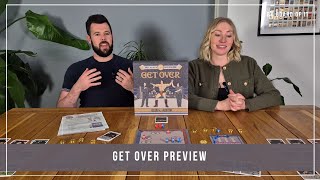
Board game reviewers are enthusiastic about Get Over, a 2024 two-player card game that reinvents how deck building works in competitive play. The consensus is clear: this is a fresh, thematically satisfying take on the deck-building battle format. Reviewers from Maple University, Board Of It, and mland University all praise the design's core innovation: instead of building massive hands to play all at once like traditional deck builders, Get Over creates a back-and-forth rhythm where players draw just six cards per round and trade attacks and defenses card-by-card, turn-by-turn. The wrestling theme runs deep throughout the experience, reinforcing the push-pull of combat through both mechanics and presentation. While the game is still in prototype form, reviewers see genuine potential in its design despite some minor fiddliness and pacing concerns they'd like to see addressed before the final release.
Core Mechanics That Define Get Over
Deck Building
Deck building in Get Over follows the familiar pattern of starting with a weak starter deck and gradually acquiring stronger cards through a market system. However, the moment-to-moment gameplay diverges from standard deck builders like Dominion or Hero Realms. Players draw six cards per round and immediately engage in direct conflict, playing cards from their hand rather than assembling complete turns before opponents respond. This creates a constant tempo push, where you might play an attack card, your opponent blocks or dodges it, you potentially chain a follow-up attack with special bonuses, and your opponent responds again. Between these combat rounds, players enter a worker placement phase where they spend momentum currency (earned through attacks and defenses) to buy better cards, increase their deck level, thin weak cards, or improve their blocking strength. The asymmetry of deck development matters, too: only one player can access the card market each round, creating tension around worker placement decisions and forcing players to strategically time their purchases.
Worker Placement
The worker placement system in Get Over operates at a human scale compared to games with sprawling action spaces. Players start with just two workers and must spend two workers to gain a third, making early-game placement decisions brutal. The available spaces let players specialize into different card types, improve block strength, level up their deck to unlock higher-power cards, purchase new cards, or grab first-player advantage. What makes this simple system sing is scarcity: only one player can use most spaces per round, forcing constant decisions about priority. Reviewers note that this creates a satisfying tension, where taking the card market this round means your opponent controls specialization, or vice versa. The worker placement doesn't overshadow the card play; instead, it elegantly creates the rhythm of deck development between combat rounds.
The Get Over Experience
Tension and Anticipation
Get Over creates a roller coaster of decision-making and momentum swings. Each card you buy is an investment in future rounds, but the back-and-forth play means you're never certain when you'll actually use them. Reviewers describe a constant mental calculus: playing a strong card now risks the opponent blocking, dodging, or reversing it. Holding back the best card might pay off if they spend their defenses on a weaker play instead. Taking the damage and saving a block for something worse coming later is another live option. The reversal mechanic intensifies this psychology. Players can flip attacks back on each other, and chains of reversals can build, creating explosive moments where momentum shifts violently. This uncertainty keeps both players engaged and guessing, even when one appears to have a health advantage. The submission token path adds another layer: you're not just racing to deal 75 damage; you can also pursue a grinding strategy to force submission through follow-up card effects.
Fast, Brutal Momentum Swings
The pace accelerates as the game progresses and decks improve. Reviewers note that games can feel swift once both players start acquiring powerful cards, sometimes compressed to 25 minutes or less. This creates a ticking clock feeling: you need your deck to be ready now, not later. Each round of the match flows rapidly because both players have only three chances to attack and three to defend, then the phase ends. The worker placement rounds add minimal downtime since they're quick positioning decisions. The overall effect is a game that never lets up, always asking players to make impactful choices in service of a concrete goal: reduce the opponent's health or force a submission before your own deck overwhelms theirs.
What Makes Get Over Stand Out
Card-by-Card Combat Instead of Turn Sequences
The revolutionary aspect of Get Over is how it divorces deck building from the traditional "big combo" structure. In Dominion or Star Realms, you buy cards and play them together as a cohesive turn. Get Over forces you to react in real time. You play an attack, your opponent immediately chooses block, dodge, or nothing. If they block, you might chain a follow-up attack that only works if the first landed. This creates a tactical, almost fighting-game rhythm where hand management meets bluffing. Do you reveal your strong cards early or bait defenses with weak ones? Reviewers consistently highlight this as the game's defining innovation: the back-and-forth flow feels like an actual wrestling match in the ring, with momentum swinging between contestants.
Thematic Integration of Mechanics and Presentation
The wrestling theme permeates every system. Players gain momentum (crowd approval) that fuels their deck purchases. The submission token mechanic mirrors real wrestling psychology: you're not just damaging your opponent's body but breaking their spirit through repetition and attrition. The prototype includes a thematic ring and audience card holder that reinforce the in-ring atmosphere. Reviewers note that even the retro-inspired art style strengthens the vibe, evoking classic wrestling graphics and video game aesthetics. The card names like dropkicks, pile drivers, and neck breakers make the theme concrete without requiring extensive board real estate or fiddly components. This harmony between theme and mechanism is rare enough to be worth celebrating.
Potential Drawbacks
Prototype Fiddliness and Tracking Requirements
Board Of It flagged a practical concern: deck tracking can become tedious. You must verify you have the correct number of defense cards (capped by a rule), count cards in your deck to determine if you'll trigger a health penalty, and reshuffle frequently since the discard often rejoins the deck before you've cycled through everything. Reviewers found themselves stopping mid-turn to inventory their deck. The numbered board spaces referenced in the prototype appear to be missing in current copies, another small friction point. While these are polish issues rather than design problems, they emerged consistently enough that the final release should address them through clearer component design or board notation.
Game Length and Endgame Compression
Reviewers who played noted that games can end abruptly once decks mature and health dwindles. Starting at 75 health with increasingly powerful cards means some final rounds can deal 10+ damage in a single turn. This can make purchasing late-game cards feel wasteful if you never get to use them. One reviewer noted that players might ask whether to bother buying cards once the opponent's deck looks established. A modest health increase (10-15 extra points, bringing the total to 85-90) could extend endgames enough to let deck interactions blossom. Additionally, some spaces on the worker placement board (like deck refinement through card trashing) become less viable when health penalties force you to keep a minimum deck size, leaving certain strategies unexplored.
If You Enjoy Get Over
Players drawn to Get Over's back-and-forth card play and reactive decision space should explore Hero Realms and Star Realms, which share the combat-focused deck building roots but resolve via simultaneous hand-building rather than sequential play. For the worker placement + deck building blend, Dominion remains the gold standard, though Get Over's combat focus distinguishes it sharply. Those who love the wrestling theme and bluffing psychology might also appreciate games with heavy deception and momentum shifts, like trick-taking games that demand reading opponents. The fast, two-player-only design also appeals to competitive couples seeking engaging 25-minute experiences with meaningful decisions each turn.
What Reviewers Are Saying
"Get Over offers a new twist on the two-player deck building battle. The battle taking place card by card, back and forth, rather than the traditional deck building sequence of trying to combo big and powerful hands all at once. There is tension and anticipation as you build your deck and try to thin out the weak cards to ensure you're ready to attack, block, or kick out when you need to."
— Stella and Taran, Maple University
"I think the art style is actually kind of style retro style. It reminds me of a video game in a way. So, I think that's a really nice touch if it's going to be kind of similar and the same, and just like the whole aesthetic really is tying in with the theme really well."
— Tally and Farrell, Board Of It
"It's an interesting different spin on deck building here, it's kind of a battle deck building game you're trying to reduce the opponent's health by getting cards that attack them and there are games like that out there, Hero Realms, Star Realms, very big in that way but this does it in quite a different way in that you are building a deck but then you draw your six cards and you play back and forward from your hands."
— Stella and Taran, mland University