/pic6004321.jpg)
The girl reached into the wood ash and grabbed a palmful, and as she blew it from her palm, the ashes swirled and churned as they moved skyward, lighting up the once dark skies.
The Girl who Made the Stars is a worker placement/tile-laying puzzle game for 1-4 players based on a San African myth about the creation of the milky way and the stars.
In the time of the first people, the night sky was dark and featureless. The village elders prohibited venturing out into the dark starless night for fear of the dangers that lurked there. One night after her mother cooked dinner, a young girl, frustrated with these restrictions, took a bit of ash and roots and cast the red and white embers into the sky, forming the milky way and the other stars, in an attempt to illuminate the night so the villagers could safely collect resources necessary for their survival.
As a village elder, gaze upon the new stars in the night sky and discern the forms of constellations to provide wisdom and illumination to the village. Draw constellations into the earth, with your depictions gaining light, stars, and stardust for the village. Then, as villagers guided by this newfound light, venture into the surrounding darkness to collect much needed resources, including fruit, fish, and small and large game. The resources you collect for the village will boost your reputation, and the player with the highest reputation at the end of the game is the winner.
—description from the publisher


Images


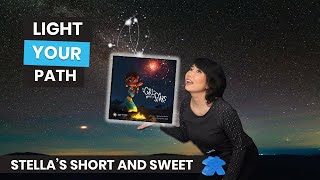
- Beautiful starry theme and storytelling
- Flexible player count (1-4)
- Simultaneous actions with player interaction
- Prototype components; rules not final
- creation of stars, exploration, guiding home
- star constellations, night sky, Milky Way
- mythic storytelling through star pathways
Mechanics (from transcript analysis)
- End condition — Game ends after eight rounds; highest score wins
- Foraging — Players collect items that can score points or be used in offerings
- meeple and light piece cost/placement — Pay light pieces to take items or make offerings with meeples
- order fulfillment bonuses — Fulfilling and offering cards can yield bonus points; some cards cannot be filled once used
- path creation and scoring — Players lay paths to score points and enable foraging opportunities
- resting — Rest/withdraw any or all meeples from the board
- stardust — Take stardust tokens to help close constellations on your board
- stargazing — Place a meeple on a night-sky track to gain extra bonus tokens
- tile drafting — At round start, three star tiles are drawn; players draft one to place on their boards
- Tile Placement — Drafted tiles are placed to enclose paths on players' boards for points
Video topics + discussion points
Quotes (from this video)
- this is a beautiful story about the creation of the stars
- make a wish well you do need to watch out your opponents
- and the milky way and in the game you are really creating these star pathways
- the components featured in this video are prototypes so rules and network are not final
- you'll probably like the girl who made the stars
References (from this video)

- Sky/constellation theme with mythic setting
- Visually appealing prototype components (sky plate)
- Simultaneous action in early rounds enhances pacing
- Closing constellations yields points and light bonuses
- Prototype nature; some components/rules may change
- Tile placement can feel restrictive at times (cannot have a path to nowhere)
- stars, sky, creation myths from cultures
- San African legend of how the stars were created
- mythic legend storytelling
- Endless Winter
Mechanics (from transcript analysis)
- constellation enclosure — close off lines to gain light and eventually score
- foraging for items — actions allow foraging for items to gain light or points
- night sky/bonus track — adding light pieces to the sky track for bonuses
- Simultaneous Actions — each round you take two actions
- stardust tokens — gain stardust when a constellation is enclosed or lines closed
- tile drafting — draw three tiles and place them on your board
- Two actions per turn — each round you take two actions
Video topics + discussion points
Quotes (from this video)
- the legend that we're looking at here is the san african legend of how the stars were created
- we're going to draw three tiles right away
- we're going to be forming constellations
- when we close off every line that's coming out of one of these colored tiles we gain light of that color
- when we completely close off a constellation that will score the bonus that it's next to as well as some points
- the two companion games have been kick-started together
- it's part of the pillars of creation series
- Salani is another star placement game
- it's more of an abstract than this one
References (from this video)

- puzzle-driven design with a clear thematic focus on night skies and constellations
- distinct non-competitive spaces that reduce direct conflict
- engaging for live stream play with audience participation
- core loop of drafting, pattern-building, and scoring via constellations
- puzzle-centric design may not suit all players
- the optimization can be deceptive and require careful timing to maximize points
- live stream lag can affect pacing and viewer experience
- light management, star motifs, constellation scoring
- night sky / foraging theme built around stars and constellations
- puzzle-driven spatial pattern building with resource management
- Honey Buzz
- Solani
Mechanics (from transcript analysis)
- Constellations scoring — complete constellations of tiles to score points based on their size and configuration
- offering tiles for points — offer tiles at tiles to gain points and unlock further benefits
- Stardust as a wildcard resource — Stardust can substitute for tiles and enable additional placement options
- tile drafting — draw five tiles from bags and draft them to form patterns on the board
- Tile Placement — place tiles to build lit paths; close a tile to earn light and collect Stardust
- tile placement to light paths — place tiles to build lit paths; close a tile to earn light and collect Stardust
- Worker Placement — a phase where players take actions on the board, including lighting paths and scoring
- worker placement phase — a phase where players take actions on the board, including lighting paths and scoring
Video topics + discussion points
Quotes (from this video)
- the game is played over five rounds
- Stardust which can substitute for these tiles
- this is a special puzzle
- Antelope because that's the highest value thing that we can go foraging in this game
- Antelope password
References (from this video)
Mechanics (from transcript analysis)
Video topics + discussion points
Quotes (from this video)
- oh hello it's Stella and tarant here
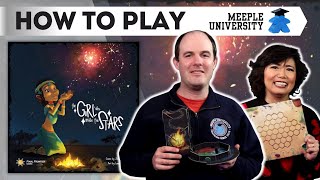
- from Maple University today we'll be teaching you how to play the girl who made the Stars game
- and that's how to play the girl who made the Stars we hope you enjoyed this video
- I think thank you so much for watching everything you do will help us every single few every time you like our video our Instagram every single comment and let us know that you're there and make sure you're doing something fun today see you next time
References (from this video)
- Thematic integration with San African myth.
- Engine building aspect through wood ash tokens.
- Engaging tile placement and loop completion.
- creation of the constellations and the Milky Way
- San African myth
Mechanics (from transcript analysis)
- Drafting — Players draft wood ash tokens from a tower, which provide light and special abilities.
- Engine Building — Wood ash tiles provide ongoing bonuses and special abilities that players build up across the game.
- Resource Management — Players manage different colors of light and wood ash tokens to perform actions and score points.
- Set Collection — Players collect resources and offer them up for points, aiming for variety and specific combinations.
- Tile Placement — Players draw and place star tiles on their player boards, connecting paths to form loops and complete star clusters.
- Worker Placement — Players take turns placing workers on action spaces to resolve actions such as Paths of light, gather resources, offering, gazing, and constellation actions.
Video topics + discussion points
Quotes (from this video)
- oh hello it's Stella and tarant here
- from Maple University today we'll be teaching you how to play the girl who made the Stars game
- and that's how to play the girl who made the Stars we hope you enjoyed this video
- I think thank you so much for watching everything you do will help us every single few every time you like our video our Instagram every single comment and let us know that you're there and make sure you're doing something fun today see you next time